

One of the best things about being an adult is that you can generally just do all the fun things that you always wanted to do as a kid, but didn't have the money / autonomy to do without parental organization. Every year, my friend group will get together, rent out a massive place for ~30 folks out in nature, and live out the summer camp experience we always wanted as kids. We call it Camp Etc. Smores, karaoke, kayaking, crafts. And, of course, a whole host of goofy camp games.
Now, those of you who know me personally know that I love making and thinking about games. I got my start in programming by tinkering with UE3/UDK. And now as an adult, I spend more than a reasonable amount of time thinking about fun and engaging ways to get a bunch of people running around doing goofy shit.
Two years ago, we did a twenty person game of water-gun capture-the-flag. Last year, we bought a bunch of high quality dodgeballs to chuck mercilessly at each other's heads.
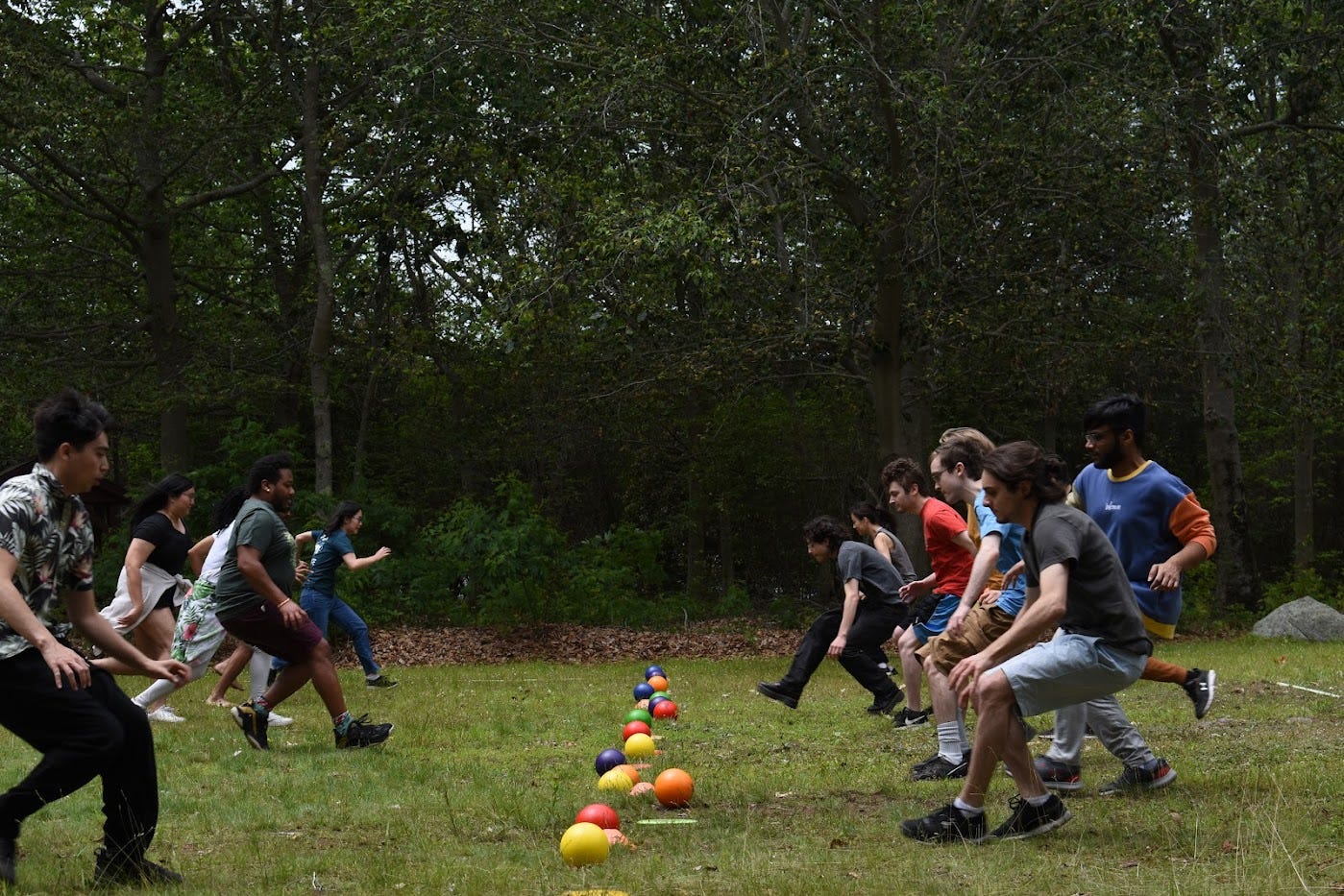
This year, we invented two new games. The first — and the subject of this post — is called Super Monday Evening Laurel League, aka SMELL,1 aka Laurel League. Laurel League is a game that plays out like an in-real-life MOBA. Imagine League of Legends, but outdoors and with your friends.2
Detailed Rules for Super Monday Evening Laurel League
REQUIREMENTS
Pool noodles colored three distinct colors, at least one per player but ideally more. We played with 18 noodles for 10 players. We used red/blue/yellow pool noodles, 6 of each, 3 of each per team.
6+ dodgeballs.
Two objects for flags.3
Played on a large field, ideally with some natural obstacles like trees, brush, sheds, houses, etc that create paths / trails / lanes.
Optional: cones or other markers to carve out the "respawn" area.
SETUP
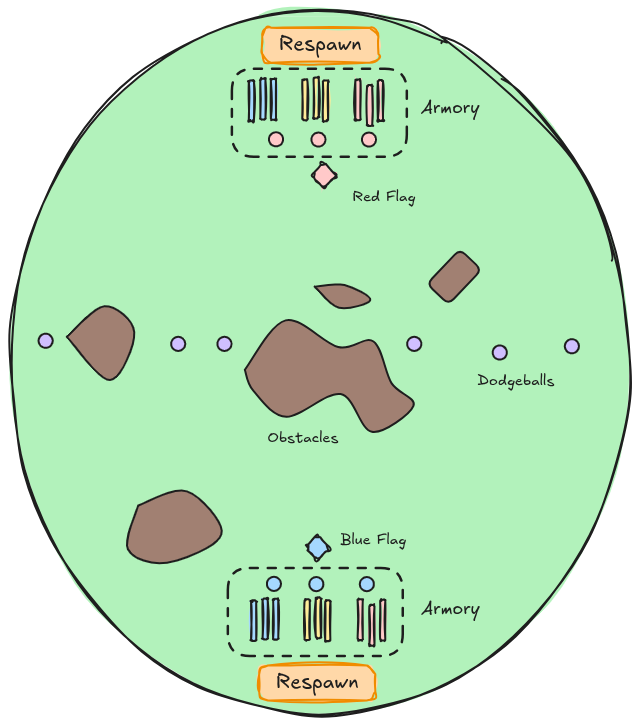
Place each flag on opposite ends of the play area. Everyone should know where the flags are. Place equal numbers of pool noodles of each color and 3 dodgeballs behind each flag (the "armory"). Place the rest of the dodgeballs in a line roughly delineating the middle of the play area, equidistant from the armories on either side. If you are using cones, mark out an area behind each armory as the respawn area.
Split into two teams and assign each team to a side. Players start in their respective armories. Someone calls out the start of the game with a countdown, after which players are free to move around wherever.
GAMEPLAY
Laurel League is a variant of capture the flag and dodgeball. The goal of the game is to grab the opposing team's flag and bring it back to your armory.
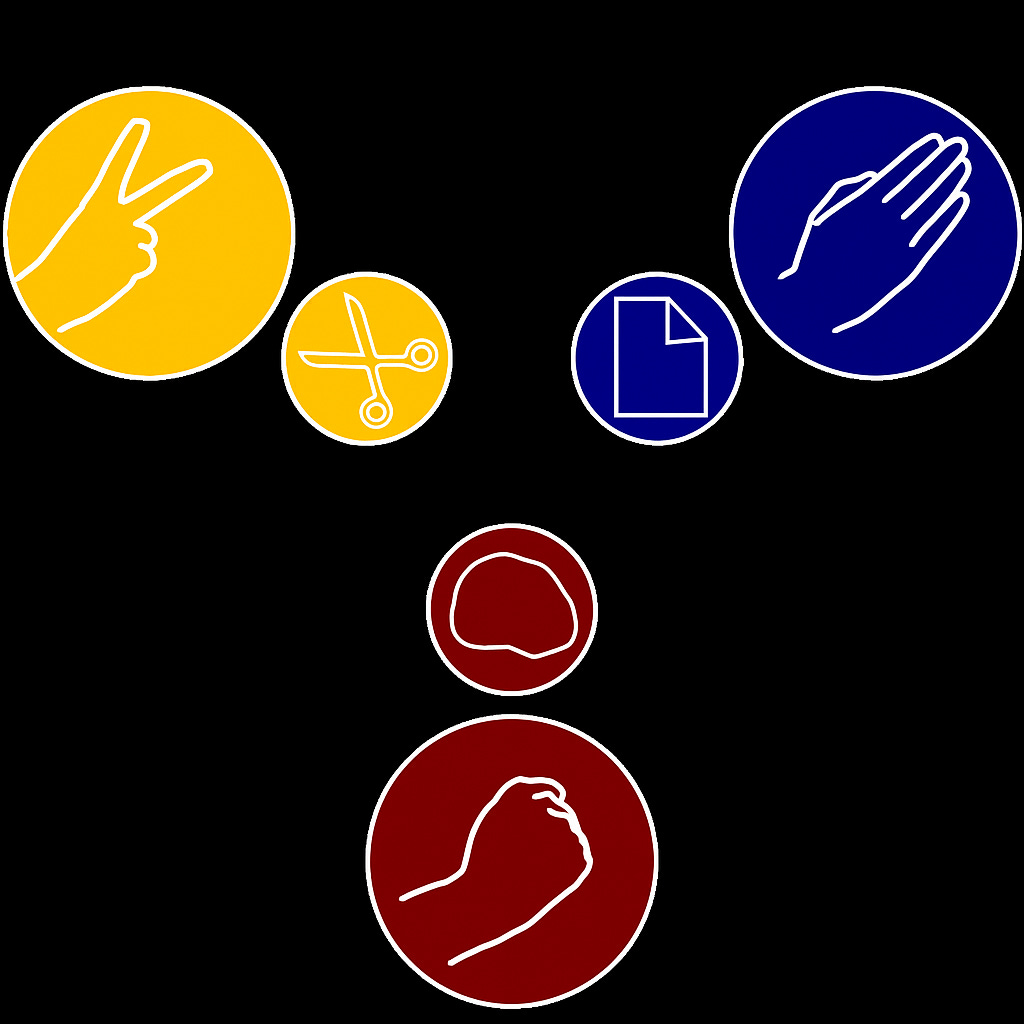
Players can tag other players by hitting them with a pool noodle. The color of the pool noodle determines who you are allowed to tag.
People who are holding blue noodles can only tag those holding red noodles.
People who are holding red noodles can only tag those holding yellow noodles.
People who are holding yellow noodles can only tag those holding blue noodles.
Additionally, players can tag other players by hitting them with a thrown dodgeball, regardless of what color pool noodle they or their opponents may be holding.
Players may carry only one pool noodle at a time. Players can swap their noodle colors at their main base, or hand off pool noodles to a teammate. If you are not holding a pool noodle, or if you are holding the opposing team's flag, you may be tagged by a noodle of any color. And if you catch a thrown dodgeball, the person who threw the dodgeball is tagged instead.
Tagged players must go back to their respawn area and wait for 30 seconds before they can re-enter play.
You should expect a single round to go for approximately 10 minutes, though obviously this varies based on the number of players and the size of the play field.
Motivation
When designing this game, I didn't intend to create a moba-like experience. Rather, a bunch of folks at camp wanted to play capture the flag, and I was mostly motivated by my dislike of traditional ctf rules.
The problem is the tagging mechanic. The game needs some way to clearly define whether someone is tagged. By default, this is done by splitting the game field in half, and only allowing people on a given team to be tagged in the opposing team's territory. In order to make tagging punishing enough to actually move the game forward, the player who gets tagged has to go to a "jail" where they must wait until someone else on their team is able to free them.
I hate this setup.
The default ctf rules strongly disincentivize actually playing the game. If you run into the opposing territory early on, you inevitably are tagged, at which point you spend the entire rest of the game waiting for a jail break that almost never comes. In large part, that's because going for a jail break is often just as risky as simply going for the flag and ending the game. These rules favor a hardened defense, which in turn means that every game is a slog and any victory comes on the back of a single "hero" play — someone who is simply faster and more athletic than everyone else stealing the flag despite massive odds.
I've been thinking about how to change the mechanics for ctf for a long time. The water-gun ctf game from two years ago was motivated by a similar thought process. In that game, we got rid of territory and introduced the respawn mechanic. Every player had a water gun that they could use to tag other players. You could be tagged anywhere, and getting tagged wasn't game ending because you were guaranteed to be back in play within thirty seconds. It was a significantly more dynamic game. Everyone was more incentivized to make big plays, and positioning and coordination actually mattered a lot more because you could get cornered or flanked or ambushed at any moment. The big issue with that iteration of the game was that it was near impossible to tell if you actually got hit with water, and a lot of time was spent adjudicating whether a tag was actually a tag between two people who claimed they got the other.
I wanted to keep the same level of dynamic play while avoiding the tagging conflicts. The rock-paper-scissor pool noodles neatly solved the issue — a pool noodle hit is pretty unambiguous, and the different classes guarantee that there is only ever one tagger and one target per interaction without having to rely on arbitrary territory boundaries. Once we had that core gameplay rule, everything else fell into place. It was natural to want to switch out noodle colors so you weren't in a cat and mouse with the same people throughout the game, and figuring out what "loadout" to play added a level of team wide strategy. The best player in the game would lose to the worst player in the game if they had the wrong colored noodle. As for the dodgeballs, well, we just had those lying around, and they served to make the game even more aggressive by allowing people to break through stalemates.
The result was something that played almost explicitly like a MOBA — without the minion-farming and leveling, of course. The game strategy relied on getting one or two members of the opposing team out before team-wiping or near-team-wiping the rest and going for the flag. Players would look for 2v1 ambushes to try and generate opportunities (i.e. ganks). You had a 'shop', where players who died or who went back to their base could change their weapons and come back to the battlefield better armed. There were even 'lanes' due to the structure of our play field.
Variants and Misc Considerations
We quickly discovered that dodgeballs were quite powerful, which resulted in one or two players on each team discarding pool noodles entirely and sprinting to pick up dodgeballs at the start of the match. This was something of an emergent "additional class" delineation. It could easily be formalized. We considered reducing the number of dodgeballs in play to make dodgeballs (and this 'additional class') weaker; in general I think we didn't fully balance how dodgeballs interact with the rest of the game.
We discovered early on that getting tagged is pretty punishing. Even though the respawn timer is only 30 seconds, the game can swing a lot in that timeframe. To avoid full team-wipes, both teams started keeping at least one or two players back near their flags to play defense. The goal of these defenders was not to stop an attack, but rather to delay long enough for their fellow teammates to respawn. This in turn forced much more aggressive attacks, which led to more tags and more swinginess. We played with the 'respawn time' a lot between rounds. Thirty seconds was where we landed for our relatively small playfield and 10 players, but I think you could easily increase this for larger fields and more players, and decrease in the other direction.
You could really lean into the MOBA aspect of the game. One way to do this is by codifying roles more explicitly — for example, you could imagine a "support" role that cannot attack or be attacked but can ferry different colored weapons from base or collect dodgeballs. Another way to make the game more MOBA-like is by layering multiple targets that need to be captured in sequence, akin to towers. And you could add increasing respawn times if you are tagged more than once. I suspect trying to add minions, farming, leveling, or unique items is difficult and too complicated to track in person, but I'd be curious if anyone goes in this direction and manages to make it work.
I think the play area is really important. Or, more specifically, I think strategy is really important to making these games fun, and the play area really impacts strategy. You want to have your players constantly thinking about where and how to focus their energy. That requires trade-offs, and a big flat play area simply doesn't have meaningful trade offs. Choke points, trails, back entrances — these are things that allow players to feel clever. Play area size is also critical. Larger fields will result in less action and more sneaking around for 1:1 encounters, while tighter areas will lead to more conflict involving more people. We purposely aimed for the latter.
If you like this sort of thing, I recommend checking out my post about The Great Bagel Chase from a few months prior.
The Great Bagel Chase

In October of last year, I organized a Capture the Flag game that took place across Queens, Brooklyn, Manhattan, Jersey City, Hoboken, and Weehawken. This was the first ever Great Bagel Chase. On Sunday we did it again, this time just over Manhattan. It was really fun! I wanted to take a minute in between the usual AI / Civ6 posting to write out what th…
We’re getting close to October so we’re gearing up for this year’s iteration of GBC too. Stay tuned!
Part of living out childhood dreams includes stupid humor
I'm aware that many in the League community may have trouble imagining both of these things.
We used a bundle of pool noodles zip-tied together, but you could really use anything here.
This sounds like a really good game.
How much were speed and athleticism a factor? I take your point that more complex terrain increases the value of strategy, but it also increases the chance of injury. I am tempted to organize a game in my neighborhood. The two locations are diametrically opposite types of terrain: flat open grass field or a hilly semi-dense wood.