

Note that this article was heavily self censored. The original draft called out several people in the tech industry by name, and linked to tweets and essays to back up the overarching criticism. The final draft does not. Chilling effects are real, but it's difficult to call attention to them. This is my weak attempt to point out the impacts of censorship without incurring more risk.
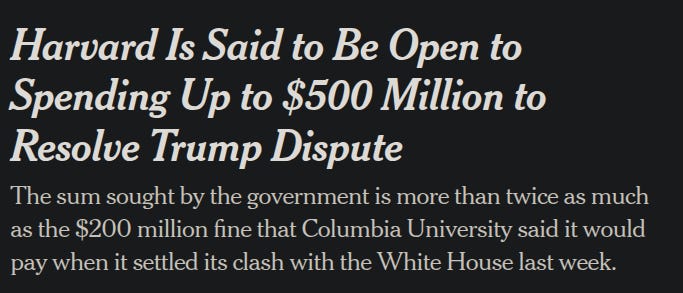
About two months ago, the Trump administration decided to cut billions of dollars in university funding. This broadside was part of a larger war against the higher education system, a war that thus far includes attempts at enforcing government sponsored ideological curriculum and increased police and ICE "enforcement" against university students. For some reason, many of Silicon Valley's most committed libertarians are very excited about this. This is odd to me. I would think that the government using its awesome power to tear down otherwise free institutions would be met with horror and disgust, just on principle alone.
After a lot of heated conversations with some of my more entrepreneurial minded friends, and after reading quite a few bizarre tweets, texts, and blog posts from the MAGA wing of Silicon Valley, I've come to the realization that many in the Valley seem to fundamentally misunderstand the US university system. Mostly, this is because we are all hyper focused on an extremely small part of it. Everyone spends the vast majority of time talking about undergrad admissions, and the vast majority of that time is in turn spent talking about approximately 10 schools with a total undergraduate population of less than 75k students. There are ~20M undergrads, so we're talking about .3% of the total undergrad population, only .2% of the total US population aged 18-24, and .02% of the total US population.
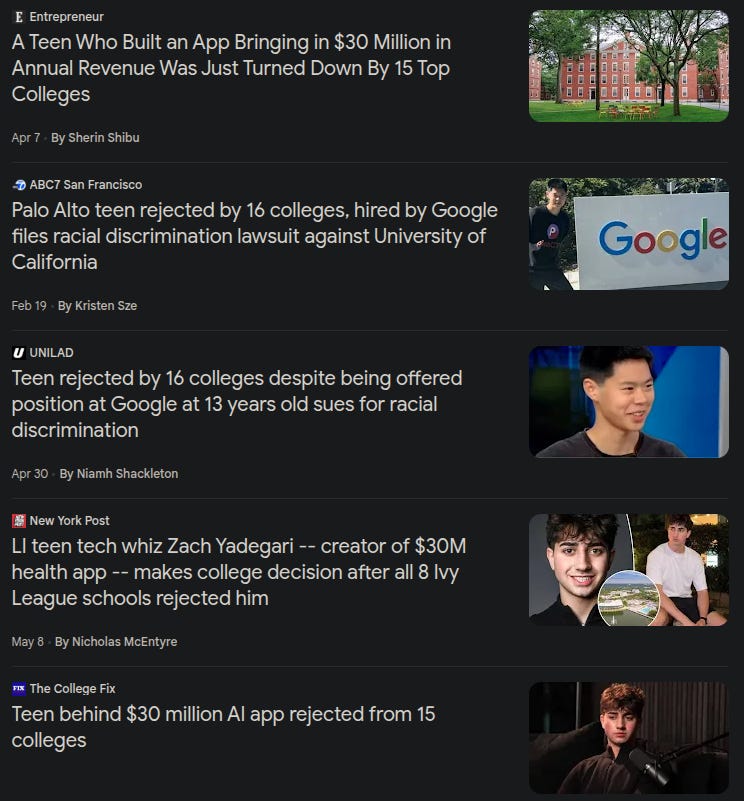
Any conversation about our university system is fundamentally warped by these numbers. Bluntly: the vast vast majority of people have no idea what they are talking about. The extent of their knowledge of university campuses comes from exaggerated and selected news stories that highlight the most egregious and ridiculous aspects of university life, down selected to a very particular set of schools. No one cares if, like, the dean of Deep Springs College is secretly a lizard or something. That's because Deep Springs College is a college that's so small you aren't sure if I just made it up for the purpose of this example. By contrast, everyone loves when some random alum from Harvard does something mildly embarrassing. It becomes international news, just because of the schadenfreude. Probably this is because the college admissions process leaves deep psychological trauma, but that's an article for a different time.
I mention all of this because I think the way we talk about university and university funding in the national discourse is just totally wrong. It's informed by bias and bullshit, spin from people who have an axe to grind and dollar signs in their eyes. Unless you actually went to or worked at a top 20 university in the last, say, ten years, your perspective is likely warped by an extremely hostile popular culture. Unfortunately, that animus is now driving some ridiculous foot-gun government policy, all with the intent of bringing the university system to its knees or destroying it entirely.
In my opinion, that's a tragedy.
So in this article, I want to take the rather unpopular position that it's a very good thing that our university system is funded by tax dollars. The dissolution of America's universities would be bad for education and American soft power, obviously. But it would be devastating for our private tech and research industries — including for many of the VCs and entrepreneurs who are currently cheering the destruction.
Public funding → University Research → Industry
Before diving into empirics, I want to present a not-quite-correct history of innovation in this country. Our story starts in the midst of WWII. WWII was a total war — the entirety of US infrastructure, top to bottom, was mobilized to support the war effort. Workers were drafted to be soldiers. Car factories switched to making tanks. And researchers and scientists turned their attention from the mysteries of the universe to things like "how can I prevent disease on the front?" and "how can I intercept and decode enemy messages?" and "how can I ensure food is preserved until it reaches soldiers?" and, of course, "how can I make big boom?"
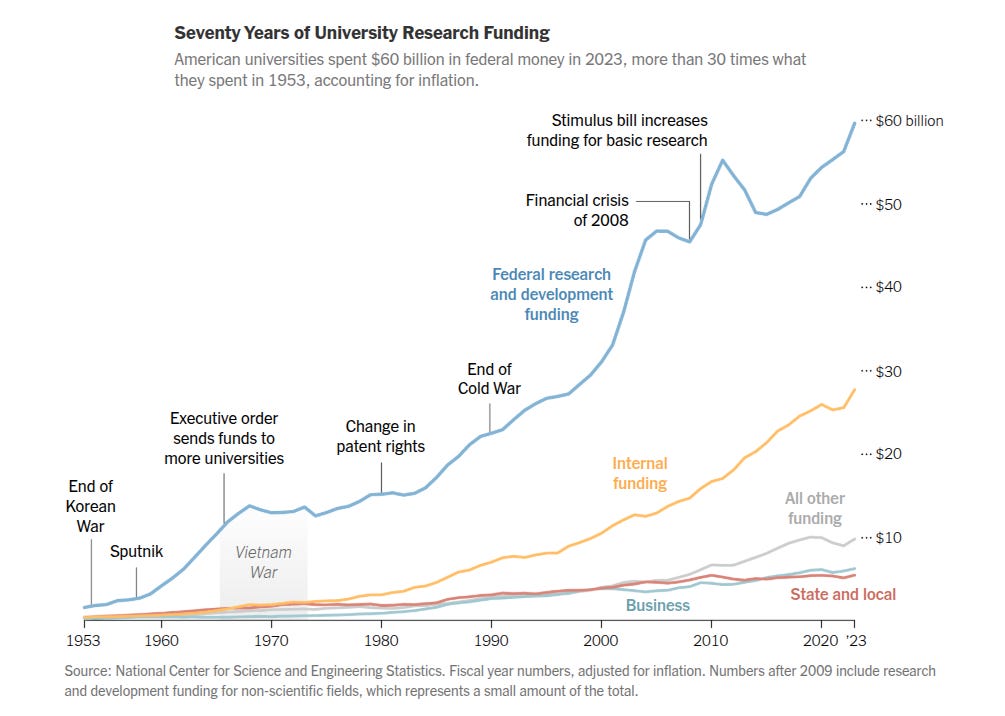
If you saw Oppenheimer in theaters two years ago, you have an idea of what this looked like — US tax dollars being funneled to the top minds in physics, chemistry, and materials science, to universities all around the country. Fermi and Szilard and Teller from UChicago. Feynman and von Neumann and Einstein from Princeton. Seaborg and Lawrence and, of course, Oppenheimer himself from Cal Berkeley. With federal funding, these researchers saved lives and helped end the war with an Allied victory. The US Government saw the obvious benefit to publicly funding university researchers. Before WWII, almost all university funding came from private donors and foundations set up by folks like Carnegie or Rockefeller. After WWII, the government was the single largest source of funding for all university research in the country. And by the mid-60s, the federal government was responsible for ~75% of all university R&D work through billions of dollars of grants.
That funding was paying dividends — not in the public sector, but rather in the private sector.
When the war ended, those researchers didn't just go away. Many of those scientists went on to work at private labs or spin off their work into industry. The most famous example is Bell Labs, which built an extremely strong pipeline for hiring government-funded PhD students. One such scientist was William Shockley. Shockley was a researcher at MIT; joined Bell Labs; was drafted to work on radar technology during WWII1; re-joined Bell Labs with many of his military colleagues; and then created the transistor based on government-funded semi-conductor research over the previous fifteen years. Shockley moved to Mountain View, California to start the Shockley Semiconductor Lab, where he continued to hire other government funded PhDs. And then those guys left Shockley to start Fairchild Semiconductor, which in turn gave birth to companies like Intel and AMD, as well as the concept of Silicon Valley. And all of those companies continued hiring government-funded PhDs, using their research to continue to grow.

Public funding → University Research → Industry.
This is the engine of American dominance. The US government decides to fund research in a certain area and provides billions of dollars of grants to universities. University labs use that money to incubate new ideas, training thousands of researchers in the process. Those researchers either spin off their own companies or go on to private industry with their work. And that research — which would otherwise be consigned to some journal in academia — hits the free market where it can be scaled up, productionized, and made cheap.
Almost every major innovation of the last 100 years has been influenced by this incredible pipeline. Here are a few other examples.
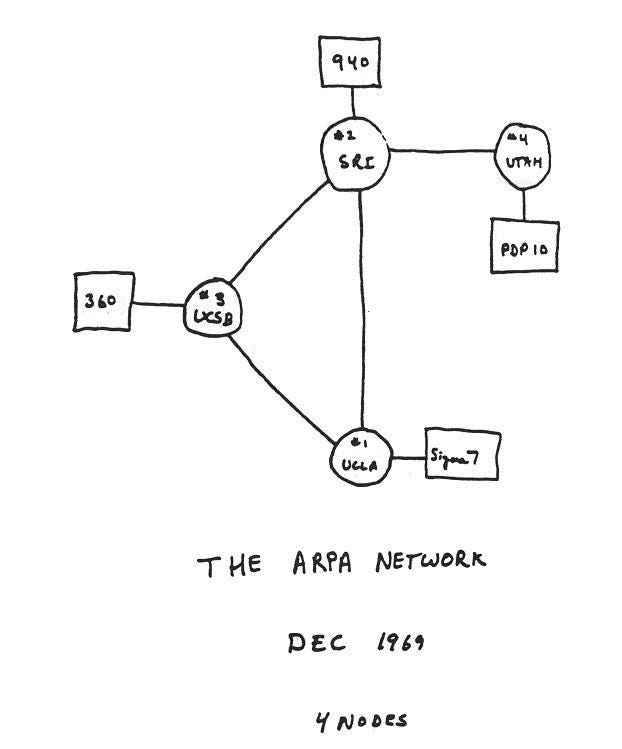
The government wants to create a system of interconnected computers. It pays out grants to UCLA, Stanford, UC Santa Barbara, and University of Utah to build the initial nodes. Vint Cerf (UCLA) invents TCP/IP, then takes his work to MCI where he creates the first commercial email system, and later joins Google. Bob Metcalfe (MIT) invents ethernet and uses his research to start 3Com to commercialize switchers, routers, and WAPs. Leonard Kleinrock (UCLA) applies queuing theory to message switching, and then founds Nomadix to manufacture public internet access devices. Approximately a trillion companies and engineers come out of Doug Englebart's lab at Stanford, which created hypertext, program windows, the modern file system, and the mouse.
The government wants to fund the development of drugs that can tackle difficult-to-cure diseases. They pay out millions to universities and medical schools around the country. Carl June from UPenn invents CAR-T Cell Therapy; the research is bought by Novartis and becomes the drug Kymriah, which is used to cure types of children's leukemia and lymphoma. Katalin Kariko, also UPenn, takes the funding and develops a technique to reduce immunogenicity of RNA. The research becomes the foundation for the COVID-19 vaccines produced by Pfizer and Moderna. David Liu is a PhD student at UC Berkeley, there on a DoD fellowship, when he invents genetic tools to individually modify DNA and RNA strands. He commercializes the research by founding 8 different companies. Robert Langer runs the largest biomedical engineering lab in the world at MIT. He uses NIH dollars to create a novel biodegradable polymer for drug delivery systems, and invents the field of regenerative medicine. His work is commercialized through partnerships with ~30 companies, several acquired by J&J and Pfizer. George Church is the director of Genomics at Harvard. His lab is funded by the National Human Genome Research Institute. He publishes the first direct genomic sequencing method, helps kick off the human genome project, and creates or helps start ~50 biotech companies.
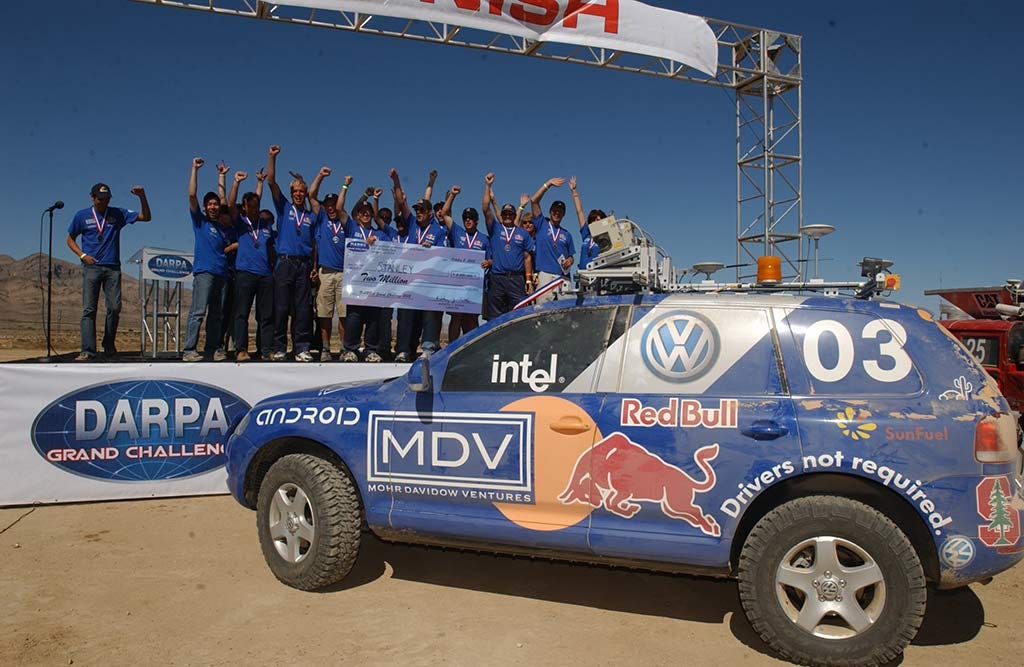
The government wants self-driving cars. It sponsors the self-driving car grand challenge. Teams from Stanford, CMU, Virginia Tech, MIT, UPenn, and Cornell participate. The lead of Stanford's team founds Waymo. The lead of CMU's team founds Aurora. The lead of Berkeley's team commercializes LIDAR. Those students become key players at Zoox, Nuro, and Tesla.
The government wants AI. It develops massive grant programs, to the tune of millions of dollars. Minsky, McCarthy, Simon, Newell, and others build up huge labs at MIT, CMU, and Stanford. Those labs attract folks like Geoffrey Hinton and train folks Andrew Ng. Further government grants fund labs under Yann Lecun at NYU and Fei-Fei Li at Stanford. These people become pioneers in deep learning. Students from their labs — also all funded by government grants — become key players at DeepMind, FAIR, OpenAI, Anthropic, and more.
This pipeline is still going strong. I worked at Google Research for a few years, and still have close connections there. It is extremely common for professors to take sabbatical and work at Google. It is also common for PhD students on government grants to spend part of their research time at Google. There is a rotating door of folks coming from and going to university labs all around the country. A friend of mine started a PhD at Stanford; joined Google during his PhD where he reported to a professor from Cornell on a team run by a professor from MIT; left Google to become an assistant professor at MIT; and, after raising money from a prominent Bay Area VC, is now working on a startup based on his work. This is an extremely common story.
Google was two PhDs. Sun Microsystems was a professor. Mosaic was a university research lab. Every defense company. Every tech company. Every energy company. Every bio company. They are all pulling from the same pools of scientists, who are all productionizing research coming out of university labs that was done on the back of US dollars. That work is why we have ubiquitous internet, cheap electronics, miracle drugs, and more. The American university-industry research pipeline is probably the single most valuable asset in the US. It takes brilliant people from every country in the world, and turns them into a part of American power projection. In return, it makes those brilliant people — and the venture capitalists who invest in them — extremely wealthy in the process.
For some reason, people think this is a bad thing. Silicon Valley owes its existence and its continued importance to this pipeline, but many in the industry seem downright giddy at the prospect of killing the goose that lays the eggs.
A National Research Lab with an Education Arm
Let's talk numbers.
Some folks like to joke that the top American universities are hedge funds with education arms. It's funny, but it slightly misses the mark. The top American Universities are national research labs with education arms.
In 2023, the US Government spent ~$60b to support R&D at universities. 60% of all university research funding came from the federal government; 30% of all federal R&D spending went to universities. University R&D is slightly more than the amount the government spends on all private industry R&D (~$59b). It is also slightly more than the amount the government spends on HHS (~$52b). And it dwarfs the amount that the government spends on the Dept. of Energy (~$16b), NASA (~$11b), NSF (~7.5b), nonprofits ($6b), and state and local government ($4b). You could add up those last 5 categories and still be $15b short before you matched university spending.
Put a slightly different way, universities are the single largest external recipient of federal R&D funding.
For the most part, that money is not evenly spread. More than a third of those funds went to only 20 universities, nearly a billion each.2 The rest was spread among 640 different institutions. The government provides a handy table, and the NYT a visualization mapped over the country.
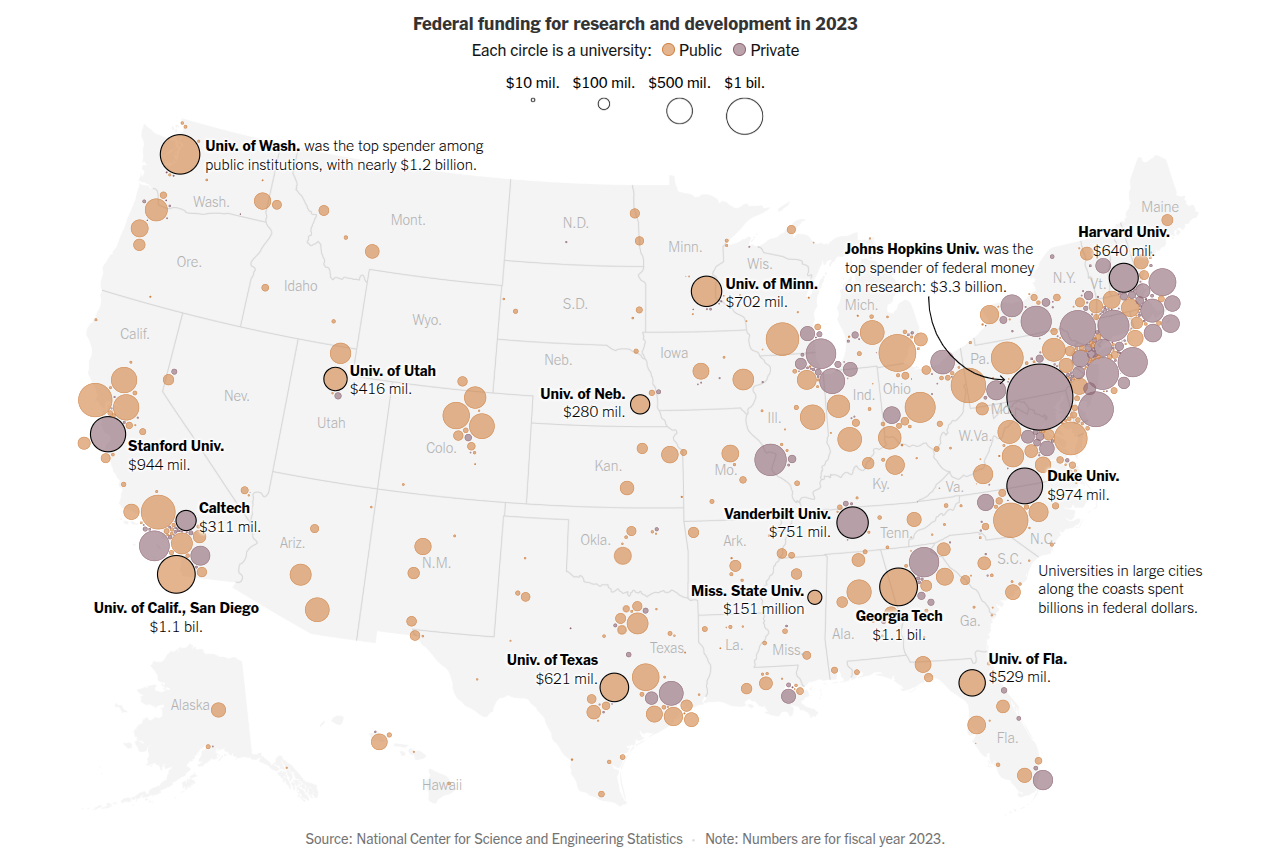
So based on expenditure alone, the US federal government is deeply enmeshed with the research capabilities of US universities.3
What about from the university's perspective?
Even though we spend an outsized amount of time talking about undergrad admissions, almost all of the private schools have significantly larger grad school (read: research) populations. Here’s a sample of a few universities picked from the top 20 grant recipients:
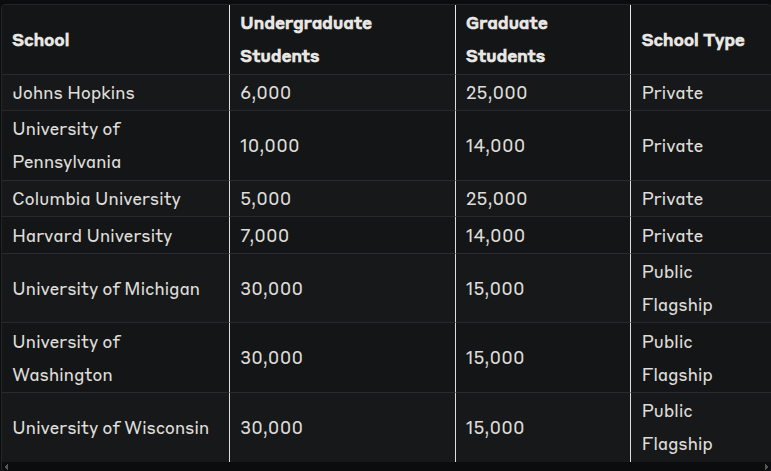
Among the famous private universities, the research population is significantly larger than the undergrad population. By contrast, it is the big flagship state schools that tend to have larger undergraduate class sizes.
And of course, University budgets reflect their research focus.
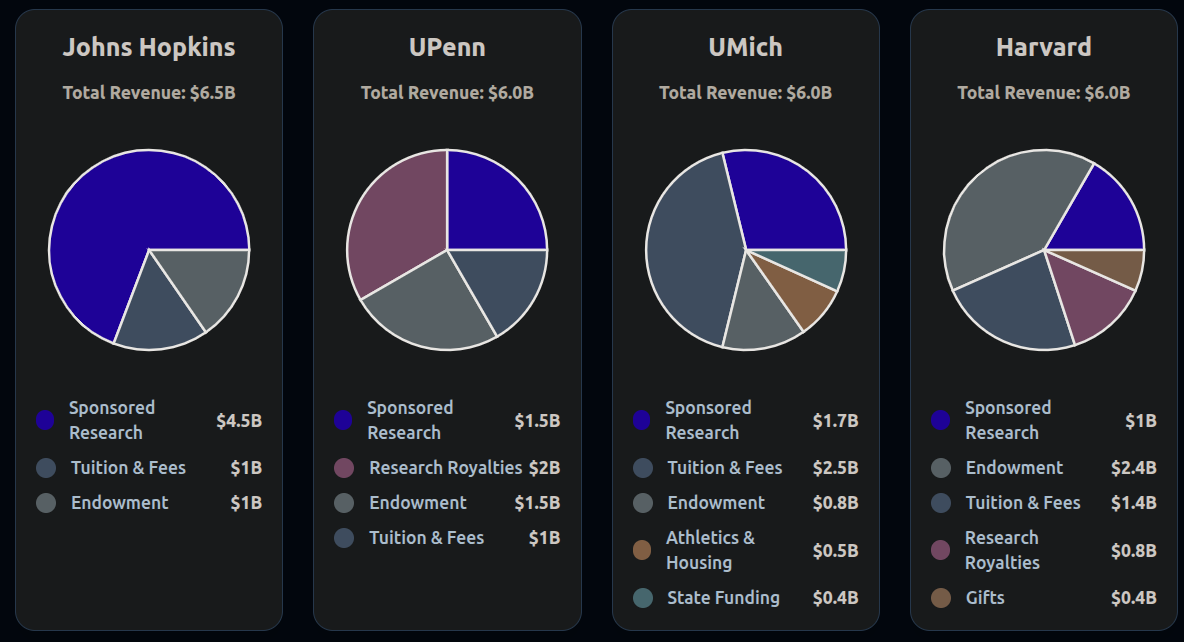
Each school has a budget of about $6b. Each school is dedicating something like 15-55% of their budgets just to federally sponsored research. At Johns Hopkins, more than half of the budget is related to federally sponsored research (~$4.5b).4
I think there is a perception that government grants exclusively go to Ivy league schools in blue states to fund humanities education. All of this is wrong. Most of the funding goes to big state schools. A huge amount of funding goes to schools in red states. All of the grants we are talking about go to graduate-level STEM research. The private schools spend more as a percentage on STEM research than the public schools. And the schools that are in the top 20 in taking federally sponsored research grants are all really involved in federally sponsored research.
By the way, there is a separate federal fund for humanities research. The federal government pays out roughly $100m to support the humanities, from philosophy to art to dance to sculpture. That's .1% of the total STEM funding.
So, again, just to hammer it home, these universities that everyone is talking about aren't really schools. These are federally funded research labs with education arms. "We should defund woke universities" sounds edgy and cool. "We should kill national cancer research labs" is bizarre and weird and, frankly, really dumb.
But that's basically what the Trump admin is doing! Trump blocked all federal research grants going to Harvard, most of which was literally for cancer research! Here's a small sample:
Joan Brugge lost a grant to identify early precursors of breast cancer.
Steven Shuken lost a grant to study blood-brain drug penetration for Alzheimer's treatments.
Mike Baym lost a grant to study bacteriophages that kill antibiotic-resistant bacteria.
Harvard is of course not the only school to be targeted, just the most prolific, politically motivated, and egregious example. If you're curious, there's a larger database listing cancelled grants and associated schools (though still incomplete). As best anyone can tell, the Trump admin is doing a cntrl-f for any grant that uses words like 'expression' or 'trans', so good luck writing your paper about cancerous gene expression in transgenic mice. I know there's so many things to get mad about these days, but this is really just a level of wanton stupidity that makes my blood boil.

I feel compelled to point out that these cuts don't really accomplish even their stated goals. It's tempting to think that university research grants are liquid and fungible, that cutting funding for research means the university will have to shift funds over from other places. That's pants-on-head wrong, of course. If a research lab doesn't get a grant to pursue a specific research area, the research just doesn't happen. The university has no a-priori commitment to, like, fund particle physics or something. That happens only if the government wants it to happen. Or, put another way, the grants aren't gifts to the school. You can't use an NIH grant to build a fancy new dorm for students.
That also means that, ironically, the university's educational facilities will be totally fine — tuition and endowment are more than enough at these schools to keep the educational facilities alive in perpetuity. Cutting research funding will, shockingly, result in less research. Why is this a good thing?!
Let’s maybe not defund universities.
I, like many others, want what's best for my family and kids and country. And in that regard, I have my own beef with the university system. Still. Never in a million years would I think "therefore we should kill off the greatest research institutions in the world." I consider myself an engineer and a scientist first and foremost, and in that capacity, the Trump administration's attack on universities is nothing less than a modern burning of the Library of Alexandria, a destruction of our children’s inheritance to satisfy the whims of clowns and madmen.
Silicon Valley prides itself on innovation and freedom of information. It believes in technocratic policy and techno-optimist futures. It thrives on exactly the kind of people who dedicate their lives to learning about a very tiny area of math or physics.
Silicon Valley should be outraged.
Instead, some of the biggest names in the Bay are openly cheering this on. I cannot begin to fathom why, do they hate money and success? To me, this is a betrayal. Those who support this aren't just backing the wrong horse — they are turning their backs on the ideological commitments to progress and free inquiry that make Silicon Valley what it is. I hope that it is just because they are wildly misinformed. I hope this article can help clear up some of the biggest misconceptions. But I fear that this is a cynical and intentional powergrab, a way to pull up the ladder at the expense of future generations. And if that is the case, those who would support the dismantling of our research pipelines and our country ought be ashamed.
And famously wrote the report on casualty counts in the scenario of an invasion of the Japanese mainland, influencing the decision to drop the atomic bombs.
Except for John Hopkins, which took in ~$4b in research grants.
For completeness, it is worth mentioning that there is an additional ~$40b that the government provides in student aid through Pell Grants and Federal Work Study, and an additional ~$80b in student aid through loans. Though these are technically part of the wider university ecosystem, I think it's more accurate to see these funds as going to the students to fund their tuition — the student is the one that has to apply for those grants or loans. Not that it matters, the Trump admin is trying to cut these too. There's a larger debate about whether college is too expensive (it is) but I think that's probably not relevant for the topic at hand.
Note that all of these universities are affiliated with regional hospital systems. Those systems can easily clear $10b in revenue and operating costs, and as a result can dwarf the rest of the university when doing any kind of accounting or looking at staffing. I purposely tried to avoid including information about the hospitals when discussing the university, even though there is some meaningful overlap. O, and the Trump admin is trying to cut any funding going to these hospital systems as well. Because who cares about sick people, I guess.
I say this as a pre-eminent respecter of you, your opinions, and your huge brain: a lot of your recent pieces have been scolding "silicon valley" culture as not living by its values wrt Trump. But to me, a lot of what's happening in the dark alliance between the two is the natural outcome of the progress of silicon valley and tech as an industry. Desperation and greed have become the animating values of the valley in the last ten years, and nothing destroys stated values more than them. Perhaps it's worth considering that the apple is a bit rotten to the core, and that the positive outcomes you like are actually almost accidentally won, ancillary to the true twin purposes of the modern tech industry: destruction in the name of renewal, and extraction in the name of efficiency. But also: it's nice to see you be surprised, because it means you were optimistic. My bleak inner world sees horrific stuff from our industry and sighs an "of course" sigh. So I like reading your thoughts
there must someday be investigation into the phenomenon where left-wingers say it's bad to cave your head in with a claw hammer and maga joyfully does it so they don't seem like they're listening to woke. it's shocking the degree to which every other priority disintegrates in favour of owning the libs