

Spoilers, obviously, although is it really possible to spoil an adaptation of a 2500 year old poem? Also, I kind of hate that Odyssey reviews is a whole genre of substack post now, with reviews, reviews about reviews, joke reviews, and reviews from people who generally don’t review things. If you end up reading this review, you’ve probably already read like five others, so I assume everything that could be spoiled as been spoiled already. I’m coming late to the party, hopefully I still have some interesting things to say.
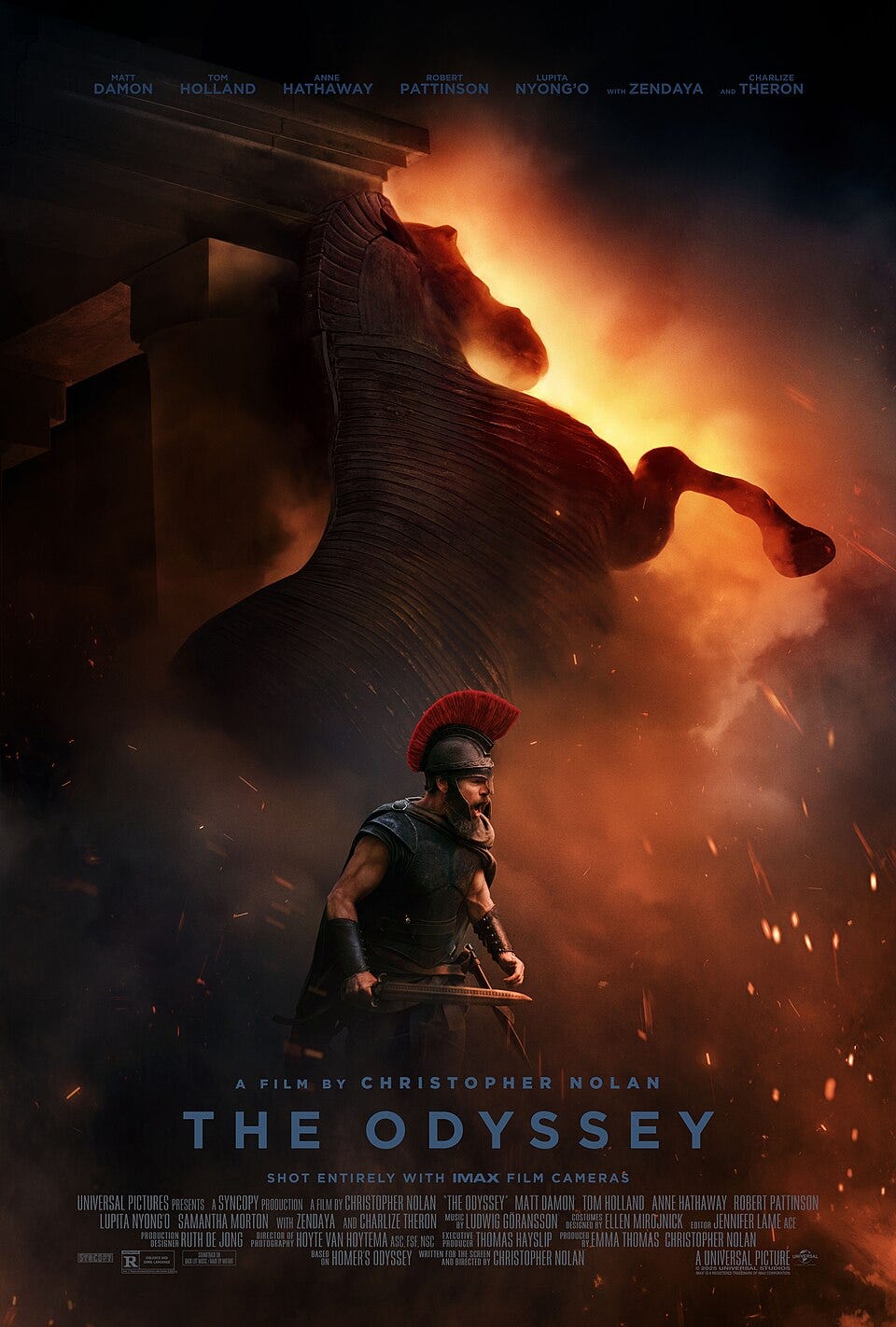
Not all works of art are made with intention. Death of the author, eye of the beholder, these idioms remind us that great art is often defined by the audience, at least as much as it is by the creator. I don’t think the original author of the Odyssey necessarily expected it to last as long as it has. Though perhaps even the concept of ‘original author’ of a tale like the Odyssey is malformed — there are traces of Odysseus’s story in Hindu mythology and in the Epic of Gilgamesh, among other places.
That said, many adaptations are made with intention. Whenever someone comes along and decides ‘I’m going to take one of the world’s oldest stories and redefine it for a modern era’, you should expect that the creator is doing so with purpose. Even more so when someone decides to spend $250 million, attached to the only director who can consistently get butts into seats. You think someone with that kind of pocket book isn’t making decisions with intent?
So when coming into the Odyssey, I think it’s worth asking the question: why should this man tell this story at this moment?
This requires a little bit of psychoanalysis, the opposite of death of the author. But we are very lucky here, because Christopher Nolan assumes that his audience is a little bit dense,1 and so has a habit of outright stating exactly what his motives are.
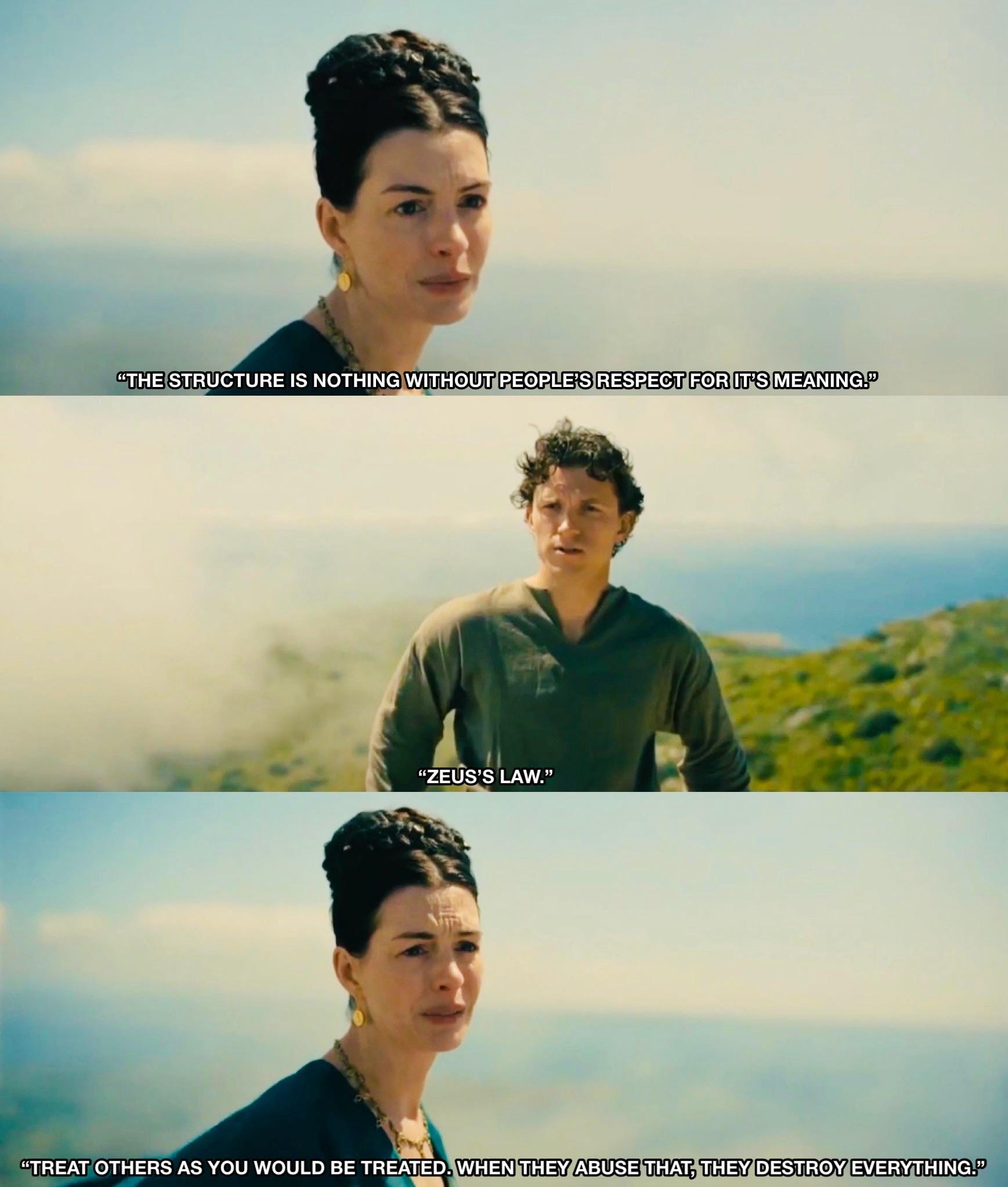
I think it is basically impossible to separate this version of the Odyssey from the political crisis that America has found itself in for the last few years. Nolan’s message is very straightforward: our House is filled with people unworthy of it, who are violating the norms required for civilization; that if we continue to violate these norms, our Age of Bronze Civilization Will Collapse;2 and that we must make things right by checks notes brutally murdering Robert Pattinson.3
Every part of the movie is a choice. If Nolan wanted to create an American version of the film, he could have gone the route of “O, Brother Where Art Thou.” Different story, different setting, hell even the main character is named something different.4 Seen through the message above, a bunch of things click:
The casting has to be diverse. This is an American movie, with a message meant for American audiences. Even though it is nominally set in Greece, we need to be able to match what is happening on screen to real life. This is also why all of the characters speak American English, even though many of the actors are British.
Why set the film in Greece? Why call it ‘The Odyssey’? Changing the name and location would have probably saved Nolan a lot of grief, because many people seem frustrated by how far the movie strayed from the source material (including the translator of the edition that the movie was supposedly based on).
But this too is intentional. The Odyssey has been claimed by a particular kind of internet weevil, the ethnonationalist right that tries to draw its heritage through ancient Greece and Rome and by extension the great works of those empires. Most of those people don’t (can’t?) read, of course, so the best way to get any kind of message through is by having their hero hitting them on the head with it on screen.This is also why all of the actual Greeks in the story are total assholes! Menelaus and Agamemnon are wildly unlikeable. The Greek soldiers commit literal war crimes and are punished for it over and over. In the third act Odysseus literally says that the Greeks are the civilization-destroying ‘sea people,’ because they were the ones violating the Law of Zeus.5
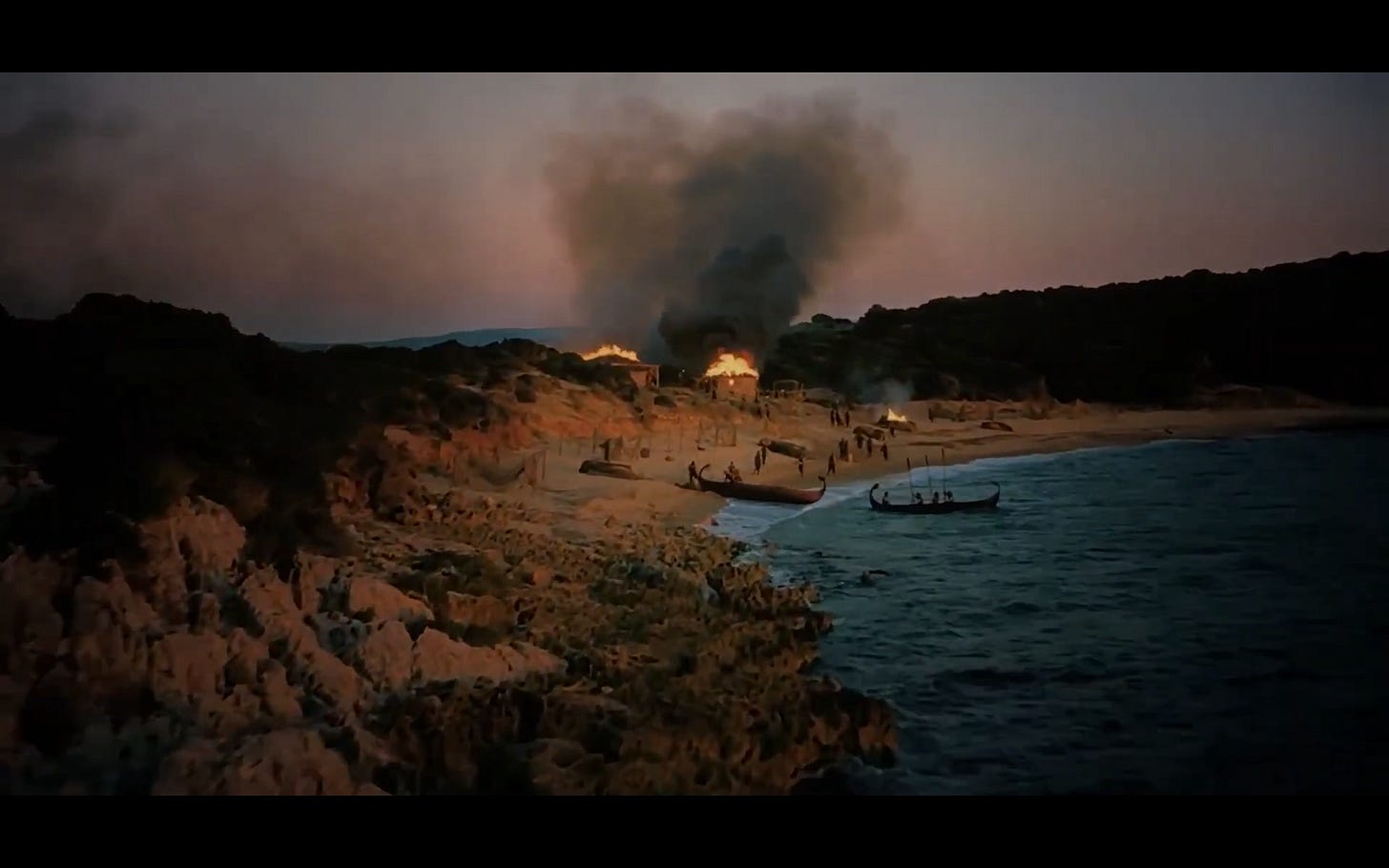
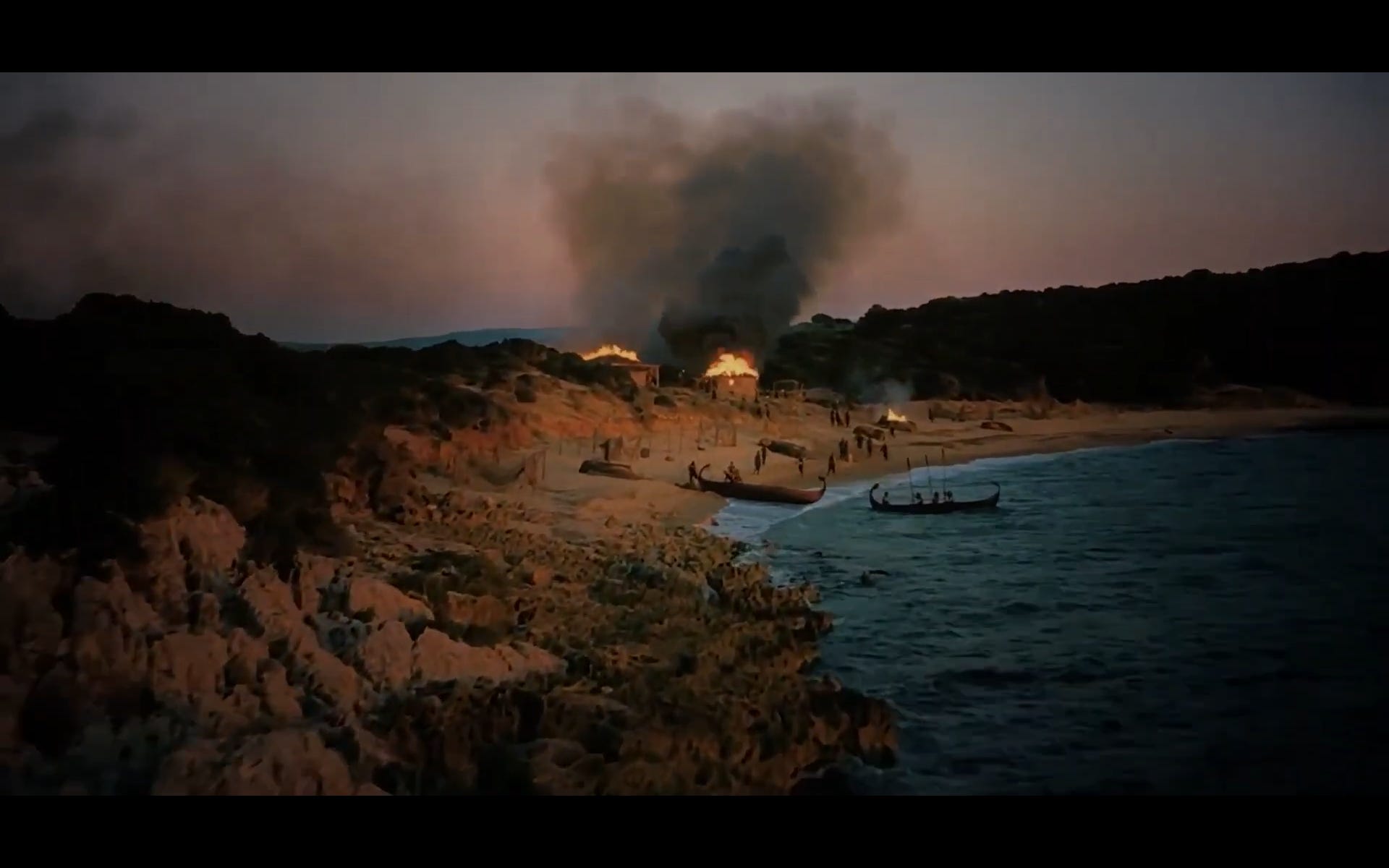
literally the first place we see Odysseus and his crew stop 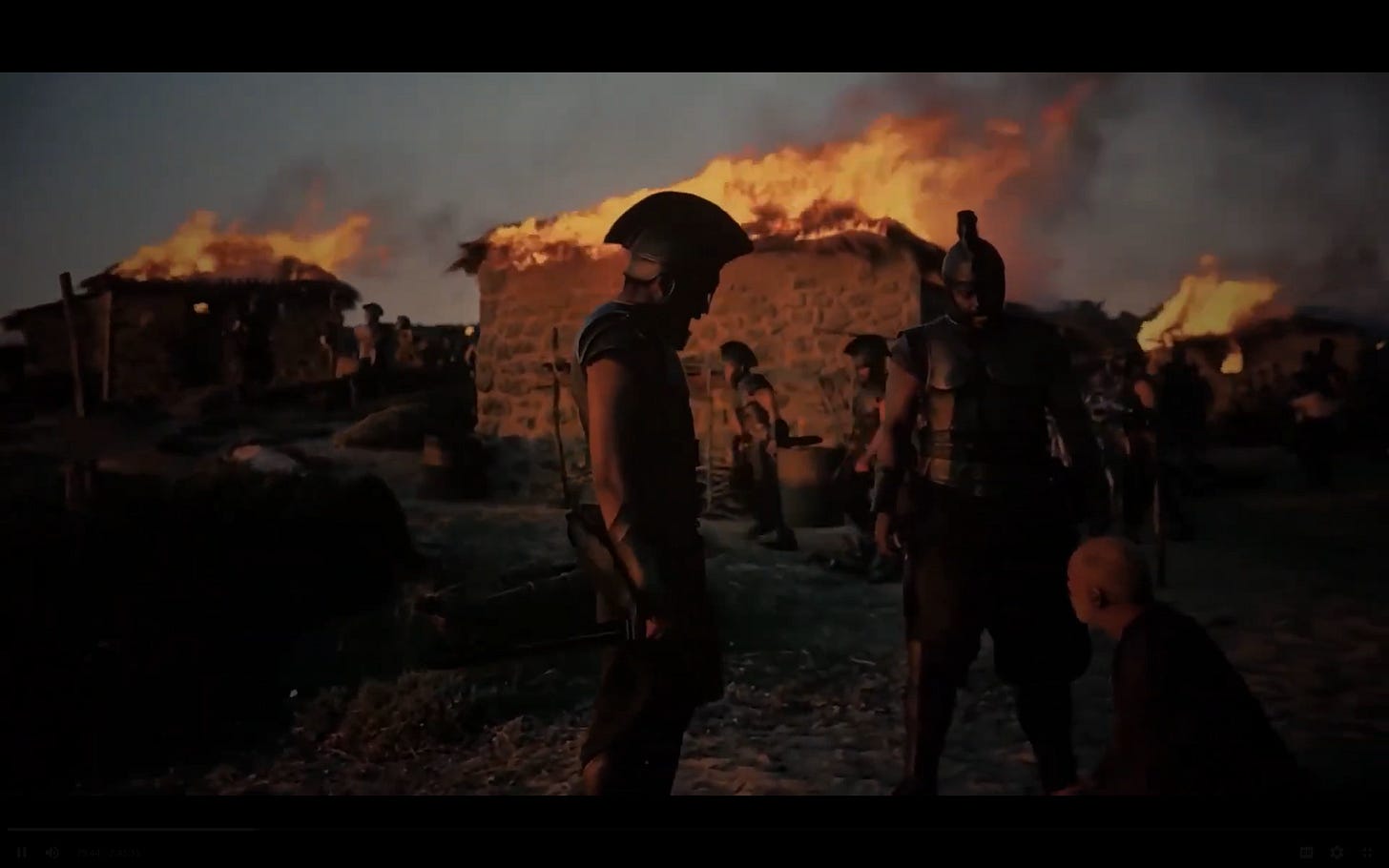
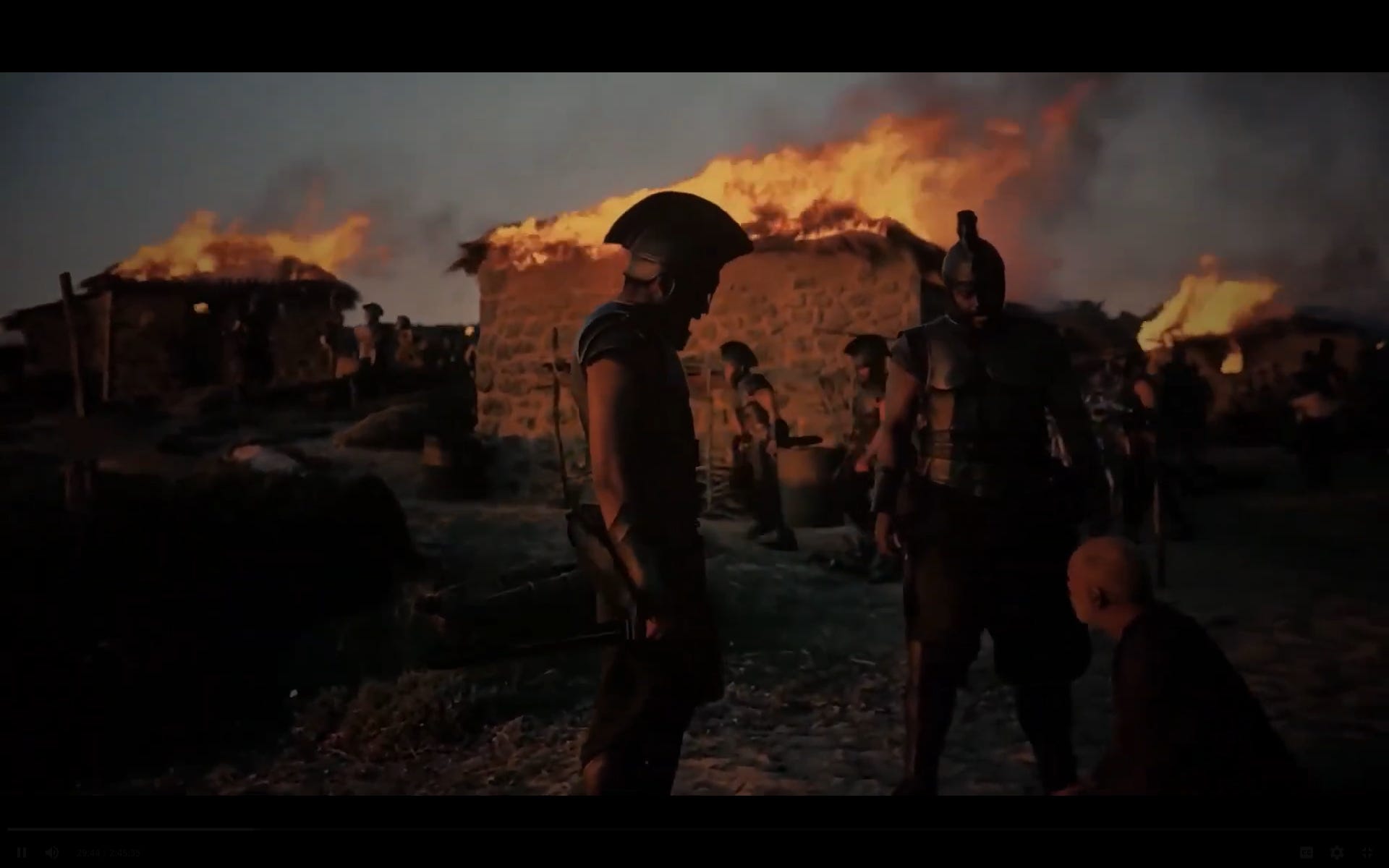
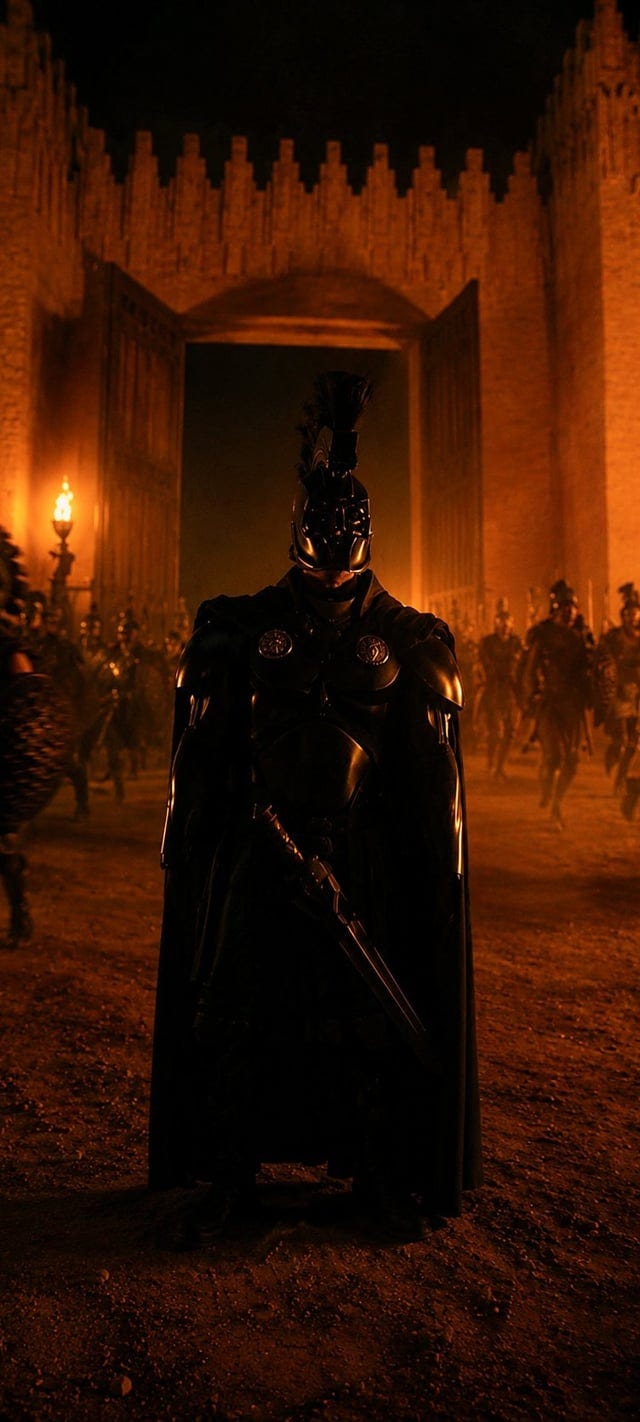
gee i wonder whats going to happen to that old defenseless man on the ground Just in case it wasn’t obvious, the Trojans are in literal white armor, while the Greeks are decked out in black and their leader looks like this:
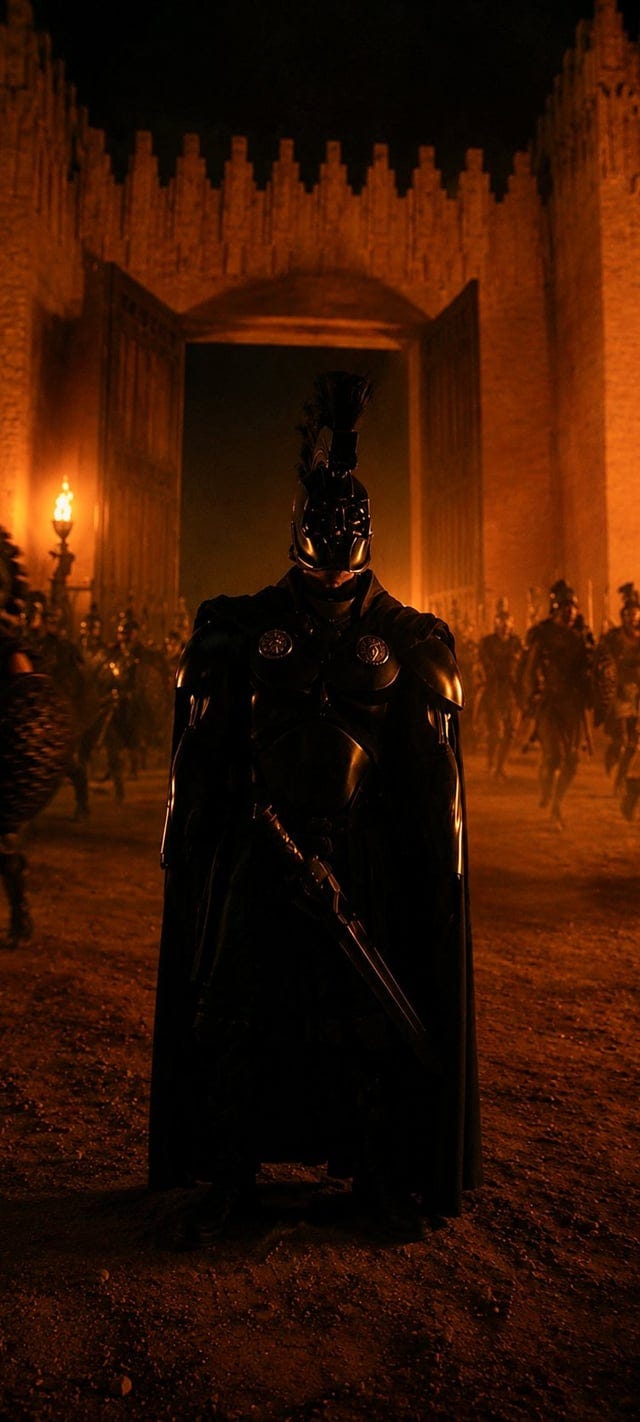
look at this vader-ass costume! Nolan is not one for subtlety
Nolan cut a lot of things out of the movie — the Lotus Eaters, Nausicaa, the winds, the hubris, any hint of Odysseus’s personality. I was really confused why he included Helen. In the source material, Helen is a side plot to a side plot. Critically important to the Illiad, of course, but barely a character in the Odyssey. She never even interacts with Odysseus! Fine, Nolan probably does need to keep Telemachus in to get that incredible payoff murdering Robert Pattinson at the end, but why include the trip to Sparta in a movie that is already so pressed for runtime? Especially when any casting for Helen was bound to create a ton of backlash?6
It’s because of this shot.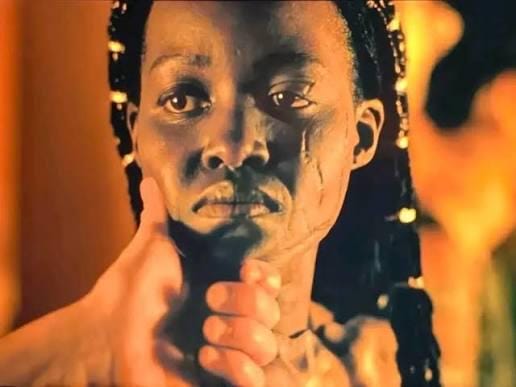
“face that launched 1000 ships ...well maybe only 500 now” — Menelaus. Also felt like a callback to the Joker in Dark Knight I think many of the aforementioned weevils put a lot of stock in the ‘protect Helen’ narrative, as part of their larger crusade to ‘preserve’ “western” norms. Having Menelaus carve Helen’s face — something that is emphatically not in the original — shows how hollow the political narrative is. The justification for the Trojan war is to keep Helen safe, but she is most endangered by the people claiming to be her saviors.
The core theme of the movie is hypocrisy. Agamemnon is a hypocrite, and Menelaus is a hypocrite, and Antinous is a hypocrite. The soldiers are hypocrites and the suitors are hypocrites, and the Greeks in general7 are massive, massive hypocrites. Everyone is given just enough rope to hang themselves, creating the conditions for their own demise. The only question is magnitude. The more hypocritical they are, the more the audience cheers for their eventual comeuppance.
So why make a movie about hypocrisy leading to civilizational collapse in 2026? I mean…

Also, in a stroke of incredible timing for the movie, the US literally went to war in the Middle East over false pretenses8 and is now stuck in a stalemate fighting over trade routes!
All this to say, I think The Odyssey mostly succeeds in getting its message across. I’ve been frustrated by the discourse around this movie — a lot of it never makes it past the name of the film. “Odysseus from the movie The Odyssey is different from how Odysseus is in the book The Odyssey so it’s a bad movie” man, what are you even talking about? I have minimal patience for the people criticizing the movie because it is not historically accurate or representative of the source material. It’s not ‘Homer’s The Odyssey’. It’s ‘Nolan’s The Odyssey.’ You should’ve known that it was going to be a bit different than the book when you bought that $45 70mm IMAX seat with the 15000 watt six channel surround sound.
That’s not to say I didn’t have problems with the movie.
For one, I think there are a lot of problems with the movie’s pacing, which impacts a bunch of other things. We spend a lot of time on story beats that don’t really matter, like the Laestrygonians.9 That in turn means that we are constantly jumping from one scene of people running on a beach to another scene of people running on a beach.

In the few moments when Odysseus isn’t running on a beach, he is mostly just brooding. This is a massive waste, we get like no personality from Matt Damon at all. I don’t mind that this version of Odysseus isn’t a clean map to a wily trickster who is supposed to be all about getting out of scrapes with his quick wit and quicker mouth. But, like, he should be something else at least! Odysseus barely talks — I think the dude has like 10 minutes of dialog across a 3 hour movie, with 9 of those 10 minutes in the final monologue to Penelope. I wish we had gotten more scenes like the ones in Hades, which were my favorite in large part because we actually got some real character development.
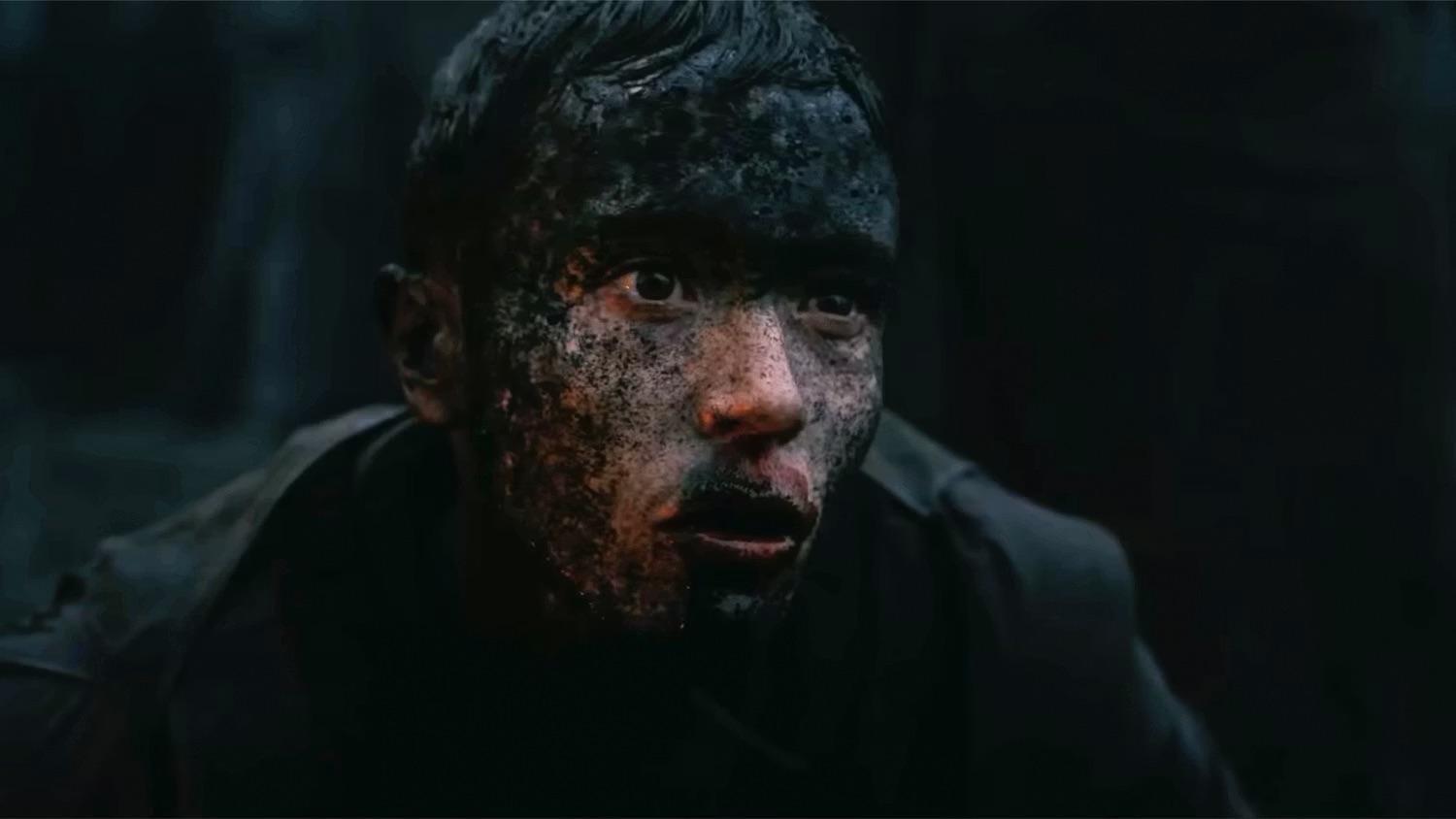
But this isn’t really a movie about character development. Some of my friends said that Matt Damon is less Odysseus and more a superhero who is sad about being a superhero. Which, like, yea, I see it. When he needs to get out of a scrape, he mostly batman’s his way through. Dude straight up mercs like 7 guys in Pylos.10
While we’re on the subject of character development, the whole Telemachus story doesn’t really work for me. The guy is meant to grow up and be a man by checks notes brutally murdering Robert Pattinson, but when the critical moment comes he gets…shooed away by Dad. I get that this version of Odysseus is meant to be a Jesus coded sin eater…
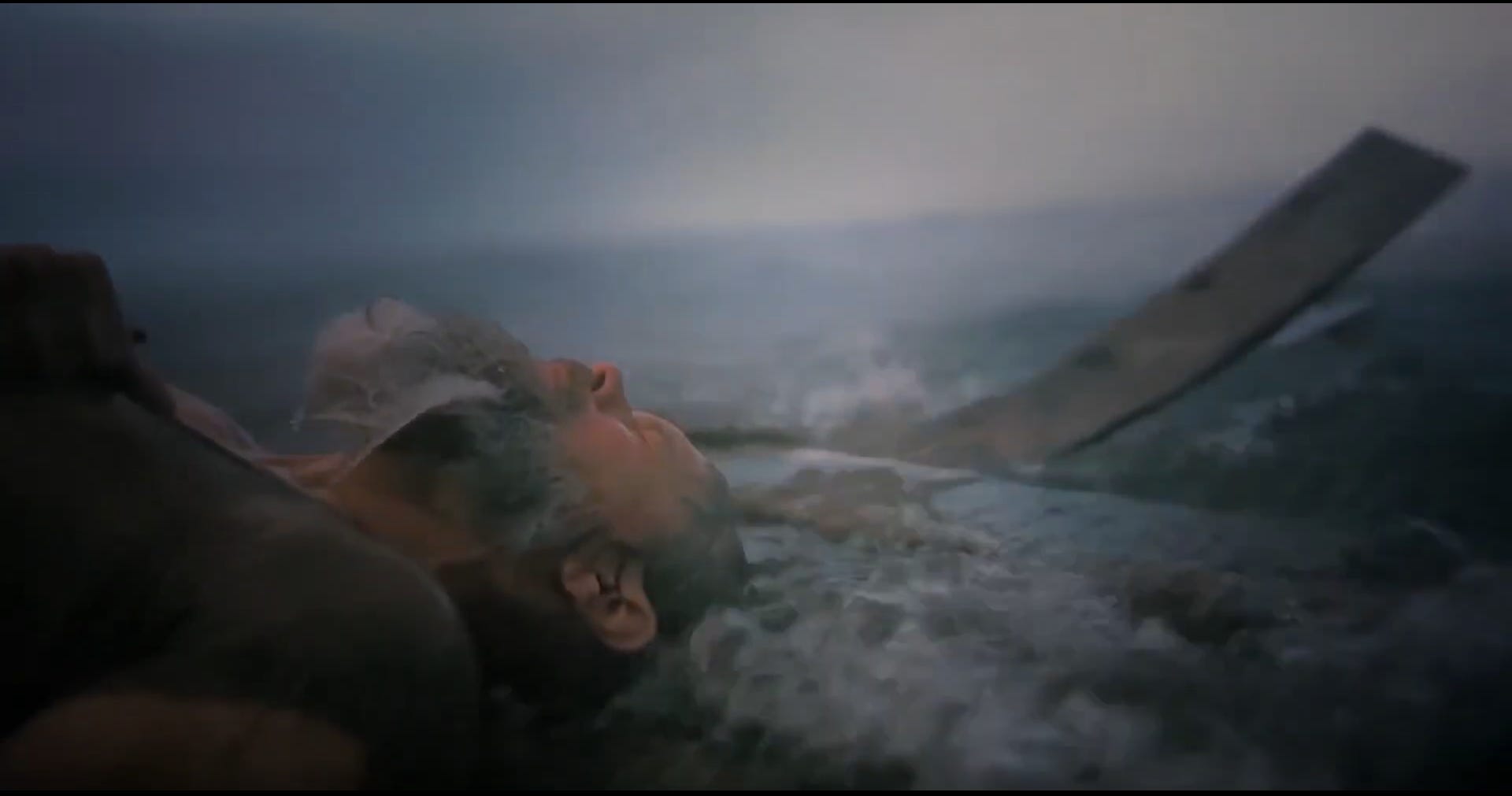
…but in the narrative of the film, it feels unfinished. Telemachus is the same whiny kid, nothing meaningfully changes for him, he’s still certainly far weaker than Odysseus, and I have no reason to believe that Ithaca won’t immediately fall apart under his rule. Kinda weird, too, that as far as I can tell Odysseus basically just leaves to go on vacation with his wife, which is what they wanted to do at the beginning of the movie anyway.
The whole Telemachus story is the most egregious, but it’s far from the only thematic arc that is hard to follow. There’s a whole ‘defy the gods’ narrative, but it’s not really clear why or how that’s important. Odysseus is only allowed to return to Ithaca once he ‘let’s go’ and ‘accepts his punishment’, but it’s not really clear what he needs to let go of or why this ultimately leads to his absolution. I get the idea that the Greeks are being punished for their hypocrisy, but why is Odysseus’s crew in particular doomed to die? Agamemnon’s crew makes it back fine! The gods really just seem to have it out for Odysseus’s men, for reasons that are never really made clear.11
I think that the big twist that Nolan is going for is that Odysseus is avoiding going home. It’s not that he cannot get there, it’s that he does not want to return because he blames himself for the destruction of Greek social norms and the impending fall of civilization. He’s bouncing around the Mediterranean to avoid confronting whatever is waiting for him in Ithaca. The ‘let go’ scene is Calypso telling Odysseus that he is not solely to blame, that all of the Greeks played their part. By virtue of being the only Greek capable of feeling a modicum of guilt, Odysseus is spared. But all of this comes out in Damon’s third act monologue, instead of being woven through the narrative.12
In my ideal version of the movie, there would be more opportunity to see Odysseus’s crew as bad people. The version we got has hints of this here and there; for example, Circe explicitly says that they are pigs by nature and calls their human forms ‘disguises’. Still, it’s too tenuous, mostly an act of telling instead of showing. In many places, the crew seems downright level headed. They warn Odysseus against going his own way, they warn against staying in Polyphemus’s cave, and Himesh Patel (Odysseus’s first mate Eurylochus and the avatar of the crew generally) is endearing and easy to root for.

If we had more time to see the crew as they are in Homer’s original — that is, short sighted, greedy, and stupid — Odysseus and the audience would have to grapple with the fact that the Greeks in the story, the people Odysseus wants to save, are obviously the villains. I don’t think you’d have to change that much of the movie to make it all work. In fact, you’d only need to make one: identifiable members of Odysseus’s crew should visibly be consumed by bloodlust during the sack of Troy, and Himesh Patel should be the one beheading Zendaya / the priestess. This would immediately put the rest of the movie into focus: defying the gods is not a heroic act, because the crew’s punishment at the hands of the gods is just, a harbinger of the same punishment that Odysseus metes out to the suitors at the end.
That isn’t really the story we got, though, and as a result I think Nolan loses the thread when Odysseus starts killing people at the end. The final scenes in Ithaca are tonally and emotionally redemptive. The bad guys get what’s coming for them, Odysseus rides off happily into the sunset with Anne Hathaway, the music swells. The message seems to be something like ‘if someone (violently?) purges all the evil people from society and then offs themself so there’s no tit-for-tat, things will be fine.’
This maybe kinda works as an extension of the Christian symbolism that Nolan layered into the movie. The sin eater has eaten the sins and we are now saved, hooray! But if you take a step back this is obviously incoherent. The actual things taking place on screen are tragic. Telemachus is not equipped to run Ithaca. The kingdom has just lost a sizeable chunk of its aristocracy / young men. Odysseus knows that civilization will collapse and says as much to Penelope at the end.
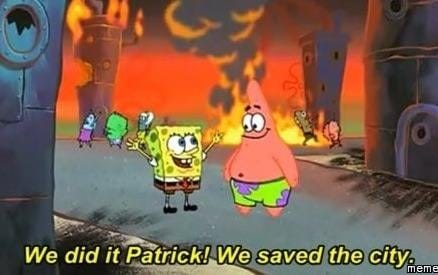
Explicitly linking the punishment of the suitors to the punishment of the crew paints a much darker story. Nolan’s message isn’t “murder Robert Pattinson as blood sacrifice to make things go back to normal.” It’s something closer to “we are all fucked, and we deserve it.” I think Nolan basically didn’t want to end on such a downer note, so he half-asses it. Even more so if you link this all back to the state of American Democracy in 2026. ‘Our civilization is corrupt beyond repair and our institutions are going to collapse’ is hardly what people want to hear right now (or ever).
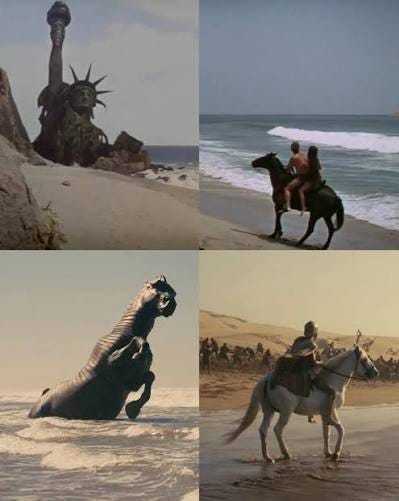
Even though I just spent ~1200 words criticizing The Odyssey, I actually really liked it. I thought the visual symbolism was great — the Trojan horse built to look like the half-buried statue of liberty in Planet of the Apes, Polyphemus referencing Saturn Devouring his Son, alongside tons of callbacks to Nolan’s own cinematography.
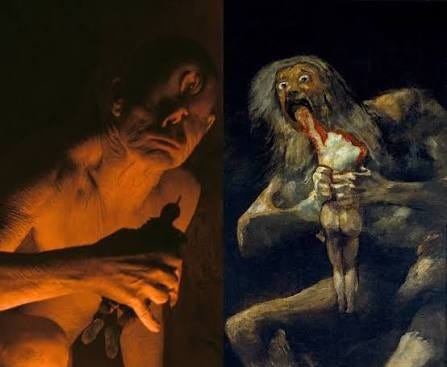
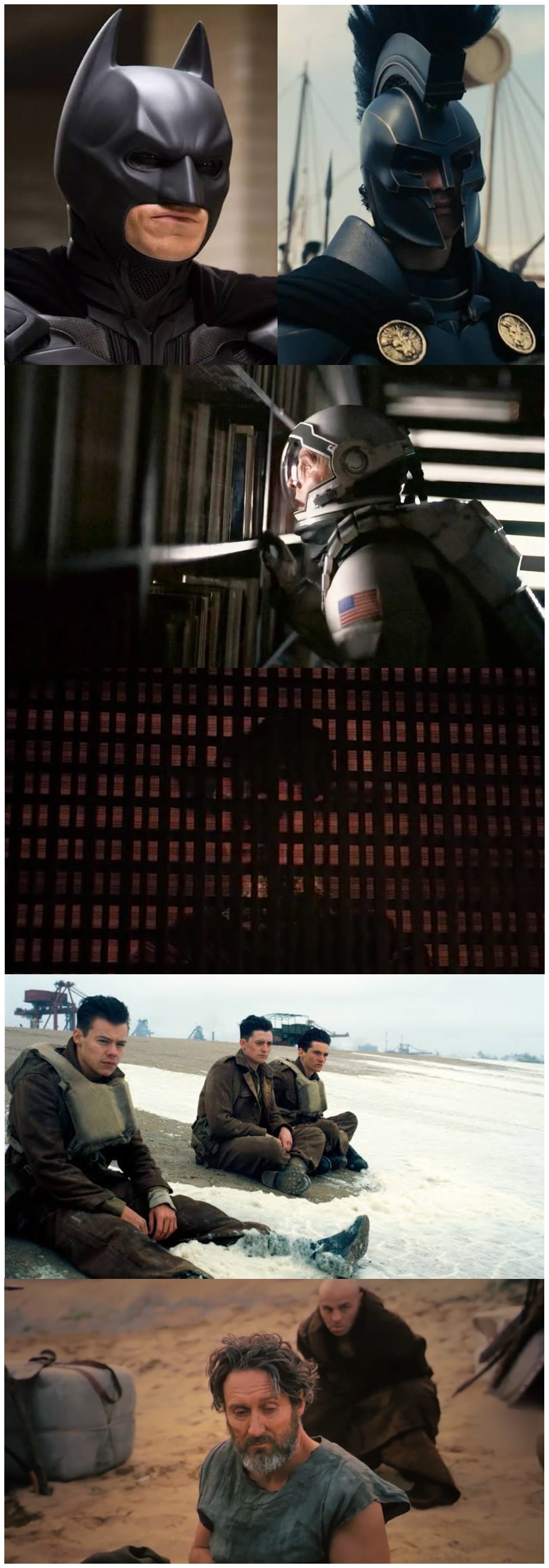
And as usual, the sound design was incredible — Polyphemus screaming in agony made me feel small in a way no movie ever has before.
This is not, in my opinion Nolan’s best movie. But Nolan deserves praise for the sheer ambition of the film, and the thoughtfulness with which he approached it. It’s a movie deserving of the ‘epic’ genre title, a reflection of our culture through the lens of one of the oldest stories known to man. I don’t think we really do ‘epics’ anymore in literature and in cinema,13 which is a shame because those are the things that live rent free in my brain for months and months on end. Many of the movies that would claim the title today — Dune, for example — are visually stunning but lack that civilizational scope.14 They don’t tell us about ourselves, the way the Odyssey does.
To that end, I want more.
I know Hollywood gets a lot of flak for only ever doing reboots and sequels, but I would adore an era of film where the bigwigs with the big budgets start mining great works of literature for ideas. Do a reboot of the Tale of Genji or the Mahabharat! Give me (Ovid’s) Metamorphosis, or Moby Dick, or Grapes of Wrath! Do 100 Years of Solitude, you can even cast Pedro Pascal as all 17 members of the Buendía family! You love casting Pedro Pascal! This would be so much better than Avengers 11: Doomsday Returns.

I recently rewatched Interstellar as well, and man he really just has to come out and say everything. “We are in a specially built tesseract where we can move around in time as if it was space” no shit!
I still cannot believe this was an actual line in the movie
It’s actually not all that obvious to me what Nolan thinks the solution is, but we’ll get to that.
Name’s Ulysses Everett McGill puts pomade in hair
To the extent that there is an immigration angle, this is an inversion of the right wing fear mongering about civilizational collapse. There are no hordes of evil immigrants, the true harbingers of decay are the people already inside the gates.
Casting Lupita as Helen was definitely done on purpose, it’s disingenuous to argue otherwise even if the exact intent isn’t clear.
except for the swineherd Eumaus and maybe Telemachus
‘weeks away from having a nuke’ is the new ‘they took my brother’s wife’
I feel like they made it in solely for marketing purposes, though Mia disagrees and thinks they show how Odysseus and crew are arrogantly going from place to place thinking they can deal with whatever, when in fact they are way out of their depth.
As a minor note, I do think scenes like this would have been a great place to emphasize the gods and the way they work on the story while giving the audience an out to suspend disbelief. Unfortunately, Nolan committed early to the idea that the gods may not even be real, which means that we more or less have to believe that a 50+ year old war vet can take on a bunch of young bandits without a scratch
This is most obvious with the golden cattle narrative. In the book, the crew eats Apollo’s cattle because they are bad people. In Nolan’s adaption, the gods literally starve them out. Supposedly, the soldiers killing and eating the cattle is some sort of causus beli, which justifies their later sinking, but the whole thing is just odd — if the gods were going to kill Odysseus’s crew anyway, why even bother waiting for them to kill one of the cows first? Seems like premeditated murder with extra steps.
And is also contradicted by Calypso’s dialogue, where it sure seems like she kept Odysseus there against his will. I’ve rewatched the ‘let go, accept Poseidon’s punishment’ scene a dozen times and it still doesn’t make sense to me.
Though I’m very curious to see what comes of The Fallujiad.
I know that Oppenheimer was also billed as an ‘epic’, but personally I don’t think a biopic can really be an epic. It’s too tied to a single person, and doesn’t do enough to step back outside the mind of the titular scientist. Contrast to Lawrence of Arabia, which is also ostensibly a biopic but is much more sweeping in the story it wants to tell about ambition, ethics, and geopolitics.
God I would love more epic-sweep adaptations. Why has nobody done tale of two cities in so long
I’m simultaneously glad it’s been made because I’ve never seen so many people buzzed about the classics, and annoyed because I really want to enjoy it but from the many reviews it just seems like I will be constitutionally unable to. I know too much about the source material. And I suspect I’d end up in the camp of Emily Wilson aka “this take is *something* but this ain’t my boy Odysseus.” I’m too much of a fangirl of the original, and know too much about the setting, to overlook it. I expect to be low-grade irritated the entire time. So in that light I don’t know if I’ll see it. I mean seeing a movie that long in theaters is not a trivial ask when I have three little kids at home, and I don’t even expect to like it. But I guess that’s the fate of every adaptation. To be dissed by the fanboys of the original. Except for Peter Jackson’s LOTR. Somehow that was the exception.