

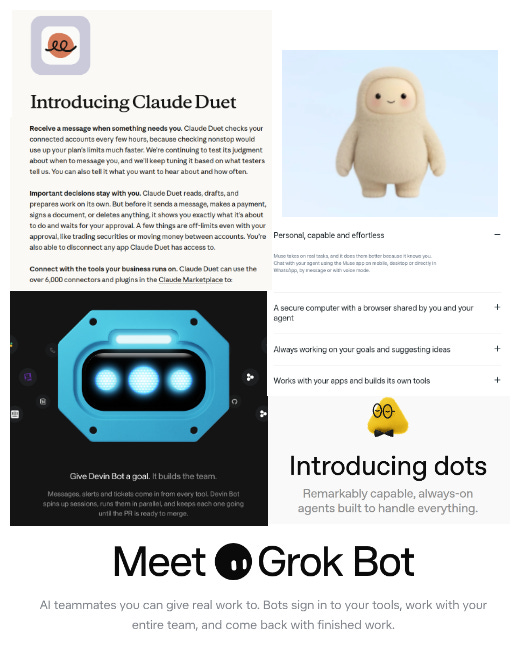
About two months ago, we got GrokBot. GrokBot is an interface to an agent running on a cloud. You can create a bunch of different GrokBots, and they can all work together and be organized into a team. Later, we got OpenAI Dots. A Dot is an interface to an agent running on a cloud. You can create a bunch of different dots, and they can all work together and be organized into a team. We also got Muse and Instinct, which are different things — they are an interface to an agent in the cloud, but you can only create one of them. And a few weeks after that we also got Claude Duet, which is also an interface to an agent in the cloud, but it makes up for its lack of creativity by only letting you create one of them. Yesterday, Devin Bots released. And I feel ennui.

That first paragraph was really just a perfect bite sized post, so feel free to stop reading. The rest is just a bunch of other scattered related thoughts that dilutes the punchiness of the first part. I added more, but I can also tell that all the additional words dilute the punchiness of the first part, so I’m doing a halfway compromise by diluting the text anyway but calling it out so it looks like I’m self aware.
Self awareness seems to be the watchword these days. Are the AI systems self aware? What about the tech entrepreneurs? Everyone seems to be maintaining a policy of strategic ambiguity about how self aware they are.
I was at AIE Code Summit last week, and as part of my usual tour I wandered between the booths to get a pulse of the market. I’m always interested in hearing where the puck is moving. The problem is, no one knows. When I went to ask the Devin folks why I should use them over Factory, they said that they are higher quality for less tokens, and they have a really cool multi-agent orchestrator. Then when I went over to the Factory folks — conveniently located right next to Devin — and asked why I should use them over Devin, they said that they have a really cool multi-agent orchestrator, and also that they are higher quality for less tokens. Overcut uniquely offers a multi agent orchestrator that is cheaper than the rest, and Warp Factories is cheap and also has a multi agent orchestrator. The only software factory offering that was differentiated was AWS Kiro, which stood out because it didn’t have a multi agent orchestrator (which was odd, given that they literally serve all the models).
I realize I already made this joke above and it’s poor form to make the same joke twice. Maybe I’m out of practice. I haven’t written a Tech Things post in a while, the last one was in September and even that was really just me collecting a bunch of my one off notes into a short story collection. The one before that was in July. The lack of commentary isn’t because things haven’t happened, a lot of things have happened. But there’s a deeper sense in which it feels like nothing has really happened for at least 6 months now. Maybe more. I feel like there has been basically no product innovation in AI since OpenClaw in January.
Every product is basically “put an agent in the cloud.” That’s literally all of the products I mentioned above, and a bunch more that I didn’t. And it makes sense that that’s the case, because an agent in the cloud can turn into ~any software. It’s an everything box! It is the final boss of software!
And before I get someone in the comments telling me about how they work on rocket hardware made from zirconium and as a result they aren’t selling an agent in a box (yet!),1 let me point out that the vast majority of software is meant to service like 50 people at any given organization. We have 70 years of companies building software meant to service 50 people per deployment, companies that are huge and really valuable because servicing 50 people consistently across companies was hard until like a year ago. As a result there is some really really jank software out there.
I can’t emphasize this enough: most of that jank software is just not that hard to build, especially with agents in the mix. In fact, the biggest limitation is that someone who has a 20 year old legacy database that aggregates pricing data about aluminium manufacturing has never once thought to ask an AI to just replace the whole thing. It’s not that they like the jank software, actually they mostly hate it. But it never occurs to them that the everything box can literally do everything. Our monkey brains can’t process it. You’d think that if you gave a monkey an everything box it would at least ask for bananas. But the monkey brain can’t make the leap. The empty text box is too intimidating and confusing for too many people.
So there’s a lot of money to be made with everything boxes, as long as you have an army of forward deployed engineers who produce bespoke bananas for each end user.
But people want to know why they should buy you when they could buy the next guy. And there’s just no super obvious differentiation anymore, at least among dev tools. Everyone has cheaper tokens and multi agent orchestration. Everyone is running their magic box in the cloud. And any time anyone does anything interesting, everyone follows in a week to a month. This is why there have been so many companies that burst onto the scene like a beautiful bright firecracker, that disappear just as quickly. What happened to Pinecone and PromptLayer and the dozens of companies that offered fine tuning services and RAG? What happened to Perplexity? What about Lovable or Replit? Jev and Instinct aren’t nearly as hyped up as they were a month ago. Even the models themselves feel totally replaceable. For 99% of tasks I don’t really care if I’m using Fable or Carbon or Astra.2
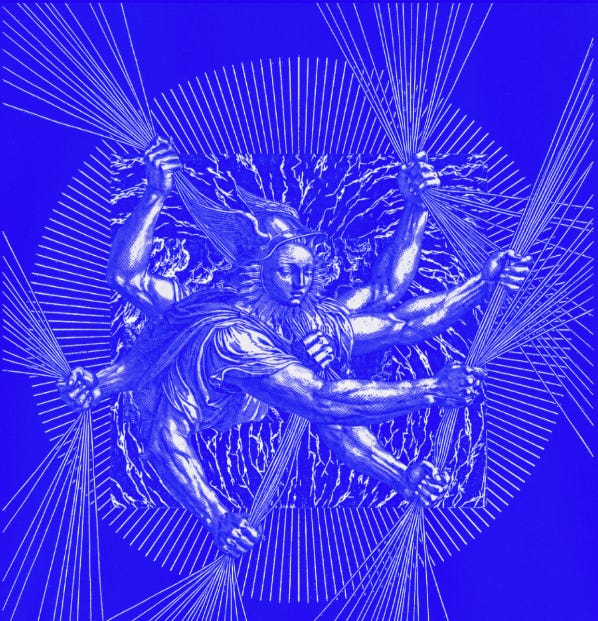
As devtools become more commodity, the things that begin to matter are branding and cultural identity. I think Hermes is a great example of this. They too are an agent in a box provider. But they have this really weird cool aesthetic! And they’re like counter cultural! And they’re like sticking it to the man by being open source! (Nevermind that they aren’t actually open source for anything that makes money, at least as far as I’m aware)
Capy is on the other end of the spectrum. Another agent in a box platform, but it’s a cute animal! You can create teams (duh) but the teams are led by Captains! Because it’s like capybara! Get it?

People are starting to pick dev tools the way they pick clothes: based on cultural norms and status and influencers. Founders think they are fighting to be the next Google, but really they are fighting to be the next LVMH.3 Do you know what it means to be LVMH? it means living in a malthusian environment, constantly running, constantly at war. I got into this field to create durable value, not seasonal fashion lines.4
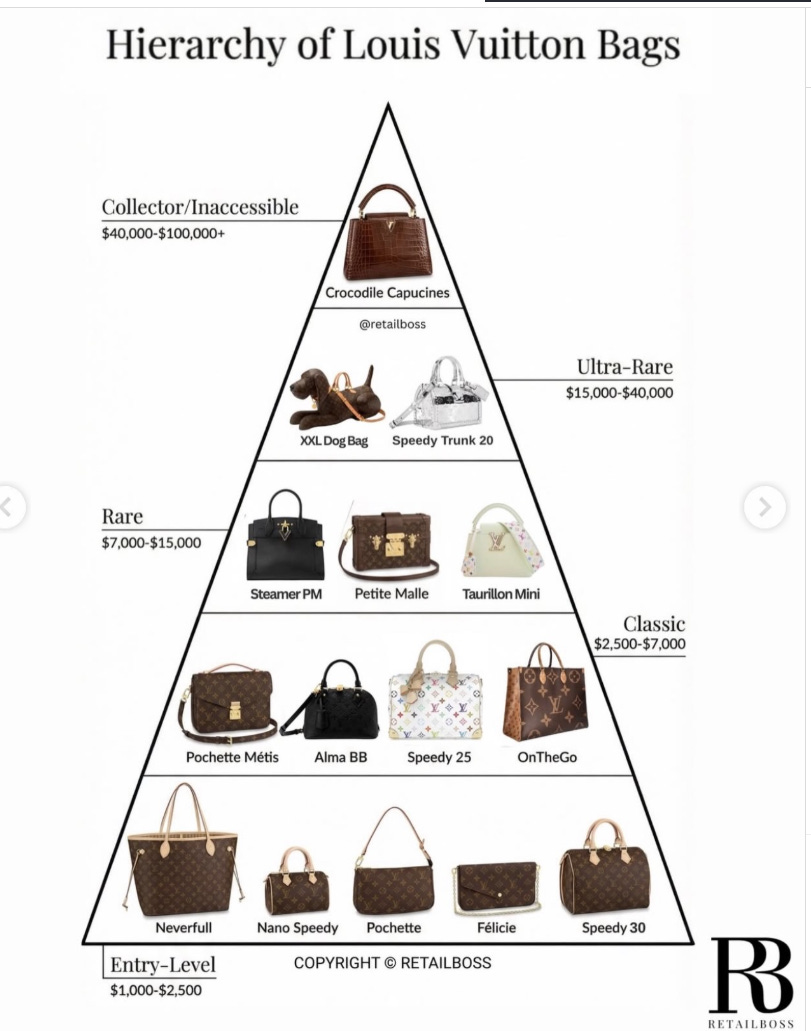
I basically predicted this would happen a year and a half ago.
In the fashion industry, roughly the same thing played out. First you had high barriers to entry, and only the people who had the materials and expertise to make clothes made clothes. Then the barriers dropped to the ground in the industrial revolution. And now you have an environment where just about anyone can make clothes, a lot more people do make clothes to fill every niche, and taste (in the form of companies like LV or Gucci, who both curate and create) matters a lot more.
…
Hopefully the parallels are obvious.
AI makes it easier for everyone to code. We should expect that this will dramatically increase the quantity and variety of software, enable new business and funding structures, and increase the importance of curation.
But I didn’t expect it to change the fundamental fabric of the industry. If all products are undifferentiated, the only real value left is how well you can grab attention. So people are putting more points in attention grabbing. Everyone is an influencer, growth hacking feels like the whole game. Do you know the right people who can signal boost you? Can you pull some favors to get on stage at a conference? Can you coordinate a launch by getting all of your high-follower-count friends to repost you on the same day? Or, worse, can you make a lot of people mad? If don’t have your own podcast in 2026 you might as well throw in the towel man, you’re done.
Some people definitely find this intuitive. These founders seem permanently online. There’s never a moment that goes by where they aren’t taking a picture and thinking of a quip. You can see the likes and follower counts in their eyes, like coins falling from the sky, more feed than person. Previous era founders dressed like they did because they didn’t care, and current era founders obviously care a lot. Which makes sense if people are buying status instead of tech!

But I struggle with it. Grabbing attention is inherently zero sum, and I think growth hacking really meaningfully distorts value creation. The whole point is to fake / hack your way to numbers without necessarily providing commensurate value because it’s a shortcut. Literally unaligned optimization. Part of why AI as an industry can feel floaty and shallow is because there are tons of backroom deals. None of the big names are paying API pricing for their tokens. Steve Yegge (gas town) gets so many tokens comped that he may as well be on payroll. But it’s not just reasonably big names like Steve, if you have like 1k followers on Twitter you can probably get some company to comp you. You just have to ask your AI agent to create an isometric view of San Francisco every now and then.
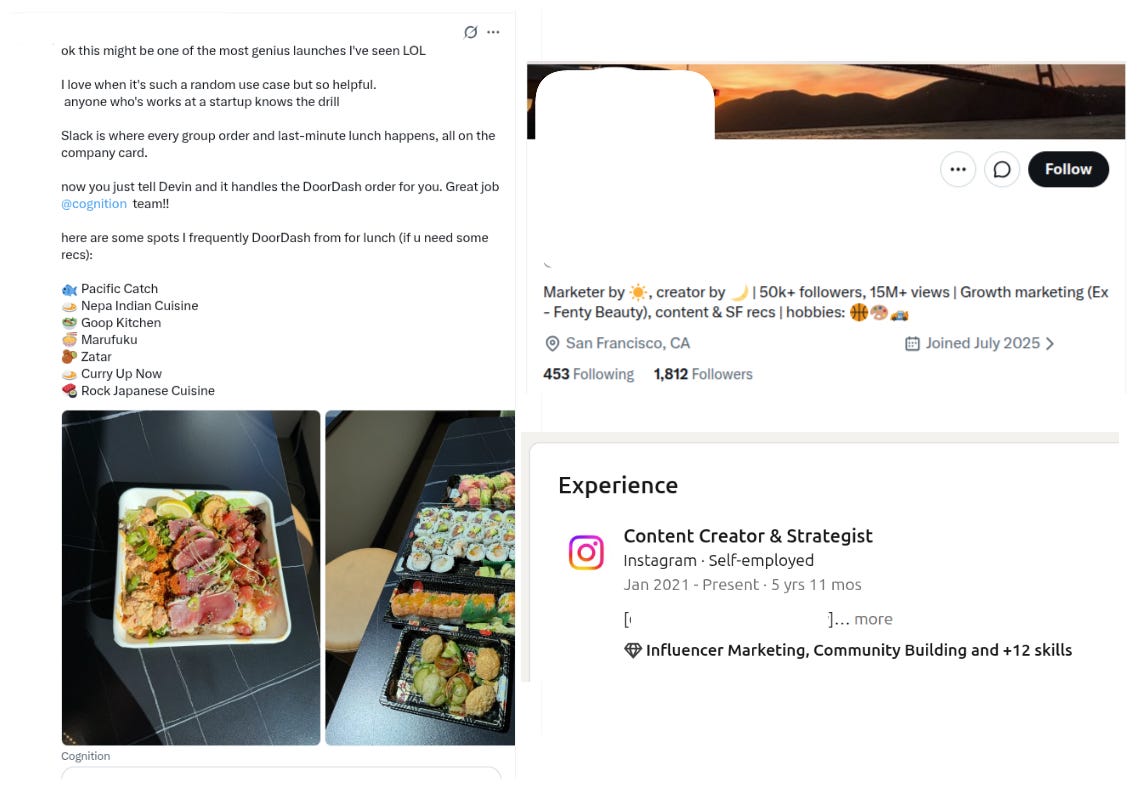
The result is that you constantly see people hyping things up, and it’s not at all obvious if it’s real. Part of why I try to minimize my time on the everything app is because I see people posting stuff about AI that I know doesn’t work or was an interesting finding 10 months ago, that gets signal boosted because you can literally pay to get it boosted. It all just feels astroturfed. (Related, sorry, I just don’t believe that talks about grok are organically trending on the social media platform that is owned by the company that owns grok.)
But tbh in the grand scheme of things, “guerilla” influencer marketing isn’t even that bad. Relentless optimization for clicks and views and engagement comes with a lot of other pretty terrible behavior that people in the bubble are totally numb to. Stop telling me to just “hire an attractive Asian woman to be my head of growth.” You shouldn’t be proud of your machine that generates mountains of algorithmic slop with fake online identities to try and get clicks. It’s not “AEO” to set up a fake blog that gives you fawning press and hides the relationship, it’s borderline fraud. Trading the same $1000 a month between all the YC batch companies in quid pro quo deals and then pretending you have “annualized” revenue is literally fraud.
Etc etc. This post got away from me a bit, and I’m worried that this comes across as unnecessarily depressing. I’m really truly having the time of my life with these tools. Have you seen my team fortress game?
The shining light is the stuff I’ve been thinking about and writing with Agentics and some of the more experimental things we’ve been playing with at Nori, which is probably why I’ve been writing so much more of that content. There’s a there there. It’s fun and joyful.
But I’ve been shying away from writing more tech commentary, and I noticed that I was doing this, and this is in some sense my way of explaining to myself why — because I increasingly dislike the way the industry is moving. Still, I generally have a lot of fun writing the Tech Things posts, so now that I’ve sorta written myself into therapy I may go back to writing more of those.
spacex sells dev tools! thats what grokbot is!
Actually, here the Chinese models really do have differentiation, because they will do things like security protection that the other models refuse to do!
one friend of mine in hardware commented that software engineers have never been in a world where everything you do can have a cheap Chinese counterfeit on the market in a few days, till now. So the LVMH comment works on a few levels
The worst part is that you will fight to keep your product up to date with the latest and greatest, and your customers will still hit you with the “why can’t I just build this myself though?” And honestly the answer to that question is getting weaker every day