

If you’re a tech team feeling the FOMO and struggling to build your AI capabilities, reach out. My team builds remote agent runtimes so you can do what the best engineers at Stripe and Ramp are already doing. Or join our public slack to keep up to date on what’s happening in AI in real time.
Since the beginning of the year, the SaaS industry has lost $2trillion in market cap. That is ~ the entire GDP of Italy, the world’s 8th largest economy. It is bigger than the GDP of Canada, Brazil, or Australia. Or you could wipe out the combined GDPs of Norway, Ireland, and New Zealand and still have some left over. That’s a lot of tokens.
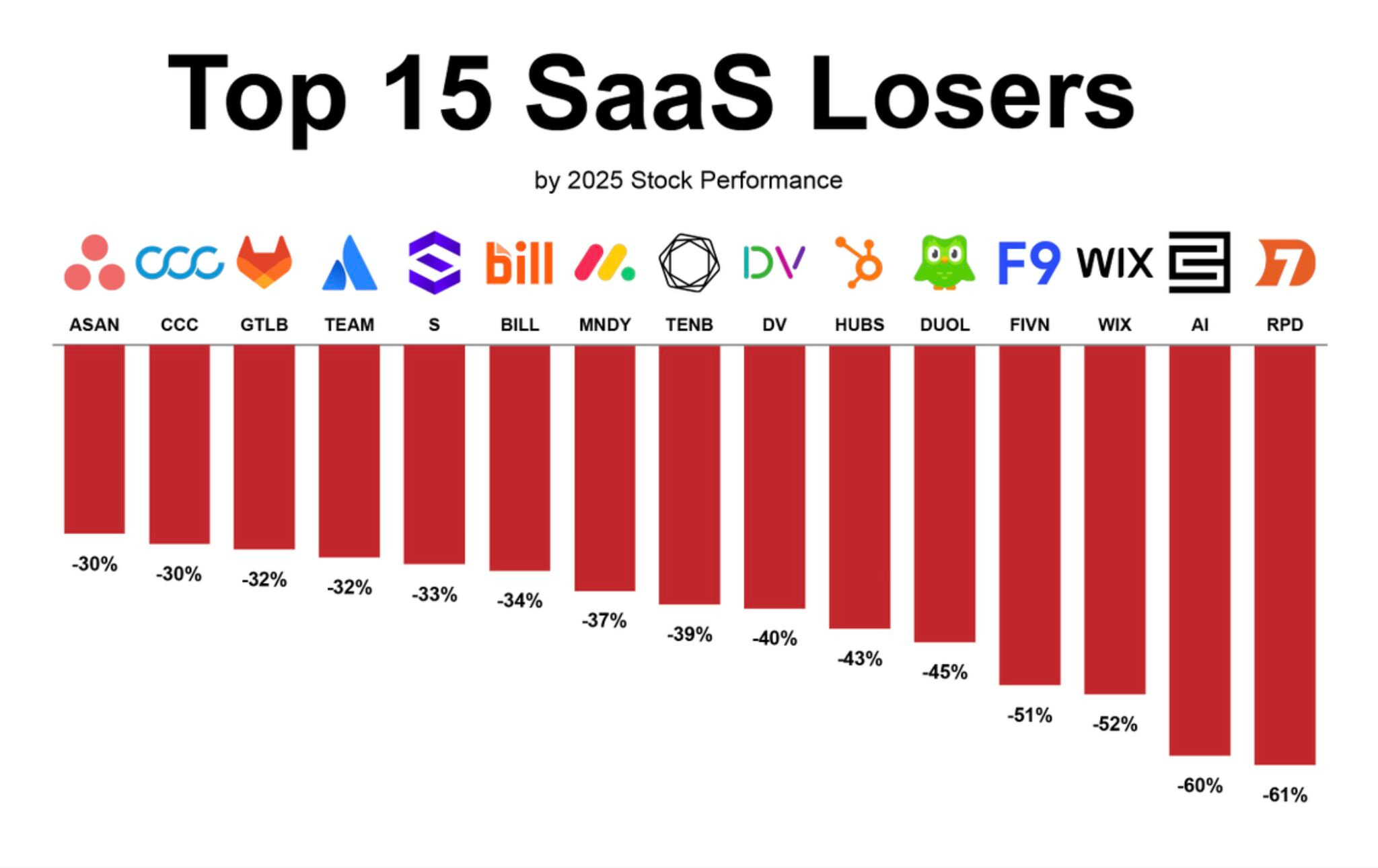
They call it the SaaS-pocalypse. What is SaaS? Obviously SaaS stands for “software as a service,” but what does that actually mean? What are you buying when you buy SaaS? The textbook answer is something like “you’re buying expertise you don’t have.” You need a CRM but you don’t know how to build one, so you buy Salesforce. You need project management but you don’t have the engineering bandwidth to roll your own, so you buy Jira. You’re paying for someone else’s competence in a domain that isn’t your core business.
But, also, that’s not really what SaaS is, right? I’ve been in startups for ~7 years at this point and not once have I bought SaaS because I didn’t know how to build the thing. At both of my companies I’ve led teams of extremely competent engineers. Most of the time, we know how to build the thing! A CRM is basically just a crud app, of course we can build the thing! If you ask me, SaaS is paying someone else to be liable for something I don’t want to be liable for. I buy Linear or Jira or whatever because it would be a distraction and a waste of my team’s time to try to maintain some internal version.
Anyway. SaaSpocalypse.
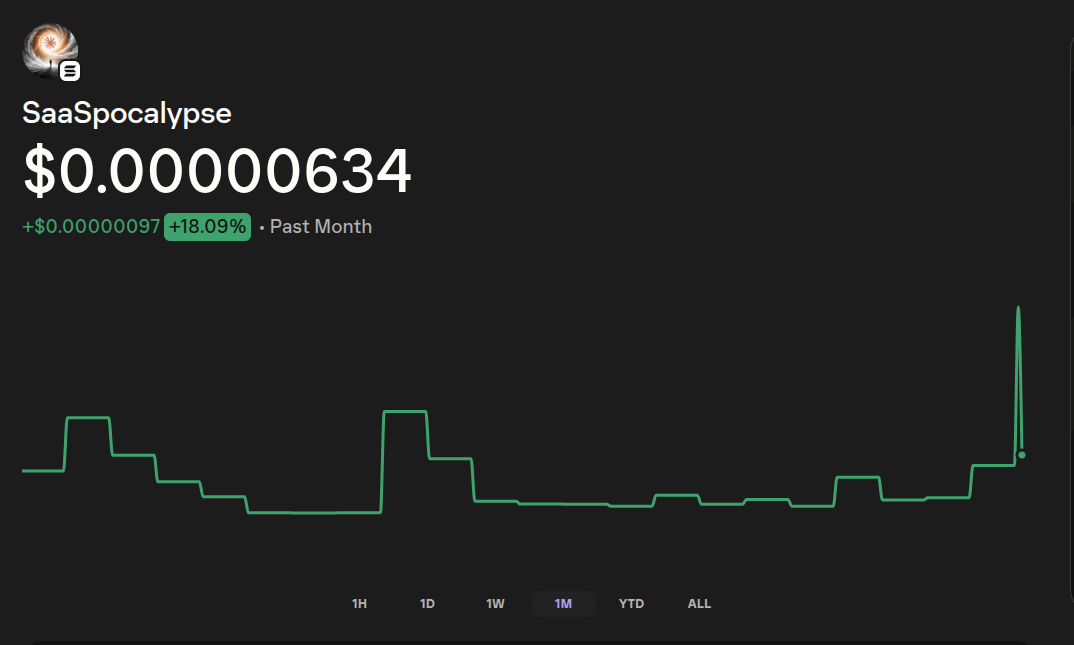
Apparently SaaS is dead because of AI. You don’t have to take my word for it, everyone is saying it. Satya Nadella went on the BG2 podcast and said that SaaS apps are “essentially CRUD databases with business logic” and that they’d all “collapse” once that logic moves into the AI tier. Forrester published a report literally titled SaaS As We Know It Is Dead: How To Survive The SaaS-pocalypse! AlixPartners put out Farewell, SaaS. Here’s Bloomberg]. Here’s CNBC. Here’s Fortune. Here’s Yahoo Finance. And, of course, there is even a Solana memecoin called $SAASPOCALYPSE (market cap: $16,000).
Matt Levine had a good take:
At this point, simply saying, publicly, “hey I think AI will disrupt _____,” for some company or industry or whatever, has a decent chance of driving down the price of _____. The market is really jumpy!
Obviously in all of these things it helps for your announcement to be well-written, well-reasoned and generally jazzy. But I have never seen a market where it has been so easy for an activist short to have a big impact. Like I feel like you could go on financial television today and say a company’s name, pause meaningfully, say “AI,” pause meaningfully, and walk off, and the company’s stock would drop 10%. Try it! “DoorDash. AI. [grim nod].”
Salesforce is down ~28% year to date. ServiceNow dropped 11% in a day. Thomson Reuters fell 16%. Atlassian — the company behind Jira, Confluence, Trello, and Loom — has been absolutely brutalized, down nearly 53% YTD at time of writing.
Is this silly? Kinda? I’m very long on AI, obviously, but this seems like it may be a bit much? Like, why is CrowdStrike down? Why is Cloudflare down? Nobody is going to look at an AI model and say “great, I’m going to recreate a worldwide distributed cloud network with edge computing in 330 cities.” Nobody is going to build a top-tier endpoint security platform that actively monitors threats across millions of devices. These are businesses where the product is deeply reliant on physical infrastructure, years of accumulated intelligence, and global scale.
I think that there are absolutely companies that are going to have a tough time because of AI. Those companies are, like, Salesforce and Hubspot and yes, Atlassian. Atlassian’s most popular product is a task tracking tool, it just is not that hard for people to build those in house and it isn’t even clear that people will continue to even do task tracking the same way.1 But companies that are close to physical infrastructure — that do things in the real world — are going to be fine. That includes companies like Cloudflare or Twilio, but it also includes companies that use software to sell things like compliance, e.g. Workday or LegalZoom. No company on the planet is going to wake up one day and decide “o, im going to go out and make deals with all of the telecoms so I can set up my own texting service” or whatever. That’s because the core value add of a company like Twilio is their relationships and deep integrations with all of the people who run the wires. The AI just doesn’t know how to do that!
Is it fair to say that, at least on the margin, some kinds of SaaS are dead? Yea, sure. If your SaaS tool exists because it is a “data integrator” or a “platform,” or its primary moat is that it’s just kinda annoying to build, you’re going to have a bad time. I have seen so many video recording tools pop up in the last 6 months, all of them almost certainly vibe coded. Otter, Fireflies, Fathom, tl;dv, Grain, Granola, Jamie, Krisp, Tactiq, Superpowered, Sonnet, Read, Sembly, Laxis, Bubbles, Backtrack, Slipbox, VOMO, nutshell, Meetkat, hynote, radiant, bluedot, readmeeting, supernormal, proactor, notes by dubber, scribbl AND of course zoom and google meets. Guys, I hate to break it to you. The TAM just ain’t that big.
But this is a very narrowly defined definition of SaaS. AI opens up new opportunities for different kinds of SaaS. Modal, Fly.io, Vercel seem to be killing it. And there is a crop of “SaaS for your agent” companies that have popped up, like Composio (toolcalling for agents), Skyfire (stripe for agents), or Anon (auth for agents). There is a generalizable principle here: even though no one knows what work will look like, it will look different, and that means new markets to discover and conquer.
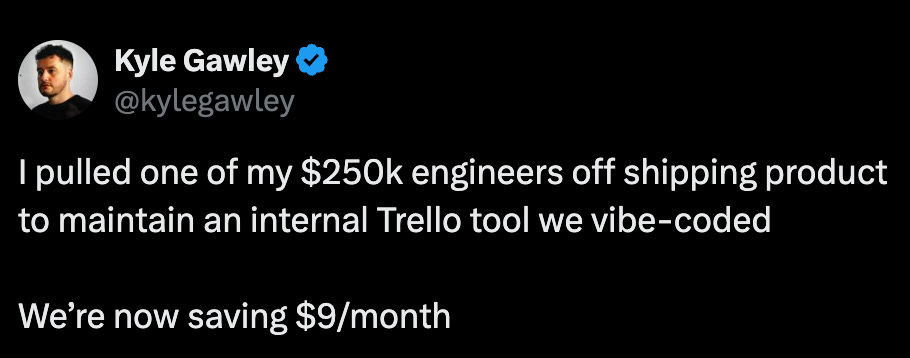
More broadly, every line of code is a liability, and there is always going to be demand for “you deal with this so I don’t have to.” A lot of SaaS is internal tooling that anyone could build but they don’t want to because it’s annoying. That stuff may be easier to simply vibe code, because it’s not directly in the critical production line that customers end up seeing. But SaaS that makes my life better — that reduces my liability to my customers or the government or whatever — isn’t going anywhere.
I think the broad shape of the new AI-driven working environment is starting to come into focus. When it does, companies that are currently feeling the heat will swoop in to acquire talented operators who executed well and built up a list of logos. That acquisition will solve the “gap” in their strategic portfolio, the stock will go back up, and everyone will basically keep trucking on till the next big disruptive technology arrives.
One last closing thought. About a year ago, I wrote:
Assume that there are five senior engineers at a company. Each can produce 4k lines of code a month, or 20k total. And let’s say AI gets good enough that it can empower a single senior engineer to be 5x more productive.
There are two possible extremes here.
On one hand, the company could decide that it does not need the extra code. The primary company bottleneck is not feature dev or maintenance, so it just doesn’t need the extra coding power. In this world, the company holds the number of lines of code constant and gets rid of 4 of the 5 engineers.
On the other hand, the company may decide that it really needs all hands on deck. Maybe the company is a standard techco that needs to push out features as fast as possible. In this world, the company holds the number of engineers (that they can afford) constant, and increases the LoC output to 100k per month.
As with all things, the actual answer is likely in the middle somewhere. But notice that any setting of this knob that’s not the most extreme option — the one that sets the “lines of code” dial all the way to the max — results in someone being fired.
If you played the clarinet in the 1910s, it was relatively easy for you to provide a middle class lifestyle for your family — the average musician was pulling in roughly half the salary of a surgeon, the highest paid occupation of the time period. Today the average musician only earns $37k. Inflation adjusted, that’s almost exactly the same as what the 1910s guy earned. But the average surgeon is earning 10x that.
It gets worse. In the 1910s the census had roughly 139k full time musicians, almost .35% of the total working population. In 2022 the total number of full time musicians was only 37k — already a massive absolute drop, but as a percentage we go all the way down to .03% of the working population.
If you were a clarinetist back before the phonogram really took off, there were a lot of jobs and they paid well. Any bar, restaurant, theater, or dance hall needed live musicians to have any music at all. Now, it’s a desert. No one wants clarinetists, because no one needs live orchestra when they can ask the genie in their pocket for whatever music whenever they want. I’d wager that you have way more people able to make music today than you did at basically any point in the early 1900s. But the ability to make a career in that space has plummeted. The barriers to entry have dropped, taste is way more important, and there are only like 3 clarinetists who matter enough to make anything close to a middle class living on taste alone. Sure, every now and then you’ll get an Elton John, but, like, you can’t exactly plan for that! This is the worst case scenario for what AI will do to all jobs everywhere, except it’ll be even worse because it’ll happen over like 2 years instead of 100.
Low barriers to entry lead to increased importance of taste and wider salary polarization between senior and junior employees. High barriers to entry lead to more livable jobs in the sector and higher average salaries.
I still think a lot of that is true.
First, regardless of whether or not ‘SaaS is dead’, there will absolutely be massive changes to the way we price and use human labor. I am worried about ongoing layoffs in the tech sector, something that would undoubtedly bring stock prices back up even as the macro environment tanks.
And second, in markets with low barriers to entry, small improvements in taste and aesthetic and userfeel generate outsized returns. Linear and Jira are basically the same product — they do task tracking for engineering teams. It’s just not that hard to build. But Linear has a fantastic aesthetic that will drive adoption long after Jira falls by the wayside. Look for the tools that people love to share and only have good things to say about. Those are the ones that will define what SaaS means.
What is an ‘epic’ or a ‘sprint’ when agents can run overnight and build anything you need?
I don't think most companies will make their own JIRA. but the easier it is to build, the more competitors enter the space, and margins/market share for incumbents goes down. Especially because it will also be easier to export data in the age of agents.
This logic applies to some companies more than others, for the reasons you say. Generally I think animal spirits, famous for being very irrational in the short term, are in fact being irrational in the short term