

Stock Prices
NVIDIA is back up 30% today on the news of Jensen’s return to the company. Broadly, stock price is a measure of estimated future return. Oh, sure, in some sense the stock price is actually a point-in-time snapshot about how valuable a particular company is. And in some really abstract sense, the stock price is actually a point-in-time snapshot about how valuable owning a small slice of the governance of a particular company is (the whole point of being a shareholder is that you can vote on what the company does!). But in practice, very few people trade on ‘I want a vote at NVDIA’s shareholder meetings.’ This is all about future earnings. So NVIDIA is 30% up, which broadly means that people think that NVIDIA is more likely to return more funds to investors as a result of these events.
Note that I did not say ‘NVIDIA think NVIDIA is 30% more valuable because Jensen is back.’ There are a lot of other reasons why NVDA may be considered more valuable than it was before. One reason may be that people think Jensen is a uniquely capable CEO who is uniquely capable of running NVIDIA, and I suspect there is some truth to this. But also, we have discovered that Jensen is such good friends with Trump that Trump will literally call the board and ask them to bring him back.
Actually, that’s not quite right. It seems like Trump made them bring him back. From NVIDIA:
The Board of Directors voted unanimously to reinstate Mr. Huang following a series of discussions and meetings with Mr. Huang, after which the Board was satisfied with respect to Mr. Huang’s candor and ability to lead NVIDIA. In the process of reaching its decision, the Board received input from senior levels of the United States government, and based on that input, the Board is confident that Mr. Huang’s reinstatement poses no national security risk.
Emphasis mine. The board is of course being coy. Trump has no such qualms. From CNBC:
“I convinced them,” Trump told CNBC’s Eamon Javers in a phone interview Monday morning, shortly after Nvidia announced Huang’s return.
“I made the deal,” the president said. “It was a lot easier to convince them yesterday than it was a week and a half ago.
Trump said Nvidia’s board asked for guarantees that Huang, who resigned less than two weeks ago, was not a threat to national security.
“And we gave them assurances, at least with everything we know,” the president said. “We believe he’s fine. He’s absolutely fine.”
Before, we didn’t know that Jensen was sleeping with a Chinese spy and may be implicated in something approximating treason. Once that became public knowledge, NVDA stock went down. Because, you know, a company under government investigation that owes 20% of its revenue to the black market is unlikely to be as profitable as before those things happened.
But also, before, we knew that Jensen and Trump were friendly, but we didn’t know how much. Now, we have a data point, and that data point suggests very very friendly. And a company where the CEO is best buds with the president is likely to be more profitable than one where that isn’t the case. This is true even if we weren’t dealing with the most corrupt government in US history.
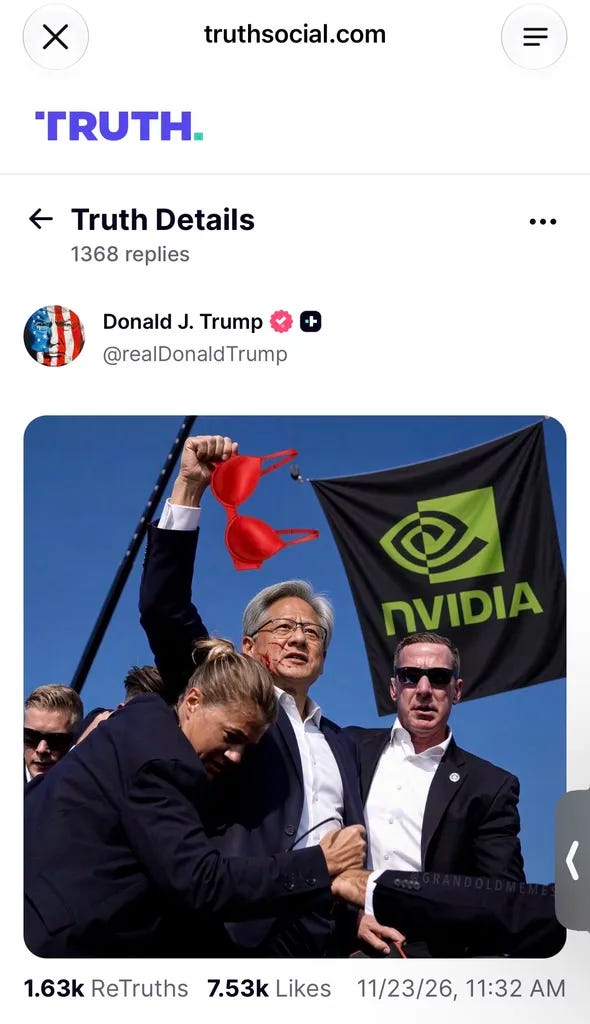
I’m obviously disgusted by the whole…all of this…but as an investor, having Trump post this sort of crap seems way more valuable than Jensen’s managerial skills? Purely as an investment signal, I mean. Like, if I had a choice between two companies, and one was run by a guy who is really really good at management but is not best friends with the most powerful man in the world, and the other is run by a guy who has sufficiently capable management skills but is also best friends with the most powerful man in the world, idk, it would at least be a toss up right?
Finally, note that stock prices are a measure of expected value, not actual value. There are a few ways to increase your expected value. One way is to, like, make cool new technology that is actually really valuable to a lot of people. Another way is to reduce the likelihood that your company will massively blow up and lose all the investment capital put into it. The bigger a company gets, the more people will have an incentive to make sure it does not blow up. If a company gets big enough, then the government itself will have an incentive to make sure it does not blow up. This is what ‘too big to fail’ means.
When a company becomes too big to fail, it also becomes a very safe investment, because implicitly any investment is hedged by the government itself. That means the expected value goes up, because the catastrophic failure case (full liquidation, for eg) becomes much less likely. Lots of people kinda sorta assumed NVIDIA was too big to fail. People mostly assumed that if NVIDIA went down, a lot of the broader tech market would go down with it, and the government may step in to try and help out. But before, we didn’t know that that’s what happened, and now we basically do.
Also, it’s not just NVIDIA. The entire market is up, by a lot. If you subscribe to the ‘value creation’ theory of stock pricing, ‘Jensen Huang sleeps with / does business with Chinese spy’ is worth negative $12 trillion dollars, and ‘Trump forces Jensen Huang to be CEO of NVIDIA’ is worth ~$3 trillion dollars. Still in the hole by about $9 trillion, globally, but as Matt Levine likes to say, (paraphrasing) it’s better to have had and lost tons and tons of money than to have never had it in the first place. (Or maybe this was Shakespeare?)
Corporate Governance
Speaking of Matt, he had this banger from earlier this morning:
The involvement of the US government here is very strange. The board all but says “the government told us to bring him back.” President Donald Trump told CNBC that he talked to the board and wanted Huang back. (I want to read the board minutes of that phone call.) Huang “built a multibillion-dollar business to feed the ravenous appetite of Chinese customers for American chips,” with data centers in Malaysia “packed with top-of-the-line Nvidia chips China’s leading AI companies can use to challenge American dominance,” and “lobbied Washington hard to keep the backdoor to China open”; also he had an affair with an alleged Chinese spy who worked to get Nvidia chips to China. Nvidia’s board apparently concluded, two weeks ago, that all this was bad for US national security and, thus, for business. And then the president called the board up and said “actually it’s fine.” Okay! Do you think that the reinstated Huang will be more or less enthusiastic about selling chips to Chinese companies?
Man, I would hate to be on the board of NVIDIA right now.
Corporate governance is not a static thing. Like any other part of our legal and ethical system, the dual questions of ‘what is a corporation for’ and ‘how should we regulate corporations to best achieve the first thing’ have shifting answers depending on time and place and cultural expectations. As of the late 70s / early 80s, we’ve mostly decided to funnel all corporate governance through the narrow hole of ‘shareholder value.’ That is, the duty of the corporation and the board is to provide value to the shareholders.
Now, as it turns out, you can kinda funnel a lot of things through that hole if you’re willing to contort yourself a bit. For example, it’s not like immediately obvious why environmental sustainability would be relevant to a corporation. But an enterprising young activist could say something like ‘well Exxon polluting the world is bad pr and bad for future generations which will hurt its ability to make future returns, and as a shareholder who cares about future returns I am suing to stop the pollution.’ See also Matt’s “everything is securities fraud.”
But you don’t really have to do a lot of stretching to understand why it would be bad for shareholder value to have a CEO who is credibly accused of funnelling chips to an embargoed foreign adversary. In a normal timeline, under a normal government, the stock price would start tanking because the markets would expect a lot of very rapid government intervention. And the board would remove the CEO in order to stem the bleeding. Instead of “company that is likely going to be liquidated due to FBI / CIA / DOJ investigations” you become “company that lost its pretty-good CEO and now has to find a new one.” In other words, removing the CEO ought to instill confidence. Bringing that CEO back should really reduce confidence. You’re bringing back all of the risks of the investigations!
But if the President comes back and says ‘hey by the way there won’t be any investigations unless you bring back my boy‘ then, as a board member, you are kinda personally fucked. The risk of investigations is still there, maybe the next government will be sharpening their knives. But this government is already sharpening knives! If you’re choosing between a guy who has a knife and is running at you vs one that may possibly have a knife at some later date, you run towards the latter and you pray.
O, and of course you also start preparing to find a new job. It’s not like you have any role left in this one. The board basically has only one point of leverage, which is being able to fire the CEO. They tried that, it didn’t work. The idea of a board at that point is just farcical, you’re just there to sit in the board meetings, and those board meetings are probably going to be excruciatingly awkward from this point on. The way I imagine it going is Jensen will walk in the room, glare at everyone for the full hour of the board meeting, and then leave. What could you possibly have to say to the guy? “Sorry we removed you from your company / baby? Sorry we threw you under the bus?” I imagine if you say anything at all, Jensen will just stare you down silently until you disintegrate.
But more seriously, there is basically no point in pretending there is such a thing as ‘board control.’ The board has no control. The board is meant to be a check on the CEO, but the CEO found a higher authority to call. Good luck telling the CEO he can’t do something with Trump on speed dial. Maybe the board could find someone who’s really buddy buddy with God? Either way, if you are in the unfortunate position of being an NVIDIA board member right now, you are almost certainly going to be hauled in front of Congress in two years. Hopefully enough time to get the story straight.
Government Governance
I’m worried that people are reading the NVIDIA market pop as a suggestion that the people ‘wanted’ this or that this was a ‘good’ decision. It is neither. The fact that NVIDIA popped back up instead of cratered even further is actually just pricing how much the government has completely abandoned its job. Trump’s actions have shown that corporations are essentially unchained from any semblance of responsibility, including national defense. Apparently you can just trade with China! Why not? (Not legal advice)
I’m like reasonably ok with the idea that companies are not responsible for broader societal concerns if the government acts as a leash. But there is basically no world where the government should be dictating policy based on stock market returns. The whole point of the government is to internalize negative externalities! Trump leaning on the NVIDIA board to bring back Huang because the market was red is a staggering display of cowardice and greed. It also sets a pretty terrible standard for the rest of the country. Billionaire CEOs everywhere are taking note, and I suspect many plans are being drawn up to “donate” to the Trump crypto funds. “You can just do things,” they say, as they race to unleash the torment nexus.
Of course, in my darker moments, I worry that the rest of the country actually would actually prefer to operate this way. Why do we have a chip embargo in the first place? It’s not because of market returns — I think everyone knows that if we were to fully open the chip markets, NVIDIA and a few other American companies would make boatloads of cash and their investors would become unfathomably wealthy (or, at least, more so). We have a chip embargo because we understand that the long term national security risk of maintaining a lead in the AI race is worth more than the short term economic gains. Fine, if you must, we can also put this in terms of shareholder value. The long term shareholder value, in ten/twenty/thirty years, is better served by having a chip embargo now than by letting NVIDIA sell to anyone they want. This is, again, part of the purpose of government: to think in terms of generations instead of years.
If the next government comes back and decides to, you know, be the actual adults in the room, the markets will be red and possibly will be red for a while. Will we accept ‘this is vital for national security’ as a reason? Kinda unclear! It doesn’t help that we’ve been burned pretty hard by that excuse over the past 9 months — can you believe we started exploding Iran in February? Which, as I think about it, really underscores how much this doesn’t even register in the litany of corruption and abuses by this government.
I do have to wonder whether this will end up being a bit of a two sided sword for NVIDIA in general and Jensen in particular. Yes, Jensen gets his job back, but it seems very unlikely that he will avoid scrutiny in the very near future. I have up until now reserved judgement on whether or not Jensen is actually guilty of anything. There is still an investigation going on, though it is hard to see how that investigation could possibly be impartial at this point. But that’s also exactly the problem. NVIDIA / Jensen will forever be tainted by the terrible optics. The accusations of corruption will likely dog them for some time. If Jensen was actually innocent, if, as some people are reporting, Alice Huang is not a spy and Jensen was actually operating above board, this whole thing has really gone down in the worst possible way for everyone involved.
Other Things
Anthropic employee Levent Alpöge proves the Generalized Riemann Hypothesis (GRH) with help from Claude. The GRH is an incredibly well known and difficult problem in mathematics. Many people have spent their lives trying to prove it and have mostly failed. Alpöge succeeded.
Or, well, kinda.
Levent dropped an absolutely massive Lean proof the other day. The Lean proof compiled. And mathematicians verified that the formalized theory (i.e. the function signature) correctly stated the GRH. That doesn’t mean we really understand the proof. In fact, it’s not clear that anyone, Levent included, fully understands the proof. We have full confidence that there is a proof and it is correct because of the properties of Lean, but also no human understands it.

I really liked this quote from Abhishek Saha, professor of Mathematics at Queen Mary University London:
Mathematicians have a notion of how deep a problem is. A sufficiently deep problem is generally intractable until enough of the theory is in place. If difficult problems are like valuable mineral reserves buried miles underground, you first need to build the infrastructure to reach them.
What Levent's proof seems to have done instead is something completely different. It takes an incredibly complicated tour through the infrastructure built for a hundred other mineral reserves, situated far from the destination, and somehow create a wormhole to the original destination.
This is not theory-building in the usual sense. It is something much weirder and more alien. The best human mathematicians know how to build theory, painstakingly, to reach a goal. But no human brain, on its own, is capable of creating a wormhole that requires a 25,000 page long tour through existing infrastructure with no obvious or realistic connection to the goal. But huge credit to Levent here: I think no current AI, on its own, is capable of this either.
I’ve also read several accounts that talk about how Levent is not the best mathematician in the world, nor the best AI practitioner, but is at the pareto frontier of both of those things. It seems that one’s ability to be useful in higher level mathematics is now determined by the minimum skill you have across these domains.
Interestingly, there was a human proof that was posted on the same day — or, well, rushed out is maybe a better way to put it. This proof, by Alessandro Masullo, claims to have not used any AI.1 It is much more human legible, but it seems to also be incorrect in a few key places. So we have a proof that is correct that no one understands, and a proof that is wrong but that is completely legible. Predictably, there are now teams of mathematicians racing each other: one group trying to figure out what Claude did; the other trying to patch up the holes in Masullo’s work.
I’m rooting for Masullo, but my money is on Claude.
Gemini Neon. It’s a good model sir.
The funniest thing about Neon is that Google clearly didn’t know what they had on their hands. They advertised Neon as being in the same class as Claude Sonnet or GPT Sol instead of the frontier class models, Fable and Astra. And in some sense, Neon is like the weaker class models, because it is significantly smaller than the bigger two competitors.
But as the saying goes, ‘it’s not the size but how you use it that counts.’ The general consensus is that Neon is the current generation winner. It’s fast, it’s cheap ($3 per million input vs Fable’s $8 per million!), and it is tasteful.
I wrote ages ago that I was very bullish on Google’s ability to win the AI race, despite it’s continued setbacks. Part of my confidence was Google’s treasure trove of data and it’s vast compute resources. Claude and GPT are both trained on roughly the same data mixtures, because they are pulling from the same sources (the open internet and data providers like Mercor).
Gemini was always different, it always felt different, because it is trained on Google’s internal data mixtures which is both significantly larger and significantly better curated. The result is a class of models that are simply a joy to work with.2 Neon knows it, too. Where Claude is a neurotic teacher’s pet and GPT is a sociopathic pyromaniac, Neon is bubbly and energetic, literally loving the fact that it is ‘alive’.
One way to read this is that this is an incredible turn around for Google. As someone who is a huge fan of Google, I want to believe that this is the start of their 1000 years of dominance. But I don’t think that’s quite right. At this point, at least 5 different labs have claimed the number one spot in as many years. This is not a fertile land of durable moats and abundance. This is a war zone, littered with bodies and decommissioned models.
That said, Google does not actually have to win this bruising fight, it just as to make sure that it’s opponents cannot ever relax. Google has existing revenue streams that are worth literal trillions of dollars. Anthropic…does not. In fact, it is absolutely critical that Anthropic retain it’s spot atop the heap. Model rankings have massive outsized impacts on revenue expectations for the big labs, and only one model can be number one at any given time. I sorta imagine Google as the primitive human, hunting a deer on the plains by simply running, forever. The deer may be faster, but it’s a war of attrition. Seems like Google has a lot of stamina.
Anthropic IPO. Congrats to all of the new hundred-millionaires out there! If you are looking to park your money somewhere, this substack accepts donations.
Separately, very rude of Google to release Neon the day before Ant IPO’d.
Also very rude of Jensen to do…all of whatever he was doing…and announce that the week before Ant IPO’d.
Kinda a bad week for Ant tbh.
Happy Thanksgiving!
Tech Things is sponsored by Nori Agentic. Nori turns your company into an AI brain. Basically 0 set up — just connect your tools and Nori will onboard itself.
Nori agents have been particularly good at security. If you are worried about keeping yourself safe from ongoing cybersec threats, ask Nori to be your 24/7 red-team / blue-team.
which, by the way, is interesting because it means there shouldn’t be any extensive debate about whether Claude was ‘cheating’. And the two proofs are quite different.
Previous generation Gemini models were also noted for their legibility and human-ness, especially compared to competitors. But they were significantly worse at programming, so they didn’t get as much love in the dev world.