

Agentics is a series of posts about how to use and reason about coding agents. If you are an expert in coding agents, or interested in learning more join our community slack. More articles here.
In the last 24 hours, two stories praising Claude Code hit the front page of Hacker News. The first, titled Opus 4.5 is not the normal AI experience that I have had thus far, is sitting at 622 points and has been on the front page for ~19 hours. The second, titled The creator of Claude Code’s Claude setup, is sitting at a cool 433 points and has been on the front page for ~10 hours. The comments under both posts tilt negative, as is always true of the HN commentariat. But there are more comments that sing praises, more than usual anyway.
Ej88 writes: “I implemented some of his setup and have been loving it so far.”
Maciejzj writes “Regardless of how much you value Cloud Code technically, there is no denying that it has/will have huge impact.”
Tripledry writes “Putting the performance aside for now as I just started trying out Opus 4.5, can’t say too much yet, I don’t hype or hate AI as of now, it’s simply useful.”
And so on.
These posts follow a longer trend of ‘How I use coding agents in <month/year>’ hitting the front page. Cf:
Using Claude Code to modernize a 25 year old kernel driver (929 points)
Claude Code is all you need (851 points)
Claude Code: Best practices for agentic coding (614 points)
How I use every Claude Code feature (534 points)
Getting good results from Claude Code (490 points)
Simon Willison, who writes extensively about AI, was the most popular blogger on HN by a long shot. Hell, even I managed to make it to the front page with my post on using Claude Code to recreate the Space Jam website (116 points).

If HN is a reflection of tech industry sentiment, the shift is undeniable: there are lots of people who are increasingly very interested in coding agents, and who have figured out how to get them to work. There is also a ton of FOMO. A lot of people report being unable to get these things to work for them, and are (imo) desperately seeking expertise that may show them the path.
Model providers getting better is a big part of the story. Claude Opus is really really good. So is Gemini 3. Coding agents are able to one shot more problems out of the box, which makes their value add more immediately obvious.
But a bigger part of the story is that the industry is starting to consolidate around a playbook for how to actually use these things. That playbook basically exactly mimics what I wrote about 3 months ago.

The three key principles, in order of importance:
Parallelize aggressively.
Test driven development is vital.
You need to set up tools that give your model access to additional context.
This is why the creator of Claude Code talks about running ~a dozen Claude Code sessions in parallel:


Why he emphasizes the importance of integrating external sources of information:

And why he highlights the need for verification and feedback:
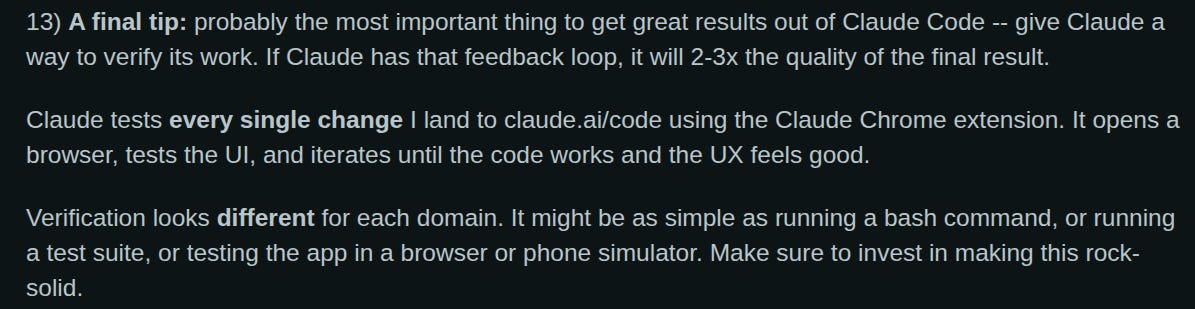
If you are an IC, this will feel foreign. The reason is simple: up until very recently, code was a precious commodity. Any line of code represented hours of engineering time, which in turn translated to thousands of dollars. Using coding agents effectively requires disabusing yourself of the notion that code is worth anything. In 2026, lines of code can be produced quickly and cheaply. That profoundly changes the calculus of what tasks are feasible.
I wrote about this a bit back in early October.

As a software engineer using a coding agent, your goal is not to get the best single shot code output. Your goal is to simply get the best code, period. If coding is a search problem, a very easy way to improve your code is by running many searches at once. So do that! Because coding is now cheap, you can spin up several agents for the same coding task. Evaluate which one did the best job, merge that PR, and simply close the rest. If none of them did the right thing, go back and spend more time on your prompt and tooling and then try again. As you iterate you’re simulating the 1000x coder, seeing and discarding all of the different routes through the search tree that don’t really work. But instead of doing that with intuition and gut feel, you’re doing it by actually looking at a bunch of variants of the code in front of you and figuring out if you like the result.
Most of the job is writing specification and code review. Design docs and markdown files, things like that. Detailed specification, sometimes even with code examples, but still specification.
If you’re already a senior engineer, this should all sound very familiar. Senior engineers write design docs that junior engineers implement. Senior engineers think about trade-offs in the codebase, about what is easy to do and what is hard to do. Senior engineers check in with their junior teammates to make sure they are on track. Senior engineers review a lot of code.
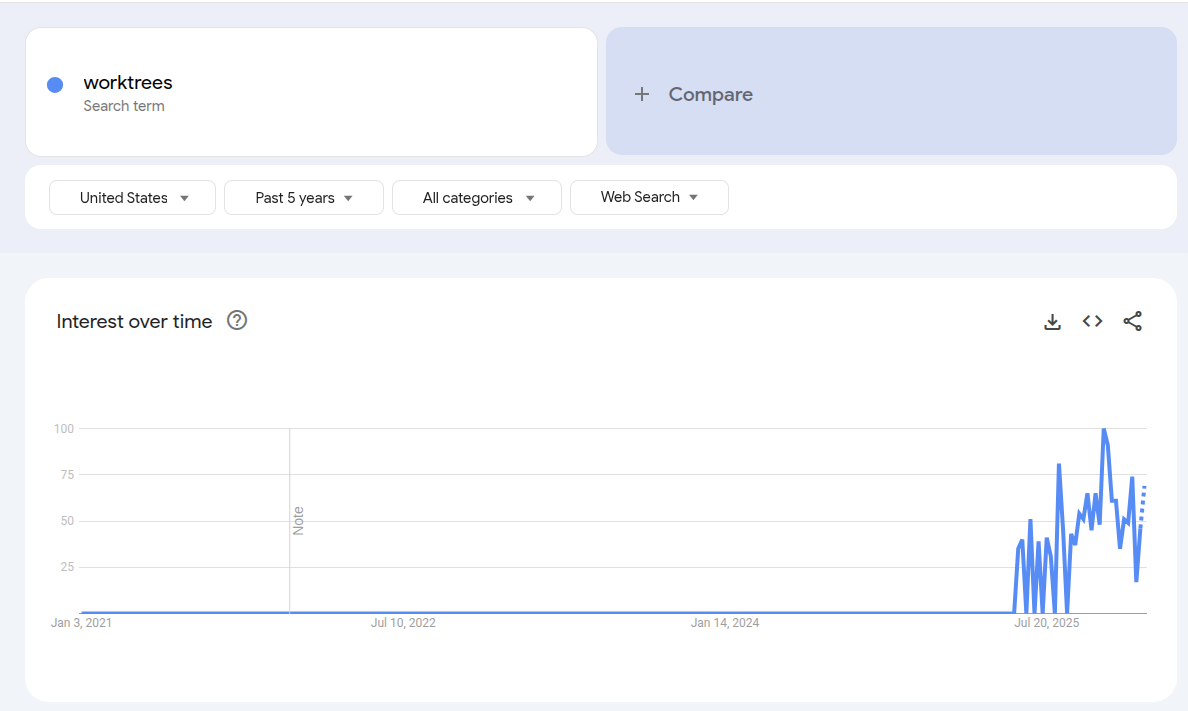
I think many ICs struggle with coding agents because they can’t let go of the feeling that code is expensive. Unfortunately, it is not trivial to reach a point where code ‘feels’ cheap. Setting up the tooling for coding agents is just extremely unfriendly, and most people with day jobs don’t have the time to sink into learning how to get these things off the ground. As an example, in order to parallelize effectively, you need something that will let multiple coding agents work on the same codebase in parallel without stepping on each other’s toes. One option is git worktrees. Did anyone besides Linus know that these things existed before they became necessary for agent parallelization? I certainly didn’t.
And even though we’ve mostly spoken about Claude Code, they aren’t the only game in town. Coding agents from Gemini, Codex, and Cursor all have their own configurations, their own quirks, and their own best practices. Even though there is some early standardization (MCP, AGENTS.md, skills are starting to see wider adoption), it clearly benefits the big players to use configuration as a form of lock-in. People who spend time ‘figuring out’ cursor are going to hesitate before switching to Claude.
There are a lot of folks who are working on making this easier, though the form factor is still very much up in the air. My own company is making big bets on personalized and team-wide configuration with sensible defaults. A lot of our customers have found a ton of value in using the default configs in nori-profiles as a jumping off point for their own configuration, paired with nori-registry as an internal “package manager” for their team to share configs across agents (def reach out if you are interested in either of these!).

But in my view, the industry still has not yet reached any kind of stability or maturation.
We are still lacking a unified interface. As someone who uses Claude Code every day, it is a buggy mess with a very poor DevEx.
As mentioned, we do not have any method for porting configuration across agents.
There is no standardized repository for sharing configuration — many people have taken to just creating lists of github urls.
We have yet to figure out seamless transitions between various interaction interfaces (mobile, desktop, web, etc).
We do not have standardized repositories for stable emulation harnesses that agents can use to verify their work.
Etc. etc.
“Programming” has had ~50-odd years of dev tooling. We went from punch cards to terminals to IDEs to web notebooks. We’re currently at year 0 for coding agents. People like making new year predictions, so here’s mine: in 2026 we are going to see an explosion of coding agent usage in the larger companies (banks, non-tech fortune 500s, etc.) that have thus far resisted the siren call. As real money flows in, that will in turn lead to the development and formalization of the wider ecosystem. Very excited to be a part of the vanguard.
Regarding the senior engineers piece, I took the same premise and arrived at the opposite title 😄
https://open.substack.com/pub/engineeringharmony/p/why-were-all-juniors-now?r=iho70&utm_medium=ios
But I think the underlying view is pretty similar - it’s a brave new world.
Would love to trial Nori with the team I’m working with