

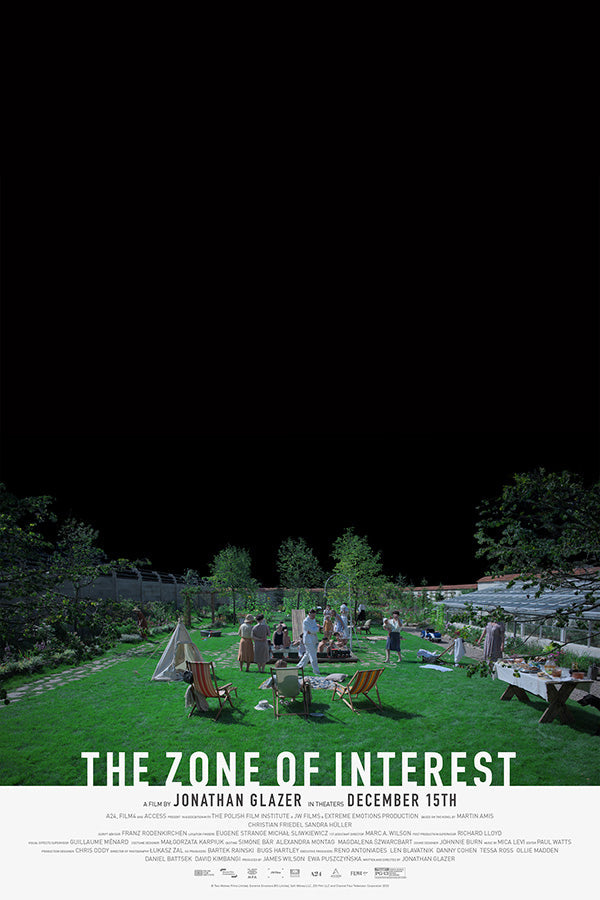
Spoilers, obviously.
The Zone of Interest opened with a cacophany of noise. Over a pitch black screen, haunting chants and droning organs blared out over the speakers. It was profoundly uncomfortable. I'd seen artsy movies open with some weird audio track before, but this felt different. First of all, it went on for a while. Much longer than I thought it would go on, at least five full minutes of nothing but that oppressive sound. Second, it filled the whole room, consumed everything. I got lost in it. It just kept going, and going, and going…
And then the movie started, color jumped to the screen, and I realized that I'd actually forgotten about the sound for a bit. Somewhere in the third or fourth minute of droning whatever, I zoned out. Started thinking about something else, like work or maybe what I was going to have for dinner.
After the movie ended, I sat and thought about that opening for a long time.
—
Like many other holocaust movies, The Zone of Interest aims to examine the banality of evil. The term comes from Hannah Arendt while she was reporting on the trial of Adolf Eichmann. To quote from wiki:
Arendt's book introduced the expression and concept of the banality of evil. Her thesis is that Eichmann was actually not a fanatic or a sociopath, but instead an average and mundane person who relied on cliché defenses rather than thinking for himself, was motivated by professional promotion rather than ideology, and believed in success which he considered the chief standard of "good society". Banality, in this sense, does not mean that Eichmann's actions were in any way ordinary, but that his actions were motivated by a sort of complacency which was wholly unexceptional.
In 2024 I think this is a pretty well understood concept, but at the time of Arendt’s writing the 'banality of evil’ concept was pretty revolutionary. Evil was thought to be a really active process, something that relied on the full throated participation of ‘evil people’. It’s a nice fiction, it allows us to separate the world into clean categories of ‘good’ and ‘bad’ and mete out condemnation and punishment accordingly. But the Holocaust, with its tens-of-thousands of willing passive participants, showed that in reality evil can come from totally common and non-unique sources of motivation. Something as simple as wanting to excel at a job, for e.g.
The Zone of Interest revisits the exploration of the banality of evil through the lens of Rudolph Hoss.
By every account, Hoss is an unremarkable individual. He married his highschool sweetheart, he has a budding family, he's upper middle class. He likes to swim, and takes his kids to the river often. At work, he's a middle manager in a large organization, essentially tasked with managing a foreign office (complete with a company house, which is where almost all of the movie is set). He's dedicated to his work; he takes pride in his craftsmanship and is eager to impress his bosses with his creativity and efficiency.
So why is Hoss our protagonist? Because he is the head of Auschwitz. The large organization he works for is the Nazi party.
—
The Zone of Interest, as a film, is fascinated by the mundane bureaucracy behind the Nazi party. The camera follows Hoss and his family around as they just live their lives, not 100 yards from one of the greatest atrocities ever committed. Hoss fills out paperwork. He takes calls. He writes and asks for recommendations. His wife gossips with the neighbors. She has a little garden party. Her mom visits and they chat about their lives. The kids play in the garden, in the pool, in the river. They go to school. The baby cries.
It all seems so normal, but it's punctuated by moments of "what the actual fuck?" that pull you out of the scene so fast your head spins. The paperwork is for crematoriums. His wife is talking about the jewelry she gets from the Jews who were being murdered. The kids are playing with teeth! Every scene there is an off screen scream, or someone-that-is-obviously-a-guard yelling, or a gun shot, or all three, and the characters just ignore it, and you in the audience are gritting your teeth because its so obvious to you how fucked up the situation is…except for when it isn't obvious, because you also, in the span of the movie, forget that random screams are not, in fact, normal.
The Zone of Interest excels at creating this deeply disturbing uncanny valley, in which you the viewer are constantly on edge because you know, you know, that horrible things are happening right behind the wall, but you also you catch yourself forgetting until something pulls you right back. That's the banality of evil.
There are a lot of moments that are literally jaw dropping. Maybe the most visceral is when Hoss is playing in the river with his daughters, only to discover that he is swimming in the remains of corpses that are being dumped up stream. But I think the one that got me the most was when Hoss meets with Topf and Son. To recap, Hoss sits down with these two engineers, and together they pore over blueprints for a new crematorium. They talk numbers. The engineers are clearly proud of their device — it manages to cool one chamber so that it can be cleaned out (of human remains) as the other one heats up (to burn more bodies) in an alternating clockwise system. Efficiency is the name of the game; it never occurs to anyone in the room to question whether being efficient at killing people is a good thing.
I think that scene hit me so hard because, deprived of context, I've been in those kinds of meetings before. "Well we got to make the ads more efficient!"
—
In my opinion, this movie is almost entirely dependent on the audio track. The Zone of Interest makes the conscious decision to never actually show the inner workings of the camps. I can speculate why — I don't think it's possible to visually capture that magnitude of evil, at least not in a way that will feel real to a modern audience. In some ways, the film has to rely on audio instead. But this is not a weakness of the film. Rather, it makes the movie what it is. The juxtaposition of happy visuals against audio of executions neatly creates the tension that The Zone of Interest is going for. Even though it's a technique that's used throughout the film, it doesn't get old. Not surprising that the movie won an Oscar for the audio.
And that brings me back to the beginning — the cacophony of sound that serves as the audience's introduction to the movie. The Zone of Interest is about dissecting the banality of evil through deep examination of one of its most ardent students. But it's also about creating an environment in which the audience might experience a bit of what it's like to be Rudolph. The musical score at the beginning is uncomfortable and weird and wrong. It's also easy to forget, and drown out, especially when it is continuously happening. Evil is easy to ignore.