

[This was sitting in a draft state for a long time before I finally got around to finishing it up]
Spoilers, obviously.
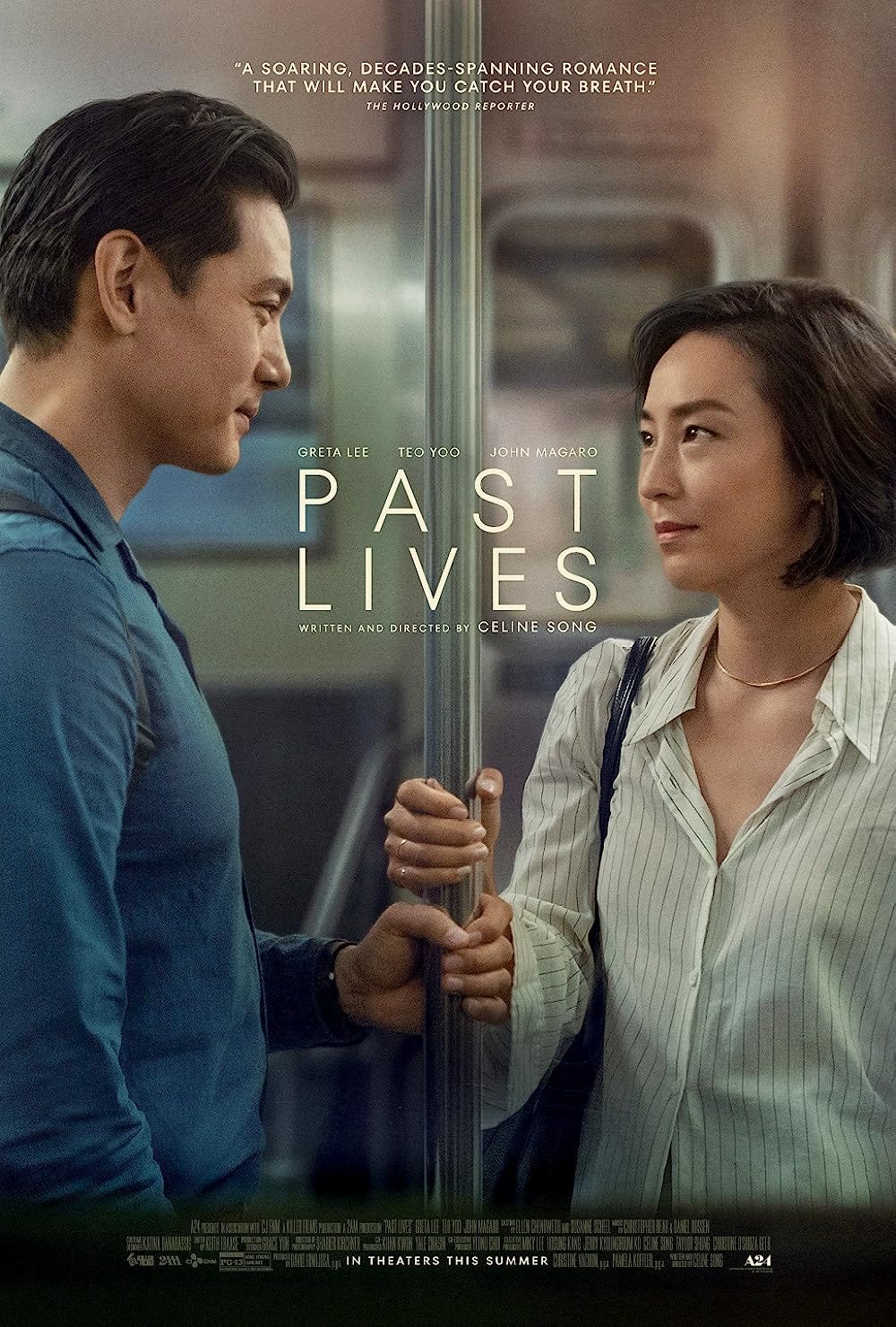
“Past Lives” is a recent movie that released theatrically in the US — and more importantly, to my friend group — in June of this year. As an A24 movie it made waves with all of the expected people, but I was nonetheless surprised at the number of close friends who told me that it was the best movie they had seen this year. I went in with fairly high expectations, and while the movie definitely succeeded in creating an emotional response I left the theater feeling deeply unsettled.
My partner and I spent a good while talking about the movie over dollar pizza, and I think we both landed on the same central complaint: “Past Lives” is an incredibly indulgent movie.
Quick story beats, just to make sure we’re all on the same page.
The crux of the movie is a relationship spanning 36 years between the main character, Nora (a writer and a Korean immigrant who arrives in North America at 12), and the deuteragonist Hae-sung (her childhood best friend who stays behind in Korea). The movie is split into three phases, each with 12 year gaps; each phase involves Nora and Hae-sung (re)connecting after the previous gap. The third phase also includes Arthur a Jewish-American writer, who, by the time we get to really interact with him, is Nora’s partner of 12 years, husband of 7.
Before diving into criticism, I want to start with what I actually really enjoyed. This movie does a fantastic job of capturing real and raw human emotions, emotions inherent to romantic relationships that just don’t work out.
A lot of partnerships really shouldn’t exist. There are tons of valid, great reasons for two people to NOT be together. And I’m not really talking about obvious cases, where one or both partners are abusive and toxic. It’s more subtle than that. Maybe she wants to climb the corporate ladder and he wants five kids. Maybe he wants to be a part of his larger extended family, and she doesn’t. Maybe she’s religious in a way he isn’t. Maybe the two of them just have trouble communicating.
In a relationship, it’s all operating in a vacuum. Lots of times, relationships can go sideways even though there is no bad guy. It’s too tempting to bucket people as ‘right’ and ‘wrong’, but the frustrating truth is that there’s just subtleties. And most of the time, the subtle things that don’t work only become painfully obvious halfway through a relationship.
I mention all this because even the worst relationships have something at the core that is valuable. The thing that drew the two together in the first place. In the process of tearing down a relationship, you have to be willing to lose that core. And even when that’s the right thing to do, it still hurts. There is an inevitable sense of loss and longing and regret.
So with Nora and Hae-sung. Through their relationship, the movie depicts an incredibly evocative emotional intensity that many in the audience resonate with. There are not that many movies that make me feel strong emotions; this movie does.
The problem I have with the movie — my main critique — is how it handles those emotions.
A great many people go through devastating, painful breakups. And countless more have a ‘missed connection’ story. And then they move on. The mature, healthy thing to do is to process the emotions that fall out of an intense split, learn from the experience, improve yourself, and then move forward. The protagonist of “Past Lives”…doesn’t. She remains stuck thinking through possibilities, lives that may have been lived, in a way that does a massive disservice to the here and now.
This is maybe a controversial take: at the core, I think Nora is not a ‘good’ person. Her inability to let go of or healthily process her own emotional hangups cause a fair bit of collateral damage to the people who are ostensibly closest to her. This wouldn’t be the first movie to have an objectionable protagonist, but I think “Past Lives” tries hard to make the audience sympathize with Nora.
Arthur and his role as Nora’s partner is perhaps the main source of discomfort for a movie audience. His presence is tangibly awkward, a spanner that turns a RomCom into a tragedy. But the movie takes pains to give the audience a way to rationalize out of Arthur’s obvious distress. First, they emphasize more than once that Nora and Arthur have a greencard marriage. Second, in the movie’s most self-aware moment, Arthur comments that in a stereotypical story, he would be the bad guy standing in the way of Nora and Hae-sung’s star-crossed love.
Though Nora essentially ignores Arthur’s visible discomfort, she never faces the consequences of this behavior. Arthur — a man who learned Korean to be closer to his wife and her family — takes everything that plays out on the chin, all the way through to wiping his wife’s tears over a relationship that didn’t happen.
Cards on the table, I hate this authorial decision.
In the theater I couldn’t help but think to myself, why on Earth is Arthur justifying Nora’s terrible behavior? I really wish they didn’t diminish Arthur, or (more importantly) give the audience an out to justify or feel better to themselves about Nora’s decision making. And really, independent of how I feel about the ethics of the movie, I personally think it would have been so much better if “Past Lives” really forced the audience to sit with the tension. Because in a lot of ways, that is the crux of it! We choose the high road, and sacrifice for our partners and loved ones, even though we may want something else. And in real life that’s a hard thing to do!
Ironically, I think Hae-Sung actually comes out looking really reasonable throughout. He respects Nora’s boundaries. He only reaches back out to Nora after he breaks up with his previous relationship. More than that actually — he avoids Nora while he’s dating someone else. (This was a subtle point in the movie. To recap, Nora briefly mentions that she visited Korea just before her marriage to Arthur and reached out to Hae-Sung, but Hae-Sung dodged her. On it’s own, this is a pretty innocuous thing; missed connections happen all the time. In context, though, I can’t help but feel like Nora was reaching out just to check, before committing to Arthur.)
And I think, for the movie to work, Hae-Sung has to be essentially perfect. Consider the alternative, where Hae-Sung is maybe a bit too pushy or a bit too confrontational. It would be so easy for the audience to avoid feeling what Nora feels, what the director wants the audience to feel. Instead of being a movie about missed connections and the depths of human relationship, it would instead be about toxic exes. That’s…not what they are going for, obviously.
Still, I think this points at a deeper conflict that I have when evaluating Nora. Imagine, for a moment, if Hae-Sung, Arthur, and Nora were gender swapped. I think audiences would be significantly less forgiving if we were watching Nolan emotionally cheat on his loving, doting wife Ashley. Without trying to be too emotionally charged, I’m sure many in the terminally online crowd would actually jump straight to ‘this relationship is abusive’. Hae-Sung needs to be perfect because everyone becomes acutely aware how toxic this behavior actually is, at least from a masculine lens. Social blinders help give Nora a pass.
Sorta.
Like I said at the top, I was deeply unsettled when I left the theater. The movie presents a really warped view of what is acceptable in a relationship, about how partners communicate and how emotionally aware they ought to be of each other. Should my friends — some of whom are going through their own breakups right now — really hold this movie in high regard? Catharsis is a powerful drug, I enjoyed Bojack too much to think otherwise. But I nonetheless wish this movie, which is otherwise so so good at portraying and engendering real human emotion, was a bit more thoughtful of the consequences.
PS: My partner and I actually did “Past Lives” as the second half of a double feature. The first half was “Only Yesterday”, a Takahata-Ghibli film about childhood, nostalgia, and maturation. It worked really well as a double feature. It wasn’t lost on us, for example, that the protagonist of “Only Yesterday” looks on her childhood tears with a sort of gentle mockery, as if to say “How silly I was for crying!”, while the protagonist of “Past Lives” ends the film sobbing.