

When I was a kid I tried making an everything-I-love sandwich. If you’ve never had an everything-I-love sandwich, the recipe is simple. You take everything you love and put it in between two slices of bread and try to eat it.
I’m worried that you read “everything I love that would be reasonable to put in a sandwich.” But that’s not what I wrote. I wrote “everything I love.” So, for 8 year old me, that included Costco taquitos, and fruit by the foot, and bologna, and ice cream, and lunchables (which kind? Does it matter?)
And you know what? That shit tasted awful. It made no sense. Threw most of it out, never made one of those sandwiches again.
Anyway, let’s talk about Dune Imperium.

My buddy Azraf got me this game as a birthday present 4 months after my actual birthday, because he knows I don’t like birthday gifts but I’m ok with random “here is a gift because you’re my friend” gifts that land on a totally non specific Tuesday. In the time since he got it, we’ve played the game maybe a dozen times with the friend group. The box says that a game takes about 60 minutes to run through. This is a lie. We have yet to finish a game in under three hours.
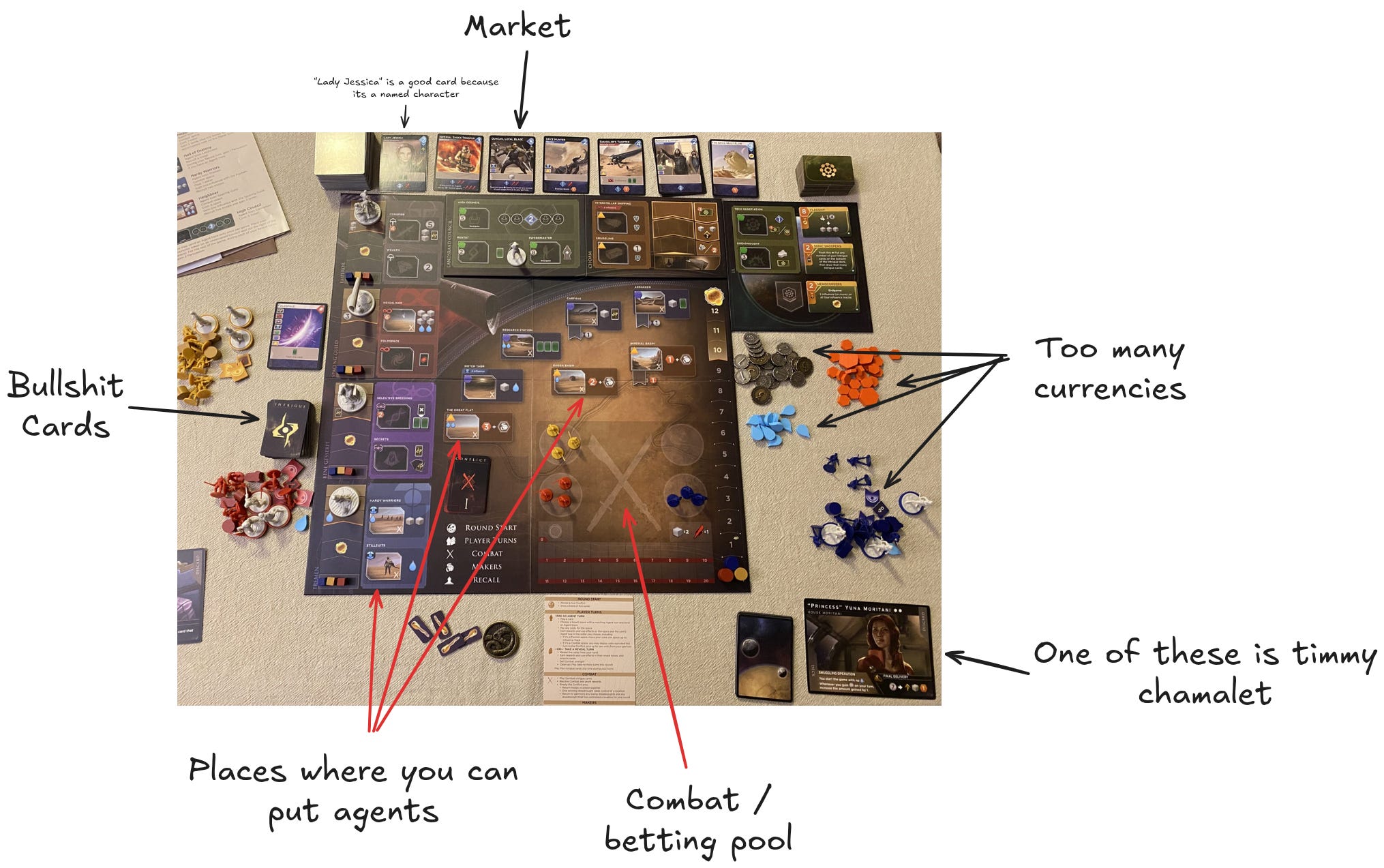
Dune Imperium is what you get when you take your favorite mechanisms from every other board game you’ve played, and stick it into a single game. It’s got the worker placement mechanics of Agricola or Viticulture. It’s got the deck building mechanics of Star Realms or Dominion. It’s got the betting / positioning mechanics of poker. It even has the random bullshit cards that you get in Catan.
It is, in other words, an “everything-I-love” sandwich as a boardgame. Except unlike my childhood culinary monstrosity, Dune Imperium actually works. It works really well. Last I checked, Dune Imperium was sitting at number 6 on the boardgamegeek rankings.
How? What kind of alchemy makes a game this convoluted actually fun?
My current best guess: the game has a sort of circular rhythm to it, which makes the whole thing function.
The rough structure of Dune goes like this:
The game has ten rounds, and each round involves players going in a circle taking a turn until no one can do anything anymore;
On your turn you play a card. Based on the card, some things happen, and you can place an agent somewhere on the board that doesn’t already have an agent on it;
Placing an agent may require some resources (water, spice, coin), and will often give you some resources (water, spice, coin, military units, persuasion, card draw);
Once you run out of agents, you can pick up some new cards from a shared market using any permission you have, and add them to your deck;
Once everyone has finished, you evaluate who invested the most in military units — that person wins the combat for that round and gets some award;
The round resets and the next player in the circle goes first…unless someone has 10 victory points, in which case the game ends.
It sounds like there are a lot of options, but unless you do something really stupid you’re pretty much on rails for most of your turns. You get some water. The next turn, the water lets you get some spice. The next turn, you turn the spice into units. The next turn, you deploy all the units and win a combat. Now you’re out of units and out of resources, so you start the cycle again.
There’s something very civ-coded about these mechanics. At each step it feels like you’re making some complicated decision; in practice, you are highly limited by what resources you have, what cards you have, and where your opponents place their agents. You’re basically forced to do something useful with your agents each turn. Good players will negotiate with each other and try to block other players, and there is some skill required in figuring out how many troops to deploy for a given combat (any troops you deploy will be removed for the next turn, regardless of whether you won or not, so figuring out what to bet is all about reading your opponents). But in general this is not a tactics-heavy game. In half of our games, players would simply pre-move before the other players had finished their turns, because they knew that new information wouldn’t change their play.
Instead, all of the actual skill of the game is in the long term strategy. Again, the game is only ten rounds. Almost all of the victory points that you need to win are doled out in the last three rounds. And basically every game I’ve been in has been shockingly close, which I think is due to a combination of the relatively short amount of time to build an engine and the amount of ‘guidance’ even new players have in terms of basic tactics. As a result, good players are constantly scheming about their last few turns from the very beginning of the game. Mostly, that ends up being about the deck building — that is, understanding how to value different cards based on your existing deck, your particular leader abilities, and your personal road to 10 points.
O, and the random bullshit cards. Did you think I’d forget to mention the random bullshit cards?
Despite being a pretty ‘crunchy’ rules heavy game, there’s a surprising amount of variance built into Dune. Some of that is built into the market-place drafting concept. Maybe you’re unlucky and all of the good cards keep getting bought up before your turn, whatever, that’s the draw. But when someone pulls a god damn bullshit card right as you’re about to win a combat that you spent four turns preparing for, that’s when you see red and start looking around for actual daggers.
Bullshit cards (in the game they are called ‘Intrigues’ but we have only ever called them bullshit cards) are special cards that you can pick up through the game that have a random effect. These things have extremely high variance. One card gives you two coin, which is nearly worthless after turn three. Another lets you get the military equivalent of 4 units, which you can choose to spring at the last second when everyone has committed their bets for combat. I’ve been in at least two games where someone top-decked a bullshit card to steal the win.
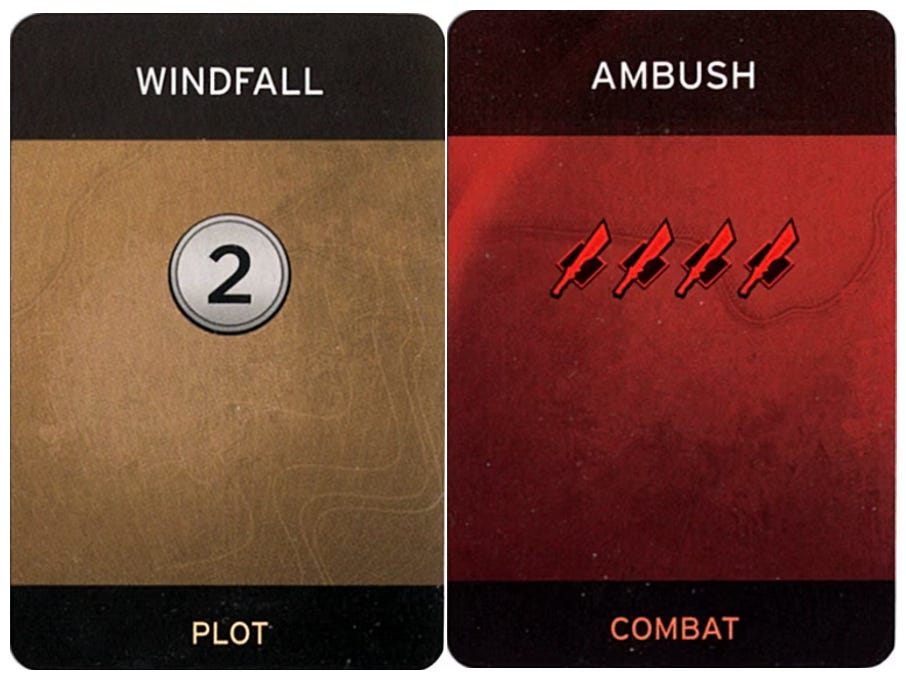
In a lesser game, that variance would be enough for me to drop off entirely. Crunchy games like this one depend on making their players feel smart. If you lose to random bullshit, you don’t feel smart, you feel cheated. But Dune somehow manages to to transmute that frustration into a desire to play again. I think it’s because in most games, everyone feels like they are one turn away from winning. That “so close” energy makes the game stick in your head, constantly turning over what things you could have done differently to change the outcome.
Of course, I would say that, because I’ve actually won the last few games I played. Some of my other friends have lost 5 games in a row. I think they are less enthused. The biggest issue with the game is that there is no real come back mechanic. When you’re behind, you’re just eating glass for the next two hours. It’s still possible for the lead to screw up, but in a competitive game you want to have options for forcing errors (again, see ‘make the players feel smart’). Dune doesn’t really have that, in large part because of the ‘on rails’ tactical feel to the whole thing. If a player buys a fantastic card off the market in the first turn or two, the game might just straight up be over. Which sucks, because of course you still have another 3 hours of game ahead of you.
Still, it’s a miracle a game with this many moving parts works at all. There are literally 5 different currencies to keep track of! I cannot begin to fathom the amount of play testing they had to do to get this game to feel even remotely balanced. It’s a testament to the designer that you can pursue a pretty wide variety of strategy and still come close to winning.
At the meta level, I find Dune fascinating as a piece of game design. I’ve long felt that there are only like 15 different kinds of game mechanics,1 and most boardgames are just mixing and remixing those into different combinations and themes — for eg, Seven Wonders is just the card passing mechanic from hearts, Sushi Go is just seven wonders with different scoring, etc. Most games need to settle on one mechanic in order to have any hope of being good, anything more ends up just being too much.
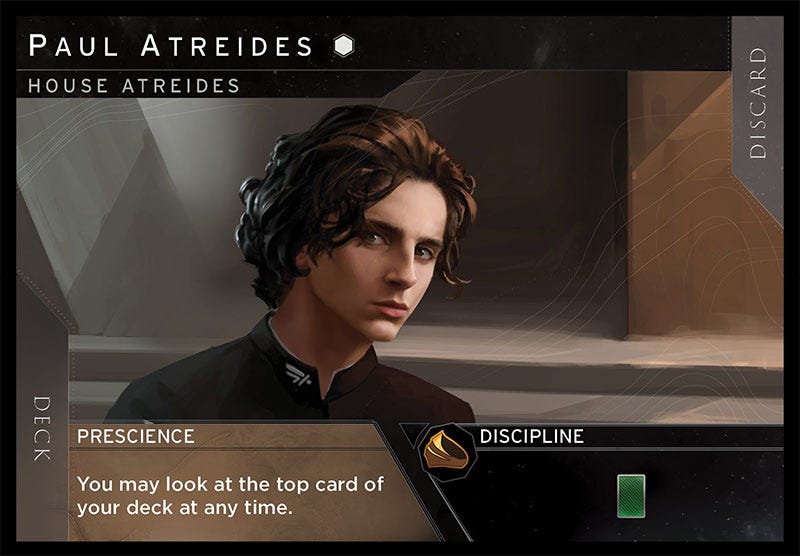
Dune joins Spirit Island as a rare exception that proves the rule. Also it’s the only game where you can play as a scrawny pingpong player that got dropped in the dessert.
I’m not sure if it’s actually 15, but it’s more finite than it seems. Trick taking and other information-sharing mechanisms like card passing, dexterity games like jacks, dice rolling, betting, variations of charades, variations of solitaire, and abstract strategy are all pretty old mechanics. More recently there’s things like worker placement, deck building and market drafting, playing against an ‘AI’, auction mechanics, ‘combat’ / ‘event’ dice rolling, currency trading, and whatever the hell diplomacy is (abstract strategy + talking?).
Good review! -Azraf
https://shapeofcinema.substack.com/p/dune-1984-villeneuves-dune?r=8dbojf&utm_medium=ios