

Two months ago I wrote about the movement in the hit game Silksong, a post that randomly became one of the most popular things I have written. Since then, I beat the game and put it away. I don’t really ever replay games. I moved onto Hades 2 pretty soon after. But the game stayed on my mind, I started listening to the soundtrack while working and lurking on the Silksong subreddit and trying to get my wife to play through it (she has since started her own save file and is currently fighting Moorwing!). And then at some point I went ‘ah fuck it’ and started up my own second save. I can count the number of games I have replayed on one hand. I have never played the same game back to back like this. I really like this game.
One of my favorite parts of Silksong is the sense of discovery. This is an extremely well written game. Which is an odd thing to say, because the actual dialogue is, like, fine, and most of the game proper doesn’t have much of a story beyond ‘the main character gets kidnapped and then beats up the kidnappers and everyone else in a 100 mile radius’. But anyone who has played the game knows what I mean: Silksong has an extremely well thought out world, which makes it an absolute joy to run around in.
Most of Silksong’s story is told through the environment. You are exploring an old, decaying civilization, one that was built on top of other once great civilizations. Playing Silksong is simultaneously an act of archeology and of intrigue; for a certain kind of player, the game ends up feeling more like a detective novel than an action packed fighter. And since I can’t stop thinking about this game, and I write to think, I figured I might as well write everything I know about Silksong’s extremely detailed lore.
This post isn’t about anything except the game itself. It isn’t an exploration of the plot or themes. It isn’t about making a statement. It is literally just my personal notes, trying to untangle the puzzle box that is Silksong. To all the people who subscribe to this blog only for AI content, or really just anything else, feel free to drop off here.
Lore is about time and place. The place is mostly pretty easy — the game takes place in and around a kingdom called Pharloom. Pharloom itself is built on top of a pool of void, and nestled between Mt. Fay on the left and some sort of large water table on the right. There are some details that make the precise location interesting; we’ll get to those later.
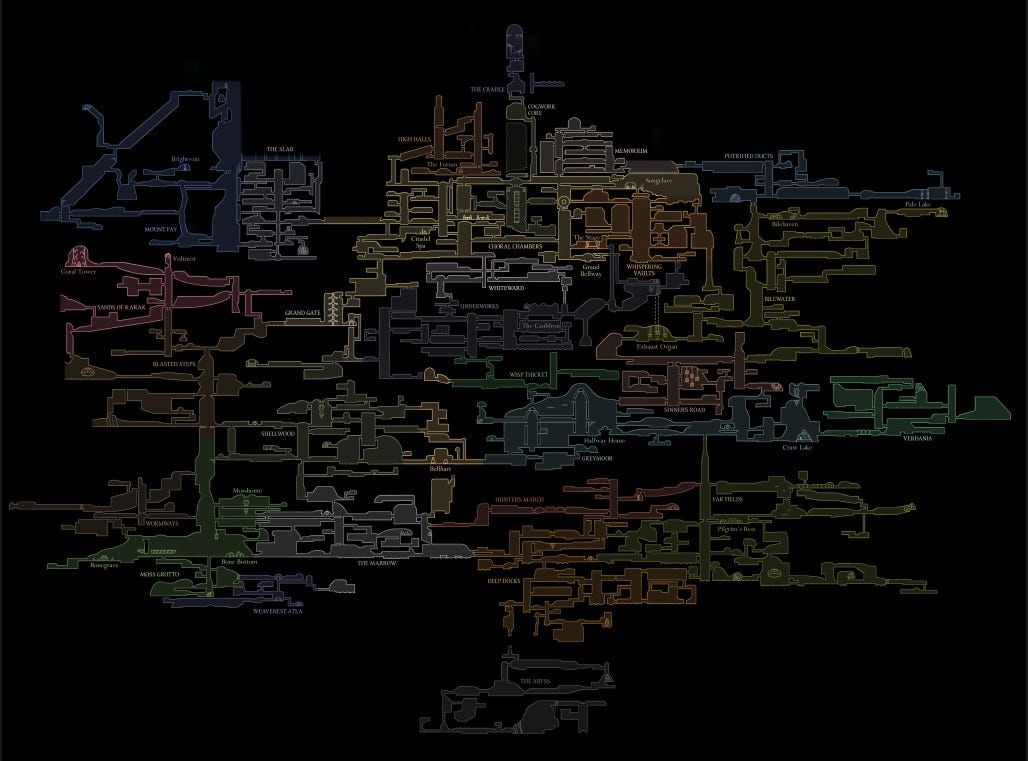
The timeline is a bit more difficult. Pharloom is a living and breathing ecosystem, one that has layers and layers of history built on the same area. I think the best way to pick at Pharloom’s lore is to understand its history, so most of this lore dump will be focused on the timeline.
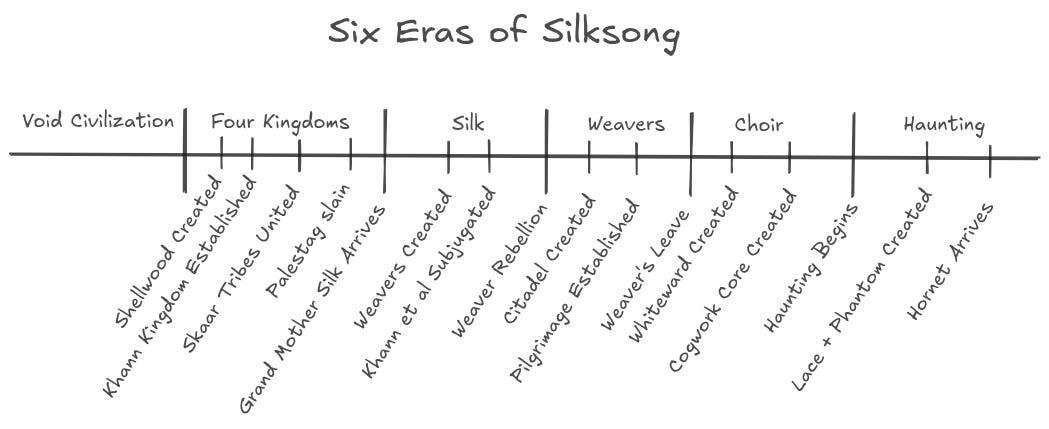
You can break the timeline into roughly 6 sections. In order from oldest to most recent: the era of the void civilization; the era of the four kingdoms; the era of silk; the era of the weavers; the era of the choir; and the era of the haunting. The entirety of the actual game takes place in the last few days of the last era. The rest is inferred entirely from the background, environment, dialogue, and the objects scattered around the game. Unfortunately, much like actual archeology, it is extremely hard to pin down exactly which events occurred in which order. For example, we know that the Citadel was once ruled by the Weavers, and later ruled by the Conductors, and later still taken over and influenced by Grand Mother Silk. We do not know which group was responsible for what happened to Verdania. In the timeline below, I more or less take a guess based on the surrounding context, and try to call out places where I am filling in gaps.
Era of the Void Civilization
We know virtually nothing about this era. There was some sort of civilization that worshipped the void. It is very old. That’s basically it.
The remnants of the Void Civilization first appear in Hollow Knight. In fact, those remnants appear all over the game — in arcane eggs, totems, giant bug carcasses. In Silksong, less so. There are a few lore tablets and an arcane egg present in the Pharloom Abyss, but otherwise there seems to be a lot less structure. This may be because this outpost of the Void Civilization was less developed than that of Hallownest, or because the civilizations of later eras scrapped most of what remained. The lore tablets do indicate that the void civilization was composed of higher beings who sought out the void as a means to end their own suffering and identities.
It seems like there is some connection between the Abyss in Hallownest and the one in Pharloom. These two kingdoms are implied to be very far apart, and yet there seems to be some mechanism of travel between them through void.
Era of the Four Kingdoms
Sometime after the Void Civilization fell, four different and distinct kingdoms developed in the area that would eventually become Pharloom. It is unclear when these kingdoms were created, or even if they overlapped or interacted with each; practically, we do not know much about these kingdoms or how they functioned.
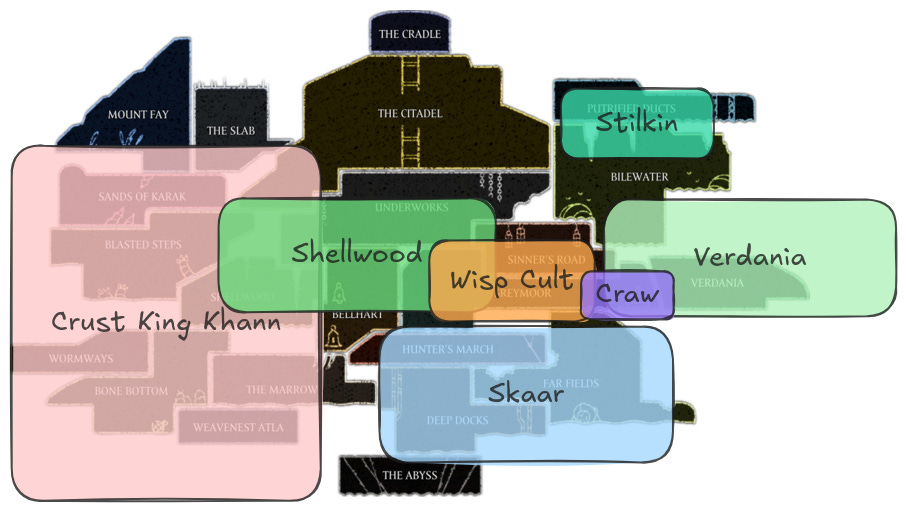
In the far left, under the water runoff from Mt. Fay, were the Karaks. This kingdom was ruled by Crust King Khann, a tyrant who ruled mostly by force. His domain stretched at the least from the Coral Tower down to parts of the Blasted Steps; during this period, that whole region was filled with water and coral. There is in-game dialogue that suggests that the Khannate covered half of Pharloom. At some point, Khann built the large Coral Tower castle, which served as the center of governance for the domain.
In the middle was the Shellwood forest. Shellwood was created by Nyleth, a supposedly peaceful and kind hearted higher being. Nyleth tamed the forest and it is implied that she created some of the Shellwood creatures that we see in game. Shellwood was likely a much larger region in this era, as the Citadel had not yet arisen.
On the far right, next to ‘modern day’ Greymoor, was Verdania. I am not at all confident that Verdania is as old as the other three kingdoms in this list. It’s unclear who the original ruling class is in Verdania or how it was founded. At some point, the Green Prince and his future lover are born. Together, they kill the Pale Stag (which may be a higher being, or may not exist at all!), which in turn marks them as having the right to rule Verdania.
Below Greymoor and Verdania is the Skaar kingdom. The Skaar were a collection of ant tribes ruled by Skaarsinger Karmelita. Karmelita was simultaneously a dancer, singer, and warrior, the first and last queen of the Skaar (which, given that we encounter her alive during the game, means she is also extremely long lived). The Skaar kingdom likely extended through all of Far Fields and Hunter’s March. The Skaar seem to gain some kind of awareness from Karmelita’s singing, an ability that becomes relevant later. We are told in-game that Karmelita’s singing is what ‘united the wild tribes’ in the first place.
There are three other groups worth mentioning.
The first is the Stilkin tribe, up in the top right of the map in ‘modern day’ Bilewater. We do not know when the Stilkin settled Bilewater, but it may very well have been during this era of Pharloom. During this period, Bilewater was filled with clear running water from the Pale Lake, so it is not nearly as toxic an environment.
The second is the fire cult located in and around the Wisp Thicket. From environmental cues, there is a strong argument that all of Greymoor was once filled with the long bamboo stalks of the Thicket. It is possible that the entire area was inhabited by the fire cult during this era. But the specific timing is very unclear, so I mention it here as the earliest possible era when this tribe could have sprung up.
The third is the craws of Greymoor. We do not know when they moved in or how they were subjugated. In fact, we don’t know much about the craws at all, except that they are structured with some kind of court governing system. For now, I just want to note that they too may have been around during this era.
The era of the four kingdoms ended with the arrival of Grand Mother Silk. We do not know where Silk came from, but we do have a sense why she arrived. Grand Mother Silk is a Pale Being, a god-like higher-order creature. Pale Beings can create new species, elevate existing ones with intelligence, and enthrall entire kingdoms at once. They are extremely powerful. Pale Beings also instinctively all crave worship; Silk likely came to Pharloom because she sensed that there were many bugs already there who were all fairly closely clustered together. It is worth noting that in the world of Hollow Knight, this is an anomaly. We are told in the first game that Hallownest is the only such kingdom to exist, which means that Pharloom is at least a long distance away (something that we also see visually in the opening sequence when Hornet is transported to Pharloom in her cage). Since the world itself is so sparse, and since we know Pale Beings crave worship from other bugs, any large cluster of bugs is likely to attract a Pale Being. It’s possible that the geography of the area — protected by Mt. Fay and with ample sources of water — made it the only protected place where any kingdom could feasibly arise for miles and miles.
In any case, the arrival of Grand Mother Silk heralded the weakening of the four kingdoms above. Note that we do not get much information about what exactly happened. We know that Silk explicitly ended Khann’s kingdom through war and by cutting off the flow of water from Mt. Fay. It’s not immediately clear how the latter was accomplished, but by the time Hornet goes through the area, all of the water has long been replaced by sand.
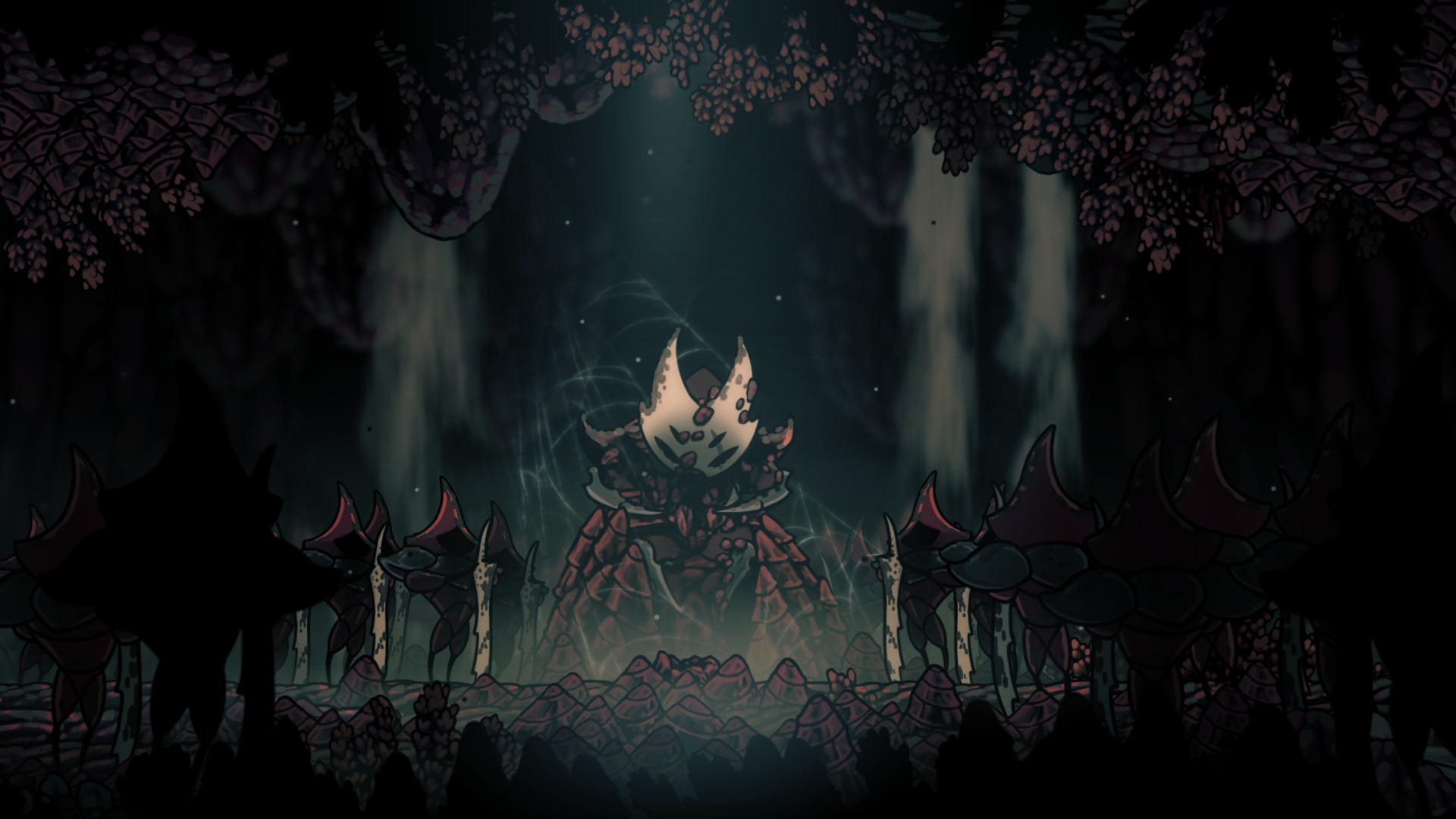
Other than that, we actually do not have any indication of what happened between Silk and Skaar, Verdania, and Shellwood in the pre-Citadel era. The Snail Shamans say that their dominion was ‘faded by the pale one’s dominion’, but that isn’t all that conclusive about how things went down. And given that three of the four kingdoms are still present (albiet in a reduced state) by the time Hornet arrives, it is possible that they all simply became vassals that saw their territory reduced, but otherwise were left alone.
Either way, this is a gradual process; these four kingdoms are still around in part in the Era of Silk. But they are no longer the main players in the area.
Era of Silk
Grand Mother Silk may not have been a despot when she first arrives. Or she may not have been as powerful as she ends up becoming at her peak. In either case, Silk’s arrival and consolidation of power is a slow thing, occurring over many generations.
The pushback from other bugs is a problem. Silk seeks worship. Since the locals aren’t exactly falling over to praise her, she does what all Gods do, and creates her own worshippers. Silk elevates a group of simple Pharlids (and possibly other Pharlid-like bugs), turning them into the first Weavers. She gives them intelligence, imbues them with her ability to create and control silk. She tells the Weavers that she is divine, and that they are divine. And she has the Weavers worship her. We do not know exactly how many Weavers are created, but we do know that there are at least 9 Weavers that Hornet can interact with in Silksong (7 sealed, as well as First Sinner and Widow), and a few more that we are aware of from Hallownest.
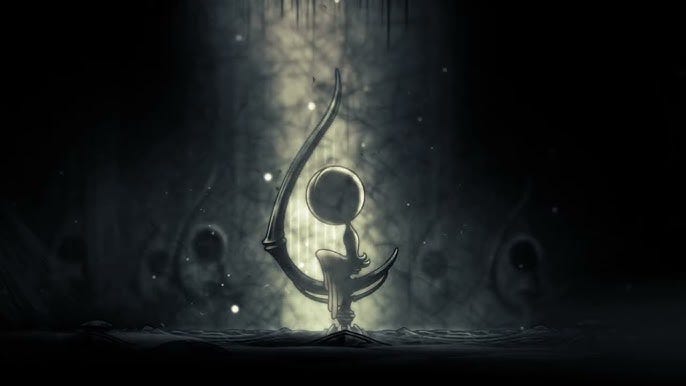
It’s tempting to think that Silk was simply using the Weavers as a means to an end, but the game suggests otherwise. Silk seems to care for these elevated bugs. She gives them far more power than she needs to, and tells them that they are her daughters. She creates a society where other bugs worship the weavers in addition to Silk herself. She seems to impart some amount of her Pale Being instinct and behavior into these elevated bugs. For example, the Weavers seem to instinctively crave dominance and power and live for extremely long lifespans, like other Pale Beings. We have seen other god-like bugs elevate other species — Unn in Green Path or the Wyrm in Hallownest. In both cases, the elevated bugs are still far below their creators. Silk seems unique in how much power she gives her daughters. The one caveat: it is very difficult for the Weavers to have children. It is not known why, but there is some theorizing that this limitation is explicitly and consciously imposed by Silk as a means of further subjugation.
For a time, this arrangement seems to work great. Many generations pass. Silk builds some initial structure near the peak of Pharloom that would eventually become the Cradle and parts of the Citadel (unclear how much). The Weavers bask in their own demi-divinity, and lend their song to strengthen Silk in a room full of harps near the Cradle. Their instinct to dominate is likely used to help subdue the other kingdoms, and Silk herself reaches the zenith of her control once the Khann kingdom ends. And they explore other interests — we know the Weaver later called First Sinner discovers how to create and manipulate silk runes.
But it doesn’t last.
One of the Weavers, later named the First Sinner, discovers that the Weavers are descended from common bugs. This triggers a full blown identity crisis, not unlike adopted children discovering their step-parents are not their real parents. When added to the Weaver’s innate desire to rule, and the likely overbearing and controlling nature of Grand Mother Silk, the discovery ends up being the spark that starts a full-blown Weaver rebellion.
We don’t know the exact timeline of the rebellion, but here is what makes the most sense to me:
The First Sinner discovers Silk’s deception and reveals it to the rest of the Weavers.
The other Weavers begin plotting in secret to overthrow Silk.
They create the Weavenests in far off places that escape Silk’s sight. Here, they experiment with a variety of tools to get rid of Silk.
They eventually discover a method of putting Silk to sleep using their song. Silk is wrapped in a giant cocoon and bound with runes (likely the same ones that are eventually used to create rune cages).
A Weaver later known as Widow remains loyal to Silk and pushes back against the rebellion, for which she is punished by her siblings. Her mask is forcibly removed (in the world of Hollow Knight, masks play a role in giving bugs intelligence. Removing Widow’s mask is akin to a lobotomy), and her ability to control silk is blocked by two large pins shoved into her spine.
I’m not 100% on this timeline, especially because I do not know exactly what happens to First Sinner that results in her being caged by the time of the events of the game. See below for other theories. Still, regardless of the exact outcome, Silk ends up in a weakened state, dormant. And now the Weavers have to keep the song going, to ensure Silk never wakes up. This leads directly to the events of the next era.
Era of Weavers
Compared to previous eras, this is the first era where we really get a lot of in depth lore through remaining structures, relics, and even dialogue.
The driving force of this era is a simple one: keep the song alive, keep Silk asleep. At first, this was likely done by the Weavers simply continuing to play their music. But the Weavers did not want to spend their entire lives just sitting at the harps. The Weavers are still revered by other bugs as the ‘first children’. They now take advantage of that reverence, leaning into their (false) divinity to manipulate the lesser bugs of Pharloom.
The plan is somewhat elaborate. First, the Weavers construct the Citadel, a massive structure that acts as a cage for Grand Mother Silk. The entire structure is built for a single purpose: to amplify song up and towards the Cradle. Note that this iteration of the Citadel is not the ornate and gilded structure that Hornet encounters during the game. The Citadel of this era is a sparse structure, more befitting a religion dedicated to holy song. Once built, the Weavers leverage their standing to change Silk’s religion. The bugs of Pharloom and its surrounding areas are told that it is a great honor to come to the Citadel and sing, and that this is the best way to worship Silk and the Weavers.
Broadly, it seems like the plan works. As the religion takes root, a few things happen.
Countless bugs over many generations make their way to Pharloom, join the choir, and sing. As the Citadel grows, the Weavers develop a social hierarchy to manage it all. At the top are three groups:
The Conductors, so named because they at one point likely were actual choir conductors.
The Vault Keepers, who were responsible for recording history and delivering religious sermons.
The Architects, constructs originally built by the Weavers themselves to automate maintenance of the Citadel (likely so that everyone else could focus on singing).
In this era, none of these groups know the truth of the religion or the Citadel’s purpose. The social hierarchy eventually extends further down, with the various castes explicitly numbered. The Weavers are considered the First.
The pilgrimage becomes a core part of the religion. In this era, the pilgrimage is entirely to encourage bugs from outside the Citadel to come and join the song. The Weavers are very supportive of pilgrims during this era, as they need as many pilgrims as possible to keep up the song. There is indication that they protect pilgrims on the path towards the Citadel, and set up infrastructure such as elevators, benches, and tunnels to help pilgrims along the way. My personal belief is that during this era, the pilgrimage does not have any aspect of judgement or ritual purity or mass murder. The Weavers’ goal is volume. Killing pilgrims defeats that purpose.
The Citadel negotiates a deal with Nyleth to protect pilgrims on their journey through Shellwood.
Bells become the defining symbol of the pilgrimage route. It is never explicitly stated why. One theory is that the bells somehow ward against Grand Mother Silk’s influence; another that the bells somehow attract pilgrims. It looks like the shrine bell design comes from the Weavers.
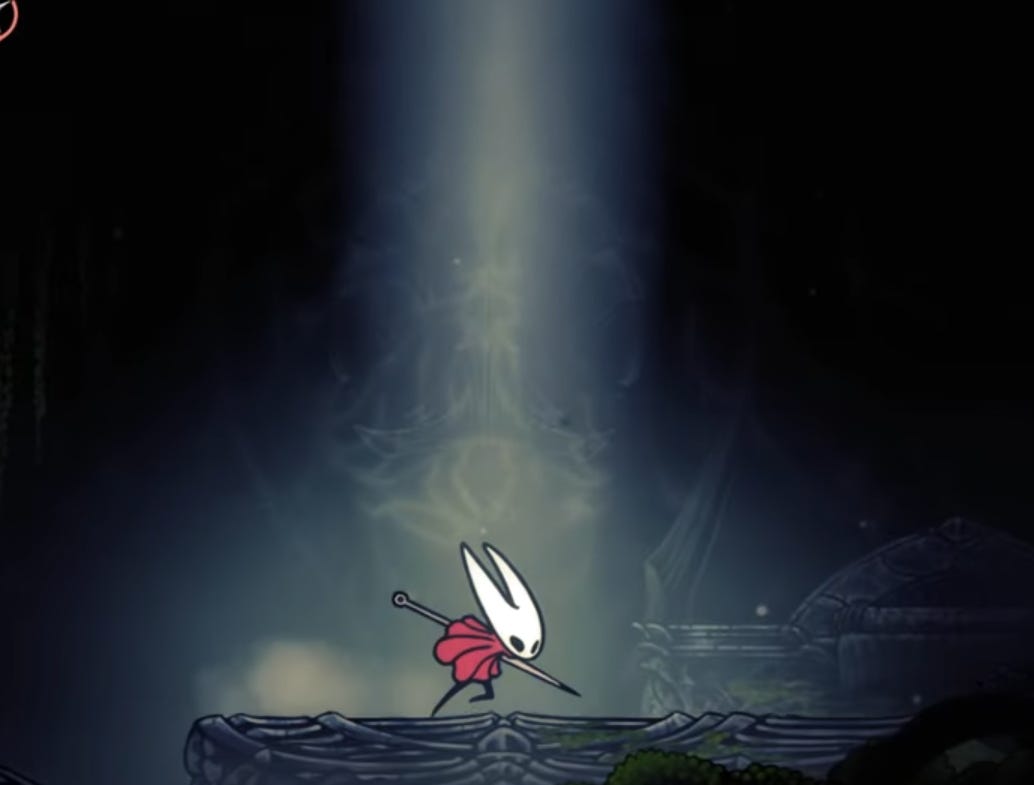
Massive tunnels are created to connect the various parts of Pharloom to the Citadel, likely to make it easier for pilgrims to stream into the city. These tunnels are traversed by thousands/millions of pilgrims, each carrying bells. Eventually, the tunnels fill with bells, resulting in the bellways that we see in the game. At some point during this process, Bellhart is created. The town itself is built inside a giant bell.
The ball-in-harp becomes the defining symbol of the Citadel, representing both Grand Mother Silk’s cocoon and the image of the Weavers’ playing their song.
The pilgrimage attracts those in the nameless town above Pharloom, depopulating it.
‘For Pharloom eternal’ enters the lexicon, emphasizing the Weavers’ goal of keeping Silk subdued forever.
The Weavers, free to indulge in their interests beyond just worshipping Silk, begin to develop new technology. They build a gondola on Mt. Fay. At some point, they discover the Fayforn and, like, hang out with it.
To continue dealing with the Citadel’s growth, sewage pipes and the exhaust organ are built to take waste out of the city, the Ventrica system is developed, and the Citadel cuts down large parts of the Wisp Thicket to found Greymoor as a farming region. At least right now, it is unlikely that most of the ecological disaster has occurred. The existence of Weavenest Murglin is some small evidence that the pipes were fine while the infrastructure was new and well kept (though the evidence may point in the opposite direction if Murglin was specifically built to hide away from Grand Mother Silk).
The Pinstress Order is probably founded in this timeframe.
The snails also probably show up around this time.
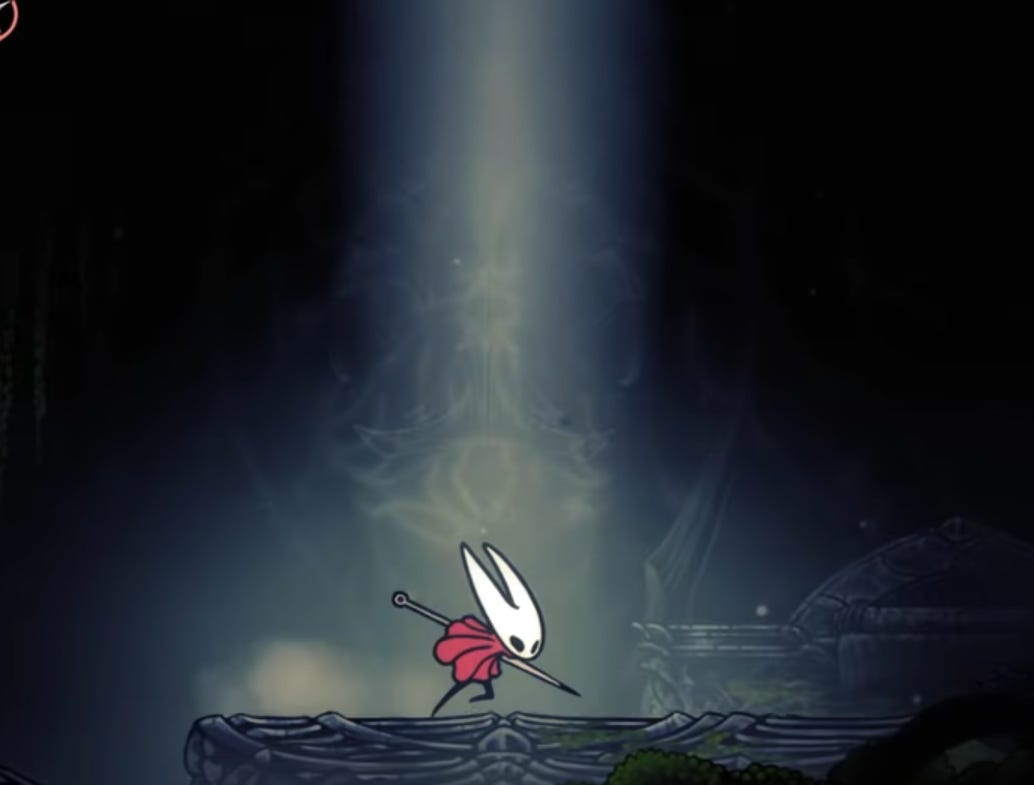
Objectively, it seems like this was a period of relative peace and prosperity for Pharloom. As mentioned above, no one was getting mass murdered. We do not know much about the relationship between the Weavers and the remaining kingdoms, but it probably isn’t that acrimonious given what we do know about Nyleth. The Skaar, Wisp Thicket cult, and the Stilkin are likely allowed to remain isolationists.
It’s hard to properly estimate just how long this period actually is. Generations is an understatement; if the theory about the creation of the bellways is correct, it must be hundreds of years. Long enough to firmly cement the Weavers’ religion in the minds of lesser bugs, and long enough for that religion to take on a life of its own.
But it does not last.
The Weavers realize that Grand Mother Silk will not be held forever, and their own ability to produce and manipulate silk (the substance) may eventually fade. One interpretation of the Citadel’s purpose is that the Weavers always knew this was a possibility, and were simply buying themselves time to come up with a more concrete solution to deal with Silk. Another is that they began to feel Grand Mother Silk stirring through their own abilities and awareness. Either way, the conclusion is the same: the Weavers try to finish Silk once and for all. They do experiments with Void (in Weavenest Absolom), and with portals (Weavenest Atla), and with projectile weapons of various strengths (Weavenets Murglin/Weavenest the-one-on-Mt-Fay), and with silk runes; though the Weavers do end up creating an abyss portal called the snare setter, they are unable to fully get it working, and abandon the attempt. They create Eva, a being of silk, in the hopes that she will have the strength to fight the Monarch; but Eva ends up weak and frail, unable to leave an iron shell. And at least one group of Weavers creates the Silk Anklets (Weavenest Cindril), maps paths to other kingdoms, and simply flees Pharloom.
This last group of Weavers almost certainly includes Herrah and the other Weavers who end up in Deepnest; their animosity towards the Pale King makes a bit more sense given their previous interactions with Silk. These Weavers attempt to have a child stronger than Eva, who they hope can take on Grand Mother Silk. Herrah eventually gives birth to Hornet.
Meanwhile, those that remain behind decide to seal themselves in weaver-spires so that some future descendent will be able to use their power to end Silk forever.
Before doing so, they hand over control of the choir and the Citadel to the Conductors, explain what the Citadel’s true purpose is, and command them to do whatever they must to keep the song going.
Era of the Choir
This era is one of steady decline, and most of the horrors of Pharloom can be traced back to this period.
At first, it seems like the Conductors are able to more or less keep a handle on things. For example, Pious Isamor is installed in the Citadel outside of Whiteward, welcoming newcomers to Pharloom. The statue talks about how the Citadel is a holy place, lacking excess, so that the pilgrims can focus on their religious purpose. But over time, without the guiding hand of the Weavers, the religion mutates and radicalizes, entering a purity spiral.
The goal of keeping the song going at all costs within the Citadel is taken a bit too literally. Justified by religious fervor, the choir begins experimenting with silk as a means of life preservation to ensure that even death will not stop the singing. Whiteward is established. The bugs develop surgical techniques to embed silk within patients, extending their lifespan. They also use Whiteward as a place to extract souls — called Silkflies — from old and sick but still living bugs, to power cogworks and in some cases just act as lights (this is framed as an honor, but it is clearly a painful process). Note that it is not exactly clear how Silkflies are created. They seem to also be created from some natural process, as they also exist in the Weavenests and in Karmelita’s memories.
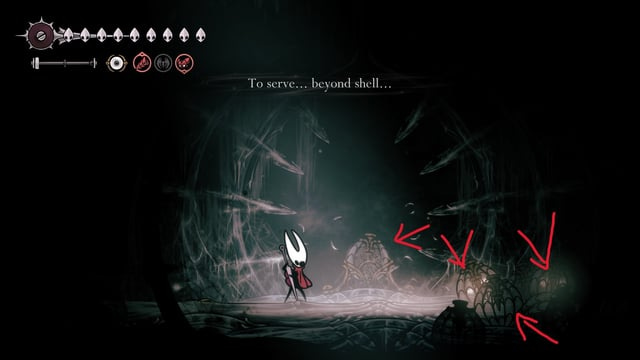
Eventually, the Conductors redirect the Architects towards constructing a massive speaker system that would obviate the need for the choir to actually sing. This ends up becoming the cogwork core. The mechanical chorus at the top of the cogwork core points directly to the cradle, and is used to automatically keep the song going. Once this is completed, the Conductors arrogantly and mistakenly believe they have solved the Silk problem. They turn their attention to other things.
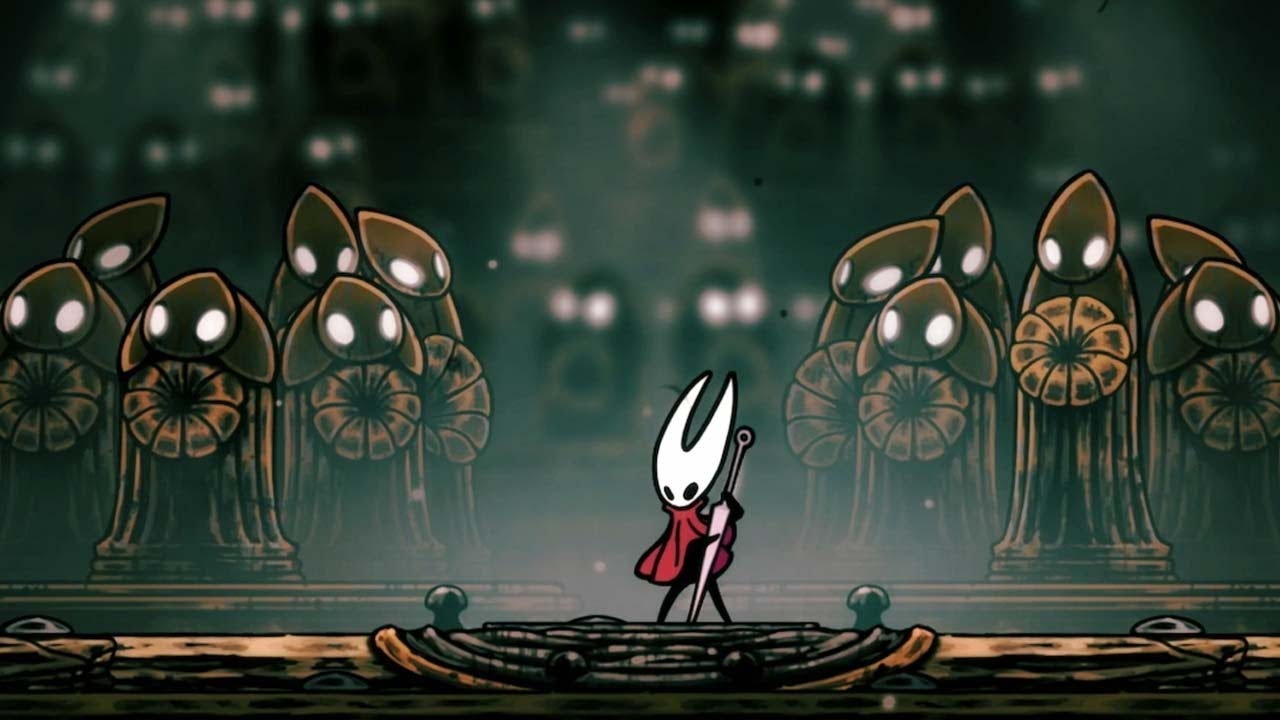
Without need for pilgrims to actually sing, the Citadel hierarchy becomes even more stratified and corrupt. A class system emerges. The Architects begin to fail because the Weavers are not around to fix their extremely complicated cores; the lowest classes of the Citadel are pressed into doing menial labor in the Underworks to replace the failing Architects. These worker bugs are held in place by exploiting their religious fervor, promised singular rosaries for menial tasks like running on treadmills. Even here the meager salaries of the workers are extracted by paid benches and silk dispensers, and a paid automated confessional.
As the importance of the pilgrims declines, the pilgrimage changes form. Once a mechanism to quickly and efficiently populate the choir, the pilgrimage becomes a zero-sum game, a mechanism to judge ‘worth’. The pilgrimage path gets harder and deadlier. The bell shrines are added as gates to the Citadel; so are the judges, bugs born into Citadel servitude who kill most of the pilgrims on the path. Taking the bellways becomes verboten, seen as ‘cheating’ for those who are trying to prove their value over others. As the bellways are abandoned, other creatures move in, including the Bell Beast. This in turn makes it even harder to use the original bellways. This is likely when rosaries began to be used as a currency, and as a means to extract wealth from those too enamored by the religion to see they were being scammed.
The Vaultkeepers turn their focus towards rooting out heresy; they too breed bugs directly into service.
The bugs of the Citadel start extracting silk from Grand Mother Silk’s cocoon. Silk becomes a critical resource. It finds its way into anything and everything, and begins to rain down from the Citadel. Over time, Whiteward becomes a place to both inject silk and to pull it out of dead bodies for reuse. The Whiteward crematoriums and silk dregs disposal pit is created. The continuous process of injecting silk into bugs and then extracting it during cremation to eventually inject in other bugs gives the silk dregs some king of sentience, a manifestation of pain and suffering.
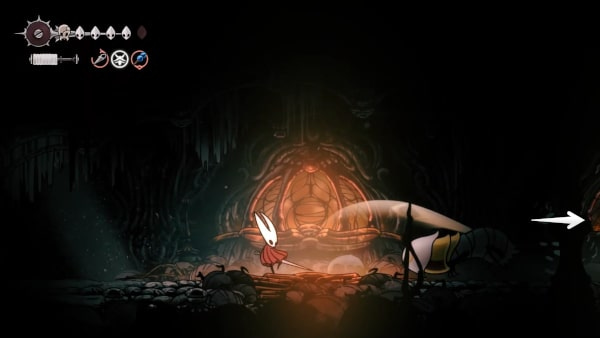
Greymoor is transformed from a place to grow food into a region where reapers are tasked with collecting falling silk from the Citadel, respooling it for future use.
The threefold melody (possibly the song that keeps Grand Mother Silk asleep) becomes sacred knowledge, available only to the highest classes of Pharloom. Only those with all three pieces of the song are allowed to reach Silk. This is approximately no one; over time, Silk herself fades from memory to all but the Conductors.
The further reaches of infrastructure fully degrade. The sewer system collapses and turns into the Putrified Ducts, while the exhaust organ starts dumping pollution. Bilewater and Sinner’s Road become poisoned and polluted. The Stilkin tribes become aggressive to outsiders. Various wildlife evolves to deal with the new environment.
The highest classes of the Citadel turn their focus to decadence and opulence. More choir members undergo silk surgery to avoid death, while the resources of the Citadel shift focus towards material things like increasing the ornamentation and adding gold everywhere and building a nice spa and an elegant dining area. Pious Isamor is eventually moved to the vaults, likely because the hypocrisy was too on the nose. Trobbio probably gets his start as a playwright around this time, as religious constraint gave way to leisure.
The Citadel also turns its focus towards expansion and extraction. It creates and fields a military, including the Sentinels created by the First Architect. At first, this military is trained by the Pinstress Order; eventually, it turns on them, killing most and forcing the rest into hiding. The military attacks Verdania, stopping only when one of their leaders sacrifices himself to become a mold for the Cogwork Dancers. Verdania becomes a full vassal state. The Citadel attacks the Skaar as well — explaining the remains of the Fourth Chorus in Far Field — though the ant tribes are able to resist with the assistance of the remaining Pinstress who lives in the region. The Citadel also reneges on its original promise to Nyleth, allowing her shrine to fall into disrepair. The Sentinels turn towards internal security as well as forcing other groups of pilgrims to come to the Citadel.
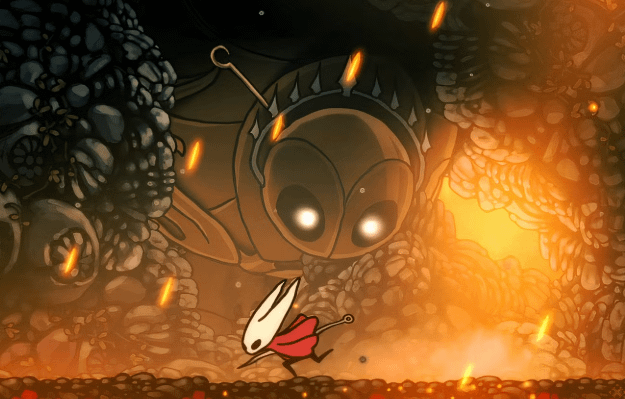
The Splinters take over Shellwood. The region becomes extremely dangerous for pilgrims.
Conductor Mizello undergoes surgery in Whiteward, and possibly dies.
Moorwing is bred to hunt bugs who try to leave their work, likely in and around Greymoor.
By this point, the Slab exists and First Sinner is jailed. We do not know exactly when these events occur, and they may have occurred in an earlier era. See below for why it is difficult to place when and why this happens.
The definition of sin expands until illness and death are themselves considered sinful — because, of course, you cannot participate in song when you are dead, and the whole religion is about dedicating your life to song. The Ventrica system is shut down because too many people ‘sin’ by dying. More people are sent to the Slab for sinning.
The initial sin of the Slab wardens is committed, possibly by the Broodmother. We do not know what it was, but it dooms all children of the same species to forever remain in the Slab.
The Chained Penitent ends up in the Slab for reasons unknown.
Over time, the Citadel begins to depopulate because fewer pilgrims are finding their way in and the Citadel keeps killing and imprisoning people. Much of the actual structure is emptied or blocked off or decays.
At some point, knowledge of the Weavenests fades. All that remains is the religious belief that music will open some doors.
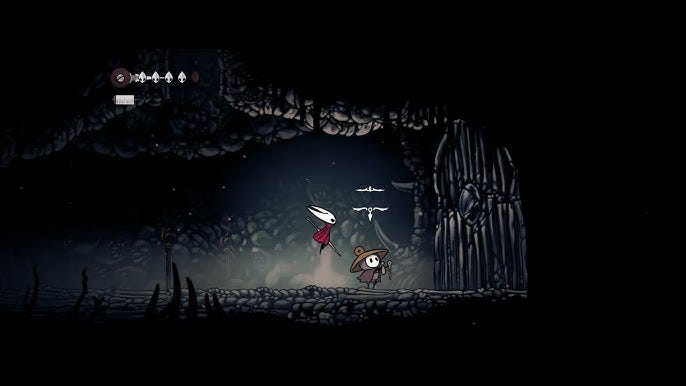
As life extension through silk becomes a norm, preservation and stasis seem to gain moral weight. The memorium is created to ‘remember’ the species of certain regions. Verdania is notably slated to be forgotten, which may have been the proximal cause for the Citadel’s eventual destruction of the real Verdania. Verdania suffers ecological collapse, possibly from being under Bilewater.
By this point, the chapels have all been created. We do not really know why the chapels exist or when they individually came into being. But we do know that the Chapel of the Reaper has to come after Greymoor becomes home to the reapers, so this era is the earliest that all chapels would exist. They are potentially holy sites along the pilgrimage route, as they are all located more or less along the main path. However, they do not carry any of the standard symbolism or ornamentation common to the rest of Pharloom.
The fire cult either comes into existence or remains in Wisp Thicket. They start burning everything with silk.
Chef Lugoli becomes famous, and is later exiled for (pickled) cannibalism. Yarnaby is exiled from Bellhart for her surgical practices.
Pilgrims Rest and the Halfway House are both established.
The Greyroot moves into Shellwood. Various pilgrims find twisted buds and bring them to the Greyroot; none survive.
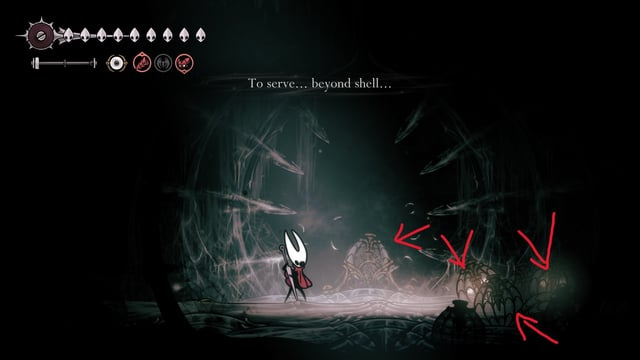
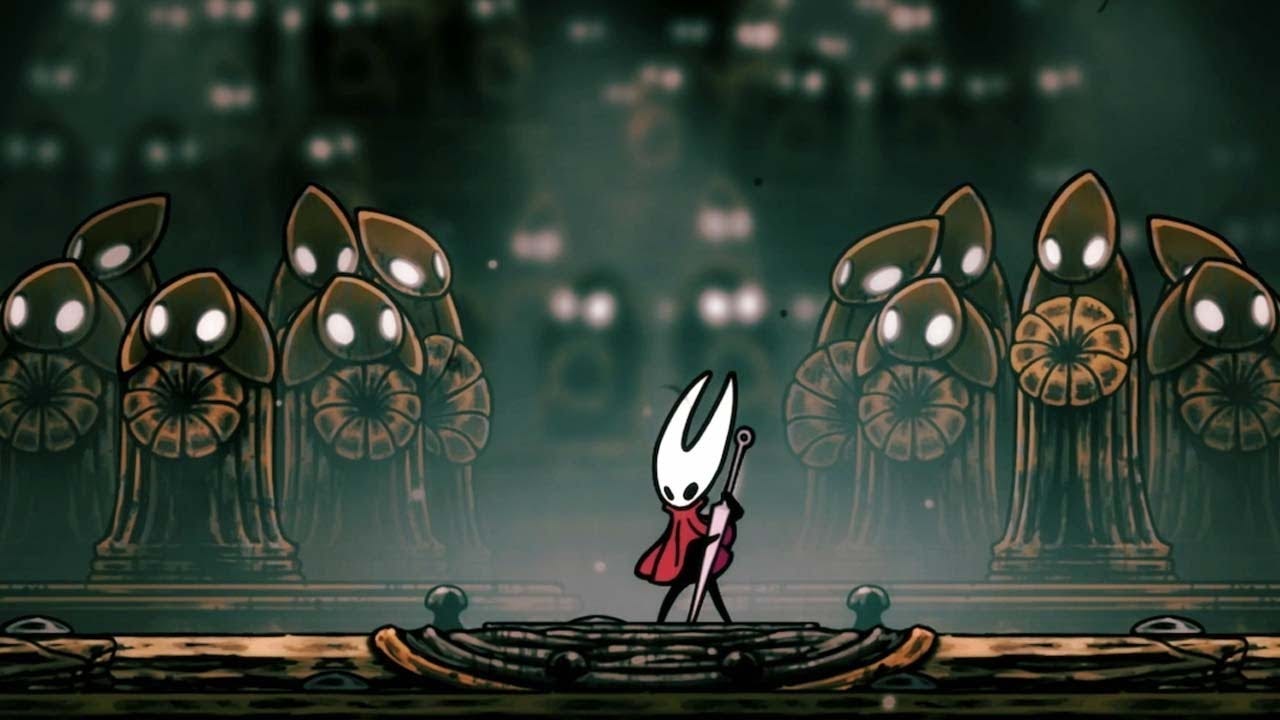
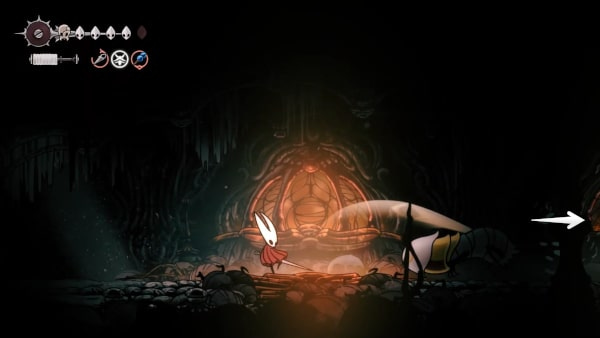
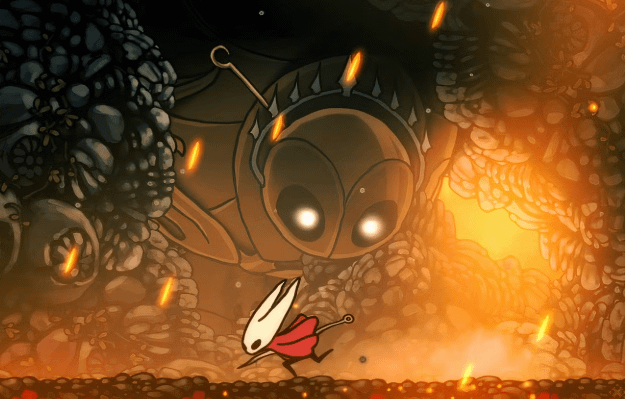
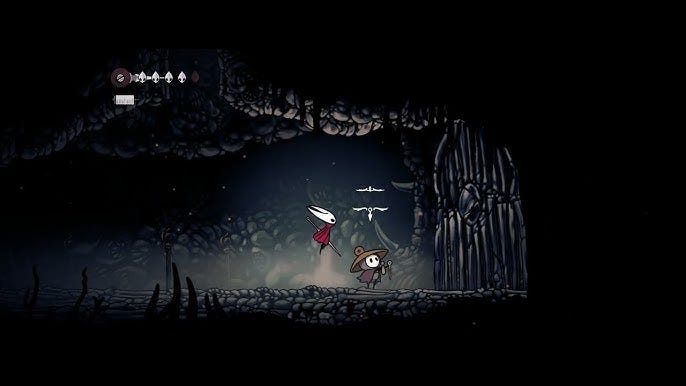
They say that all good things must come to an end. The Era of the Choir was not a particularly good thing. It, too, lasts for a long time — enough generations that the Whiteward silk becomes embedded in the children and children’s children of Pharloom, enough generations that the initial intent behind the Citadel is fully corrupted.
But it does not last.
The fall of the Choir comes about when Widow, still in the background, comes out of the shadows to wake Silk. Her attempts seem to work, at least partially. Though bound, Silk manages to wake enough to exert influence over some of the bugs by reaching out and controlling the silk inside them. These bugs stop their song. This results in Silk being able to exert more influence over other bugs, which in turn causes even more bugs to stop their song. The result is a vicious cycle, in which Silk steadily gains more power as fewer and fewer bugs sing. Close to the end of the era, the top of the hierarchy collapses:
Conductor Romino writes Pharloom’s Folly. He may have been punished for the sin of ‘dissonance’ and assigned penance through ‘silencing’ (though this may have been the Vaultkeeper Pontiff). He may have attempted to leave Pharloom, only to die outside the Blasted Steps.
The Vaultkeeper pontiff discovers the truth of the Citadel’s creation. He ‘falls silent’ and eventually dies. He may have been punished for the sin of ‘dissonance’ and assigned penance through ‘silencing’ (though this may have been Conductor Romino).
Conductor Ballador falls sick. He may have been sent to the Slab for the sin of ‘infirmity’ and been assigned penance through ‘swallowing’.
The Architects all cease to function except the Twelfth Architect. Knowledge of how to create more Architects is lost.
Grand Mother Silk slowly but surely sends her silken threads down through Pharloom. Large parts of the populace fall under the thrall of Silk, unified into a single hivemind and puppetted by literal strings. The Haunting begins in earnest.
Note that this era is likely around when the Radiance infection occurs in Hallownest, Weavers of Deepnest leave Hallownest to return to Pharloom (though they never seem to arrive), and the events of Hollow Knight occur.
Era of the Haunting
By this point, for all intents and purposes, Grand Mother Silk is fully in charge. Sure, in theory there are a bunch of bugs in various states of control. Some even seem totally immune to Silk’s influence. But the organs of power — the military and resources of Pharloom — are under Silk’s command. Haunted bugs have their own wills suppressed, and Silk is able to reanimate corpses through the silk embedded inside them. As this era continues, fewer and fewer people retain their faculties.
For unspecified reasons, in order to fully awaken, Silk needs to have a Weaver nearby. All of the Weavers who remained in Pharloom are sealed and effectively dead. That leaves the ones who fled. Silk — who seems able to sense silk in other regions — sends military expeditions out from the Citadel to capture other Weavers and Weaver spawn. Almost all of the captives die in the process of being captured.
Silk creates Phantom out of silk in an attempt to have a daughter who will always be loyal and help Silk awaken. For whatever reason, she forgets / discards Phantom, who ends up living inside the Exhaust Organ. Silk then creates Lace in the same way.
The fire cult keeps on keeping on. Their practice of burning things keeps them independent (though perhaps not entirely sane themselves).
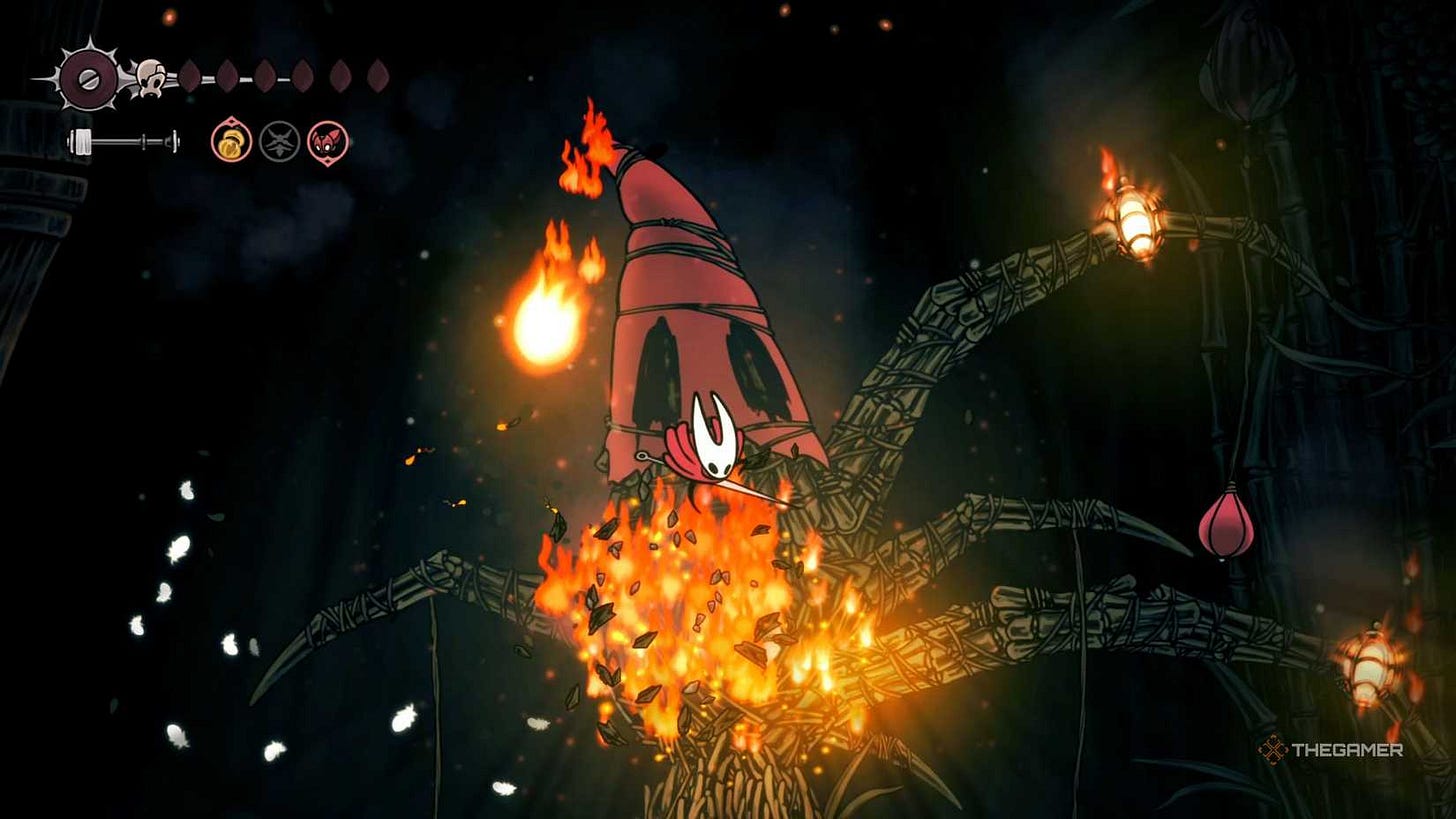
Lace spends a lot of time wandering around the Citadel killing things. She requires a lot of silk to survive, and as a result is forever bound to Grand Mother Silk. Lace despises Silk for her frail existence, and subtly betrays Silk in a variety of ways while pretending to be loyal.
The Haunting reaches the Skaar, but Karmelita’s singing (somehow still alive!) protects them from the worst of the effects.
At some point, the snails theorize that they can use an old Weaver snare setter with their soul energy to create a working void portal that could kill Silk. One of the Snails goes to the Stilkin to see if there is interest in rebelling against the Citadel. He is killed and his soul extracted by Groal the Great. The soul turns Groal into a Soul Master like creature. The other snails go into hiding.
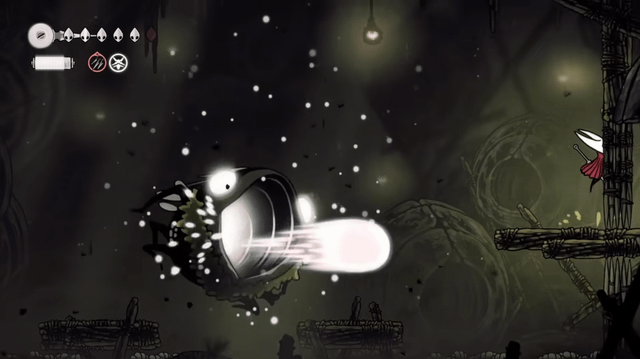
Miraculously, the pilgrimage continues. Many pilgrims become haunted, seemingly in relation to how weary and disillusioned they become as they trek upward.
Moorwing breaks free from its handlers and starts terrorizing Greymoor.
Zylotol’s master finds Plasmium, likely near or past the Pale Lake. Zylotol and his assistant Zango are tasked with bringing it to the Wormways. Zango seeds the area with the stuff.
Shakra’s master arrives in Pharloom. Shakra follows.
Garmond and Zaza’s village is overtaken by the Haunting. They arrive in Pharloom seeking revenge.
A wide range of infrastructure just falls apart. High Halls floods. The elevators to Bone Bottom and through the Blasted Steps cease to function. So do the ones in and around the Underworks.
A surgeon in the Marrow begins experimenting on Haunted bugs, discovering that the silk is in their guts and wrapped around their shells.
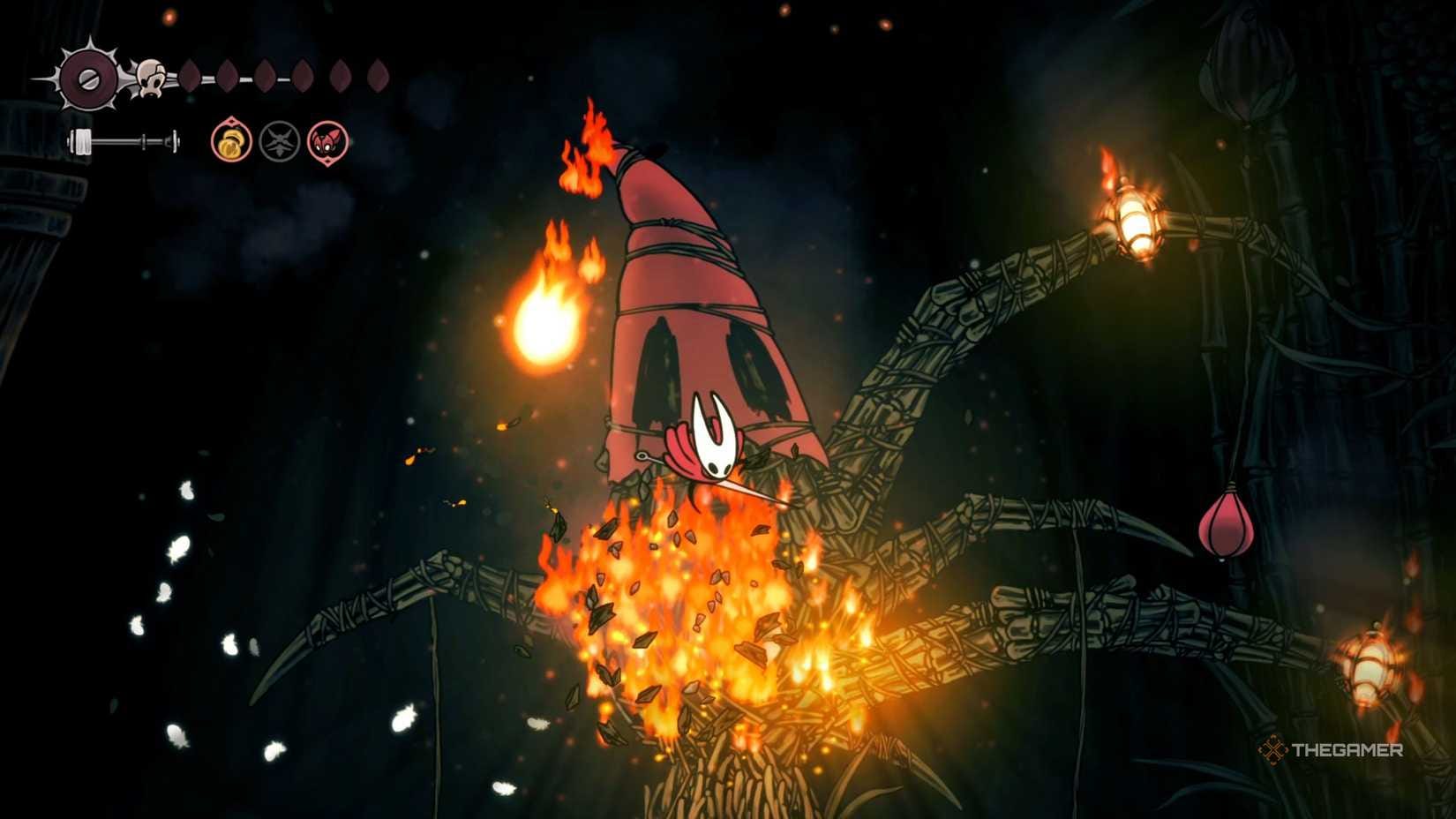
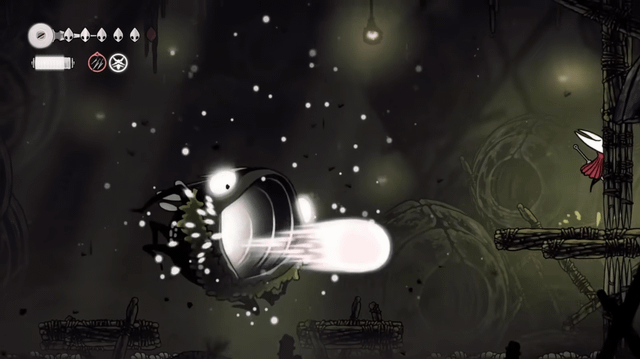
And, finally, an expedition is sent out to capture Hornet. It succeeds, capturing her in Hallownest and bringing her to Pharloom. Lace grows envious of Silk’s interest in Hornet. As Hornet is brought in, Lace destroys the bridge connecting the Blasted Steps to the Citadel. Hornet falls down to the Moss Grotto, starting the events of the game.
Hanging Threads (badumtss)
There’s still a few things I still haven’t quite figured out.
Who jails the First Sinner and why? I think the consensus opinion is that Grand Mother Silk jails the First Sinner and builds the Slab around her, and that this is what kicks off the rebellion. It sure seems like First Sinner is pretty mad at Silk when we find her.
But this raises more questions.
If this were true, surely the First Sinner would have been released once the Weavers took over?
The First Sinner is trapped in a rune cage, with additional silk runes on the outside. These are invented by First Sinner and used by the other Weavers; I’m not sure we ever see Silk use the technique herself.
The cage itself is gilded and ornate, stylistically more akin to the Citadel during the Era of the Choir, and has the harp-and-ball symbol that appears later in Pharloom’s history.
The language on the cage (First of the First, apostasy) mirrors the language of the post-Silk religious timeframe.
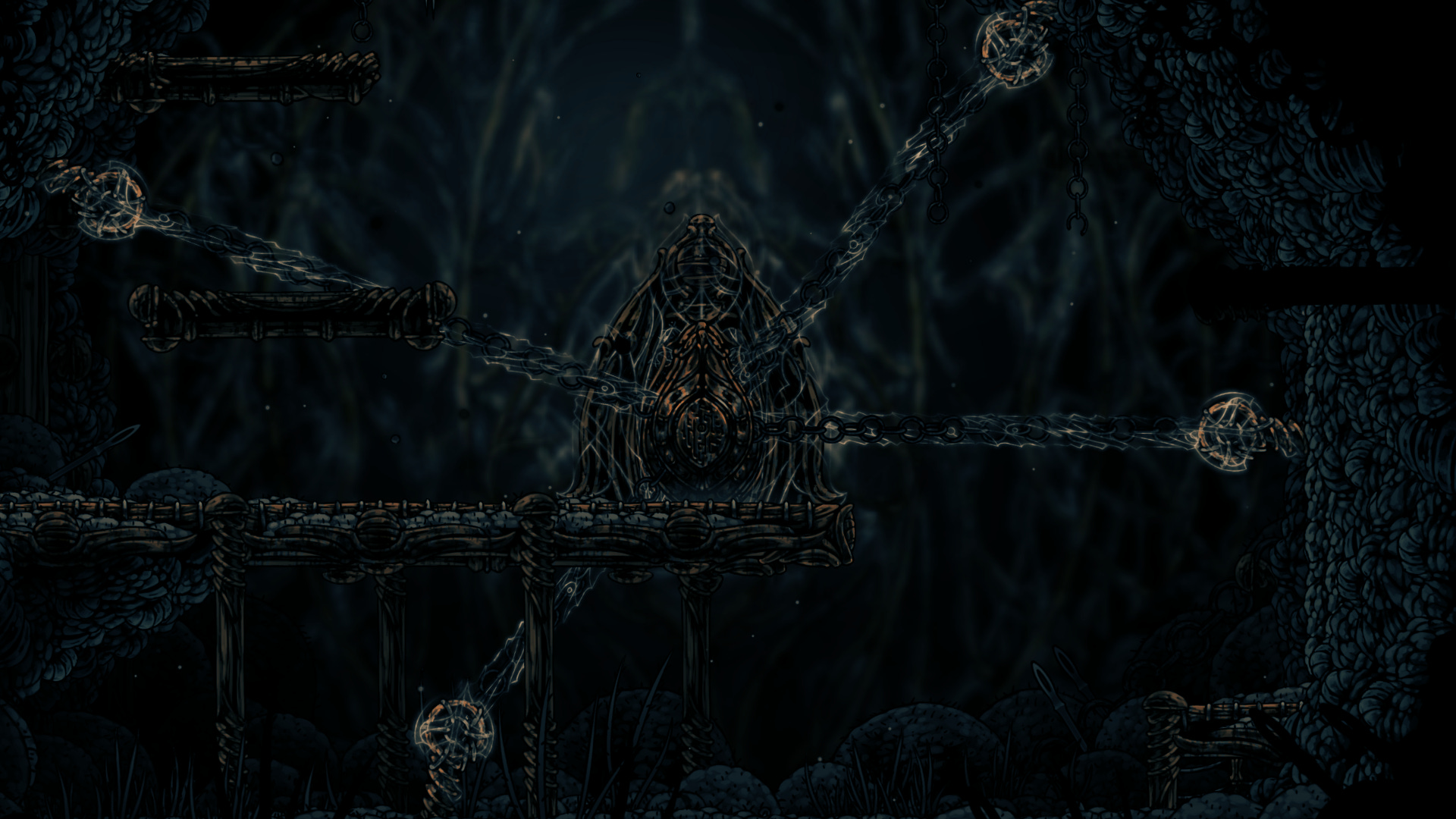
One interesting interpretation is that First Sinner is imprisoned by her siblings. In this interpretation, the Weavers rebel against Silk independent of First Sinner and set up their religion by claiming divinity. Then, when First Sinner discovers that the Weavers are not divine, the rest of her siblings lock her away so the truth does not get out, and they build the Slab on top to further entrench their new religion. I personally love this interpretation because it neatly resolves all of the motivation questions. The big issue, of course, is that First Sinner herself doesn’t say a damn thing about being jailed by her siblings! You’d think she would! You could possibly split the difference. Silk does originally jail First Sinner and kicks off the rebellion, but then the rest of the Weavers leave her in jail and build the Slab and so on. This is possibly my favorite interpretation, but it’s a bit messy, and there isn’t really enough in-game evidence to really justify this.
Another interpretation is that First Sinner was jailed by the Citadel during the Haunting. This would create a very different timeline, in which the Weavers were alive for much longer and then hunted alongside the part-Weaver children. This resolves both the motivation problem and the aesthetics question. But this would mean that the Weavers were also around as the Citadel became corrupted and the song of the Choir stopped, which seems unlikely. And it pokes a hole through the idea that Silk needed the other Weaver children at all.
There’s a related point: in the Slab, Hornet discovers that there is another prisoner, “the Twelfth of the First”, who is guilty of some unnamed sin and punished with ‘casting’. First Sinner is called ‘First of the First’, Widow describes herself as ‘of the First, the Last’, and in general the term ‘first children’ refers to the Weavers. The text in the Slab would therefore imply that another of the original Weavers was at some point punished.
But which one?
It could be Widow — she is the only other Weaver we know who experienced some kind of punishment, and the Weaver siblings wouldn’t want to name her ‘sin’ of helping Silk. This would also nicely fit the interpretation that the other Weavers punished First Sinner and were generally willing to turn on their own. But her punishment doesn’t look anything like “casting”, which generally means pouring hot liquid metal into a mould to create a new shape. Casting could in this case mean abandonment, as in ‘to cast away’, but it’s stretching the common usage of the word. Some folks think it may be the Weaver in the Cauldron. But the Weaver there is clearly in a Weaverspire, and does not seem to be ‘cast’ beyond just being in a hot place with a lot of lava. The only other named Weaver is Herrah, and there is basically no indication that she was punished at all.
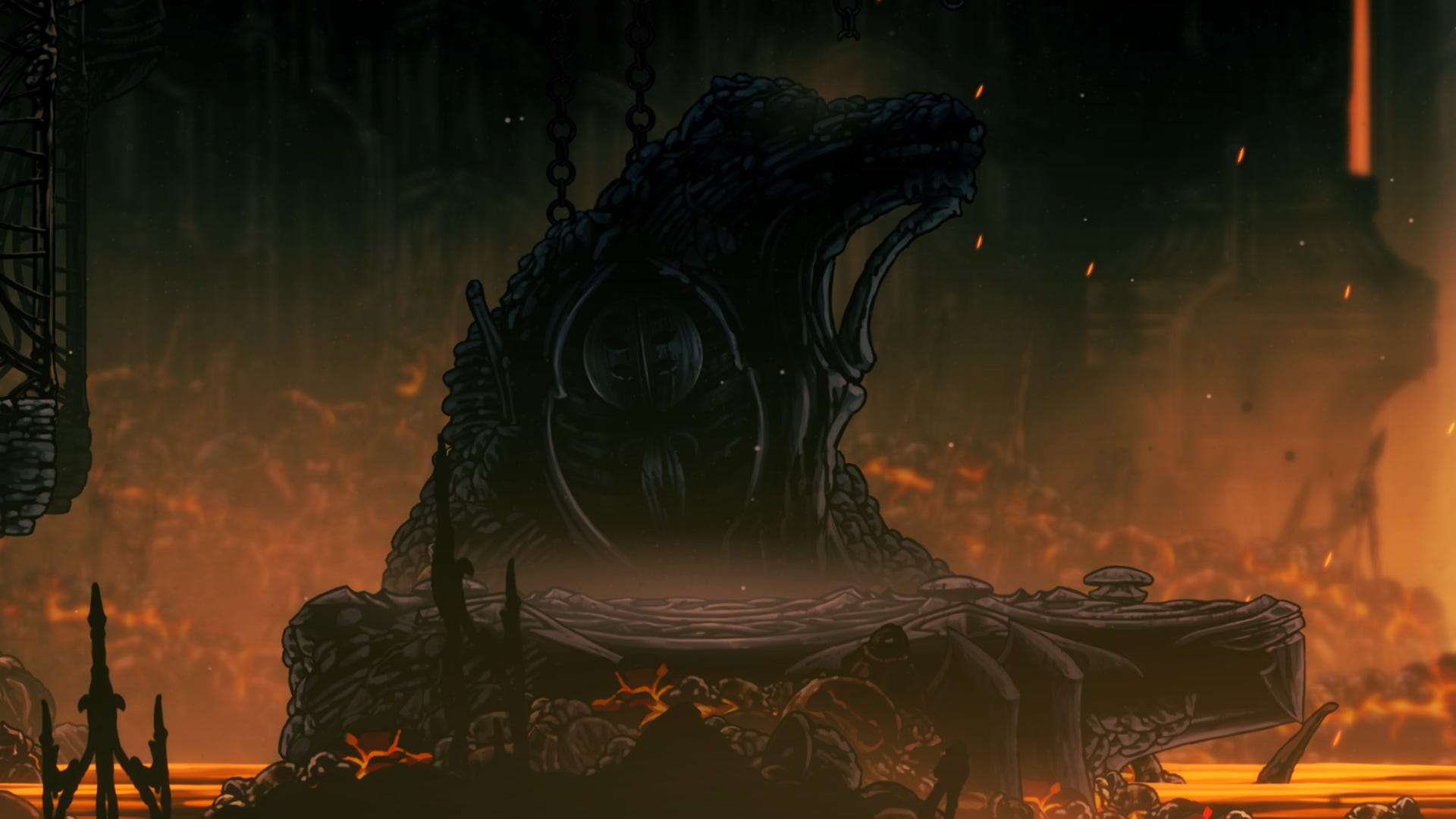
Also, if the “Twelfth of the First” is another full blooded Weaver, is she jailed in the same era and by the same bugs as First Sinner? Or were these independent events?
Overall, I don’t really know what to think, and would love comments.
Where is Pharloom located? The location of the nameless town raises a lot of questions about the geography of Pharloom. For basically the entire game, the player is led to believe that they are above ground once they reach the Blasted Steps. This is reflected in the lighting (many places seem to have sunlight); Mt. Fay, which is both cold even at its base and seems to explicitly have a snow-like substance and there’s, like, a bird thing that is clearly able to fly over; Greymoor, which has rain; and the sands, winds, and sky seen during the opening cinematic and the edge of the Blasted Steps.
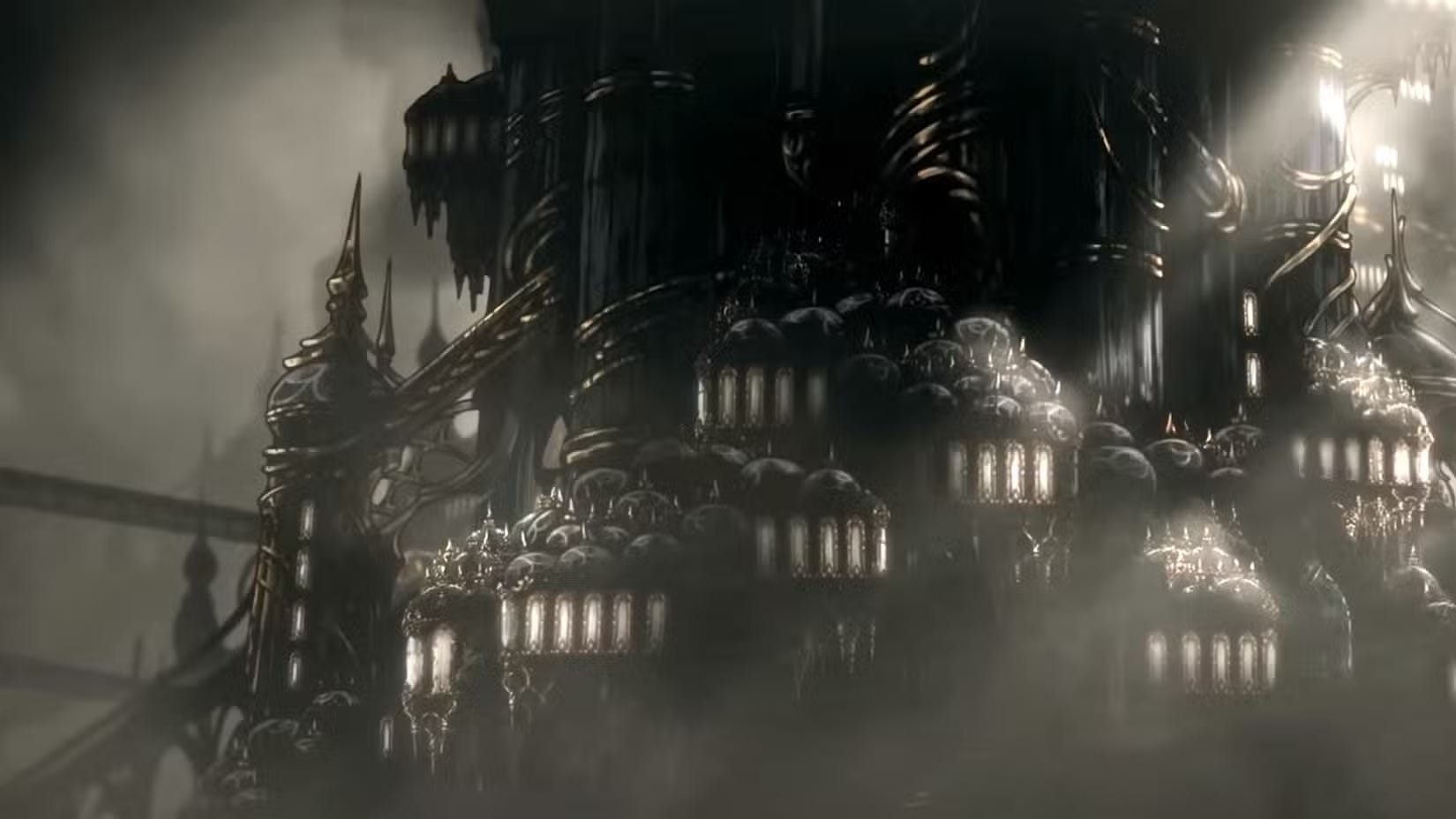
But the nameless town is revealed to actually be ‘on the surface’, higher than everything else encountered. This implies that the rest of Pharloom is underground, which totally breaks all of the other assumptions of the game’s geography.
One way to resolve the geography question is that Pharloom is built into a cliffside or hill, with some areas that are exposed to the elements. This would explain why some areas on the right side of the map still seem to have cavern-like coverage.
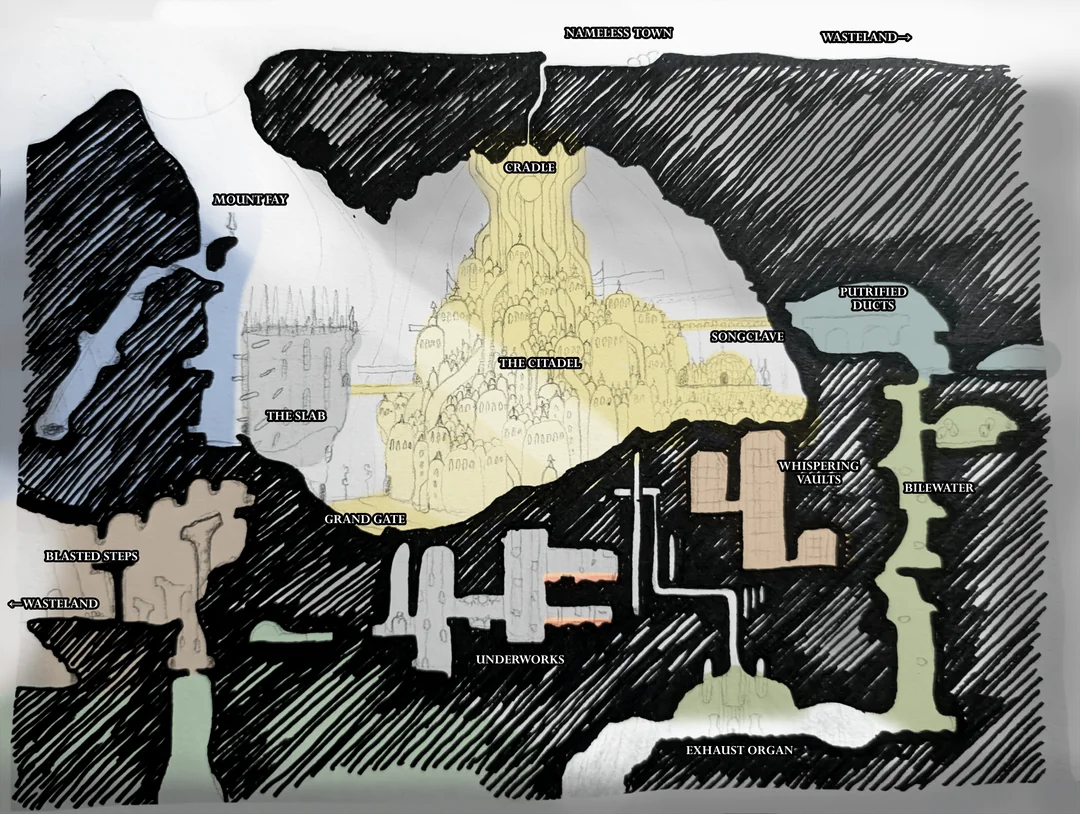
Still, this raises other questions. The surface is totally dark and barren; there is no light at all. In fact, in all Hollow Knight media, areas on the surface are never depicted having a natural solar light source. This is true of Dirt Mouth in the first games as well as the Quirrel tie in comics. So if the surface is dark and barren, and Mt. Fay is light and supposedly outdoors, where does the light come from?
I think in general Mt. Fay raises more questions than it answers. Why is Mt. Fay cold? No other area in either game is like that! What’s the deal with the weird not-quite-snow puffball things? It would make a lot of geographic sense if snow melt flowed from Mt. Fay down to the Sands of Karak, but I don’t think Mt. Fay has snow so it’s a bit unclear where the (now absent) water came from. How high is Fay actually? Where does the Fayforn come from?
One somewhat unrelated theory worth mentioning. When we go into Khann’s memories we see that the entire area is fully under water. It seems unlikely that meltwater flowing from Mt. Fay would result in the full submersion of Khann’s region of Pharloom. You are more likely to get freshwater rivers, not saltwater basins where coral would grow. Instead, it is possible that Khann’s region was flooded by ocean water, and that the lands to the west of Pharloom are actually the sandy remains of a beach that used to be flooded with water. Seawater would neatly explain the presence of so much coral, and it would explain why several bits of dialogue talk about salt in the rocks.
What’s the deal with the threefold melody? Who is that actually meant for? I’m somewhat skeptical that during the Era of the Weavers, pilgrims would come up and sing directly in the cradle. That seems like too much proximity for a normal bug. And that is even more unlikely in the Era of the Choir, especially once the cogwork core is set up. But there must have been some reason to come up with having such a very public elevator with a very public speaker robot animatronic system! Who was using that thing, and why make it so ornate and public?
For what it is worth, the entire premise of the threefold just strikes me as a bit odd. It’s not clear who actually comes up with the song and whether it is the same song that puts Silk to sleep. It’s also unclear that the other song holders even knew what would happen if all three songs were presented. Certainly the Vaultkeeper Pontiff is at least surprised to learn about Silk’s existence, which I think would have been obvious if he ever made it to the Cradle. More to the point, the actual methods of getting all three songs seem limited — the Vaultkeepers supposedly can only give their song to the Weavers themselves.
So the threefold song is just very mysterious, a tradition that does not have an obvious source or reason for existence.
Were the Weavers good rulers? I’ve framed the rule of the Weavers as an era of peace and prosperity for Pharloom, based mostly on the existence of the Weaver effigies and the infrastructure build out that they must have instantiated. But it is worth briefly mentioning that most of the locals that Hornet meets hate Weavers. They associate the species with cruelty and bloodlust and the urge to dominate others. And it is not just one caste or species of bug. There is vast amounts of dialogue in game to this effect — everyone from Shakra to the Snail Shamans has bad things to say. One of the recurring motifs of the series is the idea that higher bugs do what they may while lesser bugs suffer what they must. And one of the themes of this game in particular is the circular nature of time, how the rise and fall of civilizations follows similar patterns over centuries. With that in mind, it would totally make sense that the Weavers were actually as bad or worse than Grand Mother Silk. But just based on what we know in game, there is a built in contradiction. Some people seemed to really like the Weavers; others did not.
Wow. That was a lot. Looking back, I’m a bit embarrassed how much random knowledge I have about this game. I should’ve spent that time doing something useful, like reading a book. If you made it to the end of this, you probably also have thoughts about Silksong. Leave a comment and let me know if something may have stuck out to you during your playthrough that I missed!
All of this fits with what I'd gleaned through multiple playthroughs, except for one thing: how did you arrive at the conclusion that Lace freed Hornet at the start? It seemed pretty clearly from the intro cinematic to be a silkfly landing on her cage. I'd assumed that what kicked it all off was some single pilgrim's painfully extracted soul finally rebelling against the choir, and sacrificing itself to free someone who might be able to end the ceaseless cruelty.
What are your thoughts on the effectiveness of the cogwork core? It was supposed to sustain song eternally, which I interpreted to mean that choir bugs would no longer bound to sing eternally. Wouldn't that just free all the citadel bugs of their previous duty and weaken the justification for the rule of the conductors and other higher castes?
The only thing that reconciles this in my mind is that if the cogwork core couldn't produce enough song to replace the entire chorus, but merely to replace the volume of bugs that were dying or falling silent.
It's a plot question that I have been thinking about a bit while reading up on the lore